
When the Sea Pulls: Why Mallorca's Winter Eddies Should Concern Us
When the Sea Pulls: Why Mallorca's Winter Eddies Should Concern Us
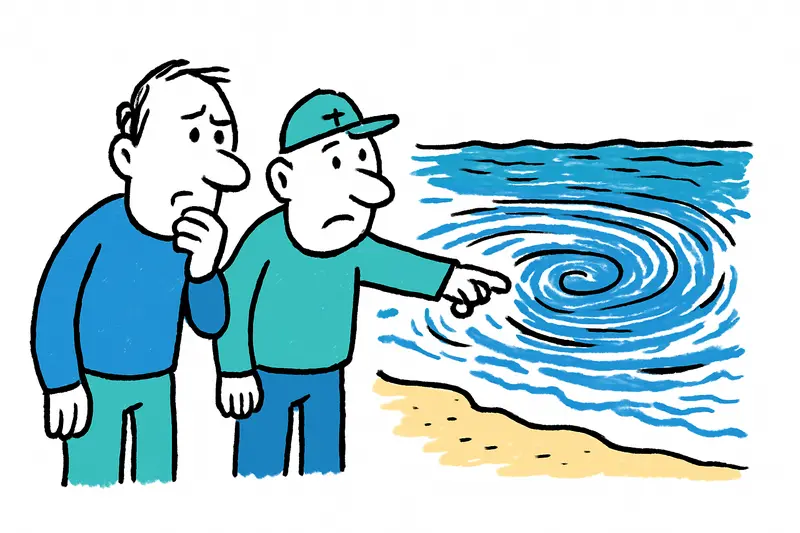
New measurements off Mallorca show: small, turbulent eddies are stronger in the winter months than in summer. What this means for the coast, fisheries and shipping has so far too often gone untold.
When the Sea Pulls: Why Mallorca's Winter Eddies Should Concern Us
Key question: What does it mean for Mallorca that small eddies in the Mediterranean are significantly stronger in the winter months than in the warm season?
The measurements, briefly
Researchers from the Imedea marine research center deployed the research vessel Pelagia in recent months around Mallorca and the neighboring islands and conducted current measurements at various depths. They complemented this with satellite data on sea surface temperature and chlorophyll, as discussed in How the Sea off Mallorca Is Heating Up Faster Than We Think — and What We Can Do About It. One result: smaller vortices and turbulent motions, which were only recently discovered at all, are more pronounced in winter than in summer. The data indicate that energy from larger currents transfers into locally concentrated, stronger turbulence — a sign of active, seasonal processes in the water.
Critical analysis: What the numbers do not explain
The study reveals an interesting physical mechanism, but it tells only part of the story. Measurements aboard the Pelagia provide valuable snapshots, satellites supply surface-wide observations — yet the link to concrete consequences for coasts, fish stocks or the safety of small vessels remains vague. We know that eddies only a few kilometers across can significantly influence marine circulation. However, reliable long-term data are still lacking on how frequently these events occur, how long they last and how strongly they locally affect nutrient distribution or the accumulation of drifting debris. Local impacts on seagrass and fisheries have been highlighted in Sea off Mallorca: When the Underwater Meadow Disappears.
What's missing in public discourse
On Mallorca there is debate about marine protection, tourism and port development, but the seasonal dynamics beneath the surface are often neglected. There is a lack of translation of research findings into practical guidance: for professional fishers, divers, operators of small excursion boats and municipalities at wind- and wave-exposed beaches. The role of such winter eddies in the distribution of plankton (and thus for fisheries) or in the resuspension of sediments on steep coastal slopes is hardly addressed.
A typical day on Mallorca
Imagine a day in January: the Tramuntana whistles through the plane trees on the Passeig del Born, a few anglers in Portixol start their outboard motors and complain about unusual side currents, and at Cala Major a lifeguard notices swimmers suddenly drifting diagonally away from the shore. Such small observations connect with what the Imedea data show: beneath the seemingly calm surface, winter can bring a lively, changeable picture. Such winter wind and swell events are the subject of alerts like Storm warning on the coast: Ten-meter waves and freezing nights in Mallorca.
Concrete solutions
Research is a start; practical steps must follow. Concretely I propose: First, install a network of stationary current meters (moorings) at strategic locations around Mallorca to document seasonal patterns over years. Second, make measurement data available in real time to port authorities, fisheries associations and recreational boaters. Third, local training: educate fishing cooperatives and lifeguards in the basics of these current phenomena so they can recognize warning signs sooner. Fourth, bridge research and practice: launch citizen-science projects with anglers and sailors for additional observations and sampling. Fifth, feed the results into coastal planning — for beach nourishment, berth planning and the management of bathing beaches.
Why this matters
Even if the eddies are small, their impact is not necessarily small. The redistribution of nutrients can alter local productivity and thus fish stocks. Turbulent upwelling affects water clarity, relevant for divers and underwater photographers; it can resuspend sediments and shape beaches differently than expected. For maritime safety, sudden side currents in areas that appear harmless on summer charts can become a hazard — especially for small craft and non-professional sailors in the winter months.
Concise conclusion
The Imedea measurements are a wake-up call: the Mediterranean off Mallorca is not a static water basin but a seasonally changing system with surprisingly strong local motions. Scientific insight alone is not enough. We need long-term measurement series, transparent data flows and the involvement of the people who look to the sea every day or depend on it for their livelihoods. Otherwise the eddies will remain something for the specialist literature — and for the anglers in Portixol who tomorrow will again puzzle over why the buoys lie differently.
Frequently asked questions
What is the best time of year to visit Mallorca for outdoor activities?
Is it safe to swim at Mallorca beaches year-round?
What should I pack for a Mallorca trip in spring or autumn?
What are the essential things to do in Palma for a first visit?
Is Sóller worth a day trip from Palma?
Are the beaches near Alcúdia good for families?
Is Cala Millor good for snorkeling?
What should I know about Mallorca's weather patterns year-round?
Similar News
Coaching change after six games: Panic or professionalization at FC Germania?
Thorsten Legat steps down after six games as head coach of the newly founded FC Germania and takes on a managerial role....

After just six games: Change at FC Germania – a small Mallorca drama in everyday football
Co-founder Thorsten Legat withdraws as head coach of FC Germania after six games. A reality check: what lies behind the ...

Powerful debut at the Bodega: Pedro López Salas enchants the audience
Young pianist Pedro López Salas gave his Mallorca debut at the Bodega Macià Batle, combining Baroque, Classical and Roma...

Playa de Palma in Winter: 21 Hotels, Around 6,000 Beds and More Life on the Promenade
Playa de Palma is aiming for year-round operation: 21 hotels remain open, and restaurants and leisure offerings bring ac...

Watch robberies in Palma: Who protects tourists from wrist thieves?
Three brutal robberies in Palma — in La Llotja, a parking garage at Passeig Mallorca and on Carrer de Ramón Llull — nett...
More to explore
Discover more interesting content

Can Cap de Bou

Townhouse Lleo 72
