
Seagrass and Beach Cleaning: How New Rules Are Changing Mallorca's Coasts
A new decree from Madrid restricts the removal of washed-up Posidonia. What does this mean for municipalities, tourism and people on the coast? A reality check with everyday scenes, missing points and concrete proposals.
Seagrass in Focus: Who Decides About Mallorca's Beaches?
Key question: Should washed-up Posidonia residues largely be left in place in future – even if hotels and beachgoers prefer otherwise?
Madrid recently tightened the rules on when and how washed-up seagrass residues can be removed from beaches. The core point: remnants of Posidonia oceanica and Cymodocea nodosa should generally remain on the beaches; removal is only permissible between March 15 and October 15 with authorization from the regional government. For background on why the brown 'leaves' aren't trash see Posidonia on the Beach: Why the Brown 'Leaves' Aren't Trash.
Sound dry? On the Passeig Marítim in Palma it looks very different: early in the morning you hear the wheels of the cleaning vehicles, crows quarrel over small blades, and tourist families push prams by while the smell of old seagrass hangs in the air. It is precisely at such intersections that environmental protection meets everyday life and the economy.
What we know: the Balearic Islands have around 570 beaches; authorities say that 183 of them already have permits for managing washed-up plant residues. At the same time, the amount of removed Posidonia residues has risen sharply in recent years – it has doubled within four years. The region hosts a large portion of the remaining Posidonia meadows in the Mediterranean; these seagrasses hold sand, improve water quality and store large amounts of CO2. The economic value of this storage is estimated at around ten billion euros. More on the broader decline and species shifts can be found in Sea off Mallorca: When the Underwater Meadow Disappears.
Critical analysis: The regulation is a step in the right direction, but it does not answer all questions. Limiting the removal period provides administrative clarity – yet practice on the ground is heterogeneous: municipalities differ greatly in capacity and in how they organize beach maintenance. Permits alone do not solve the problem when some coastal stretches are cleared entirely during the season while seagrass monuments remain in others.
What is missing from the public debate: transparency about the criteria by which municipalities receive permits; reliable data on the ecological impact of different cleaning practices; clear guidelines on how and where returned seagrass is to be stored and redistributed. The social dimension is also neglected: many service providers on the beaches – beach bar staff, lifeguards, private cleaning companies – do not know which new procedures will affect them. Related pressures from nautical tourism are discussed in Between Waves and Berth: Mallorca's Problem with 'Floating Holiday Rentals'. And tourists’ perspective often focuses on short-term cleanliness rather than long-term coastal protection.
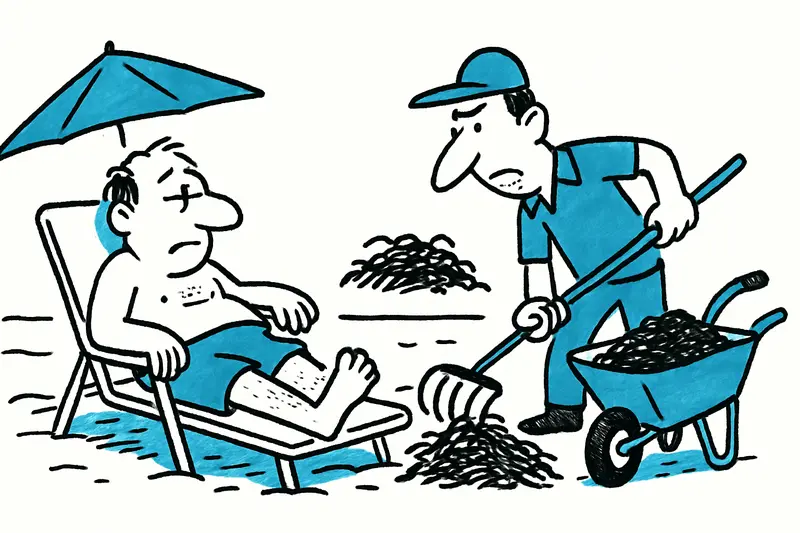
Everyday scene: In Port de Pollença you can see fishermen spreading nets in the morning, next to a crew of municipal workers with wheelbarrows collecting algae into small heaps. Guests talk about how "it looks strange now," while others praise that less sand is blown into restaurants by the wind. Such everyday impressions are important: they show that measures must work not only in government offices but on the promenade.
Concrete solution approaches: First, publish transparent permit criteria and introduce standardized control mechanisms so that every municipality works according to the same ecological and social standards. Second, create pilot zones – for example a cove near Palma, a natural beach and a heavily used tourist section – to measurably compare how different practices affect erosion, biodiversity and visitor satisfaction. Third, systematize the return of Posidonia: clearly defined storage sites, schedules and responsibilities; technical equipment for municipalities so the material is not left to rot by the roadside. Fourth, a communication campaign for residents and businesses – information leaflets, clearly visible signs at beach accesses, short clips on municipal channels. Fifth, regulate boat traffic more strictly – speed limits near coastal areas reduce sediment resuspension and thus damage to seagrass meadows; cases of damage from license-free motorboats are described in Drunk Boats, Battered Bays: When Private Boat Rentals Put Mallorca's Coasts at Risk.
An encouraging example: In the Bay of Pollença a replanting project has restored Posidonia on two hectares; after six years the survival rate is over 80 percent. Such local initiatives combine science, craftsmanship and citizen participation – and they show that regeneration is possible when patience and planning come together.
Pithy conclusion: The new decree creates a protective framework, but without clear implementation steps a patchwork is likely: some beaches will be protected, others will continue to be "spruced up." Crucial are not only bans but also practical tools for municipalities, transparent rules for permits and an intensified dialogue with those who work on the coasts every day. Without combining these elements, ecological gains risk being lost on the promenade.
What to do now: Authorities should quickly publish minimum standards, equip municipalities with technology and know-how and inform visitors early. That would be a pragmatic way to reconcile ecological protection with beach life – so promenades still hold tomorrow when the wind blows and the crows search for blades of grass.
Frequently asked questions
Why is seagrass left on some Mallorca beaches instead of being cleaned away?
When is seagrass removal allowed on Mallorca beaches?
Does leaving Posidonia on Mallorca beaches affect swimming or beach use?
What should visitors pack for a Mallorca beach if seagrass is left on the sand?
How do Mallorca municipalities decide whether to clean a beach?
What is happening with seagrass in Port de Pollença?
What is the situation with beach cleaning on Palma’s Passeig Marítim?
Can Posidonia meadows recover on Mallorca after damage?
Similar News

High heel slips, car accelerates: accident on Camí de Son Hugo
A woman lost a high-heeled shoe on the forecourt of the sports facility at Camí de Son Hugo. The car accelerated, mounte...

Phone Scam: How Two Hotel Employees at Playa de Palma Lost Thousands of Euros
One morning in September, two reception employees at Playa de Palma were pressured by alleged alarm-company staff — in t...

When the Wallet Becomes a Danger: Attack in Peguera and Lessons for Mallorca
In Peguera, two women are said to have stolen the wallet from a 75-year-old German couple. When the victim intervened, t...
Plata stays Plata: Young people take over, Llonguets remain
A small bar on Carrer de l'Argenteria will continue: Tolo Serra hands the place over to young Mallorcans at the end of t...

Unnoticed in the Luggage Compartment: How a Boy Traveled More Than 100 Kilometers in a Team Bus
A minor traveled in the undercarriage of a team bus for more than 100 kilometers until his cries for help were heard. A ...
More to explore
Discover more interesting content

Can Cap de Bou

Townhouse Lleo 72
