
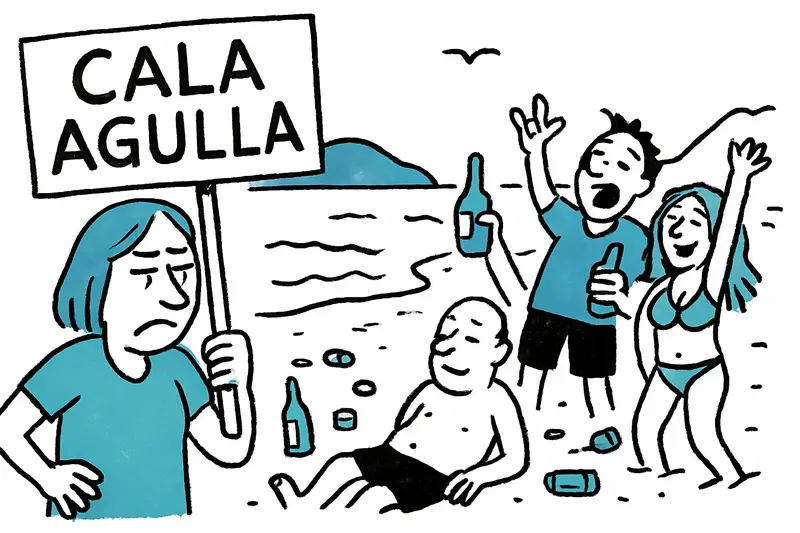
Cala Agulla under Pressure: When the Dream Beach Becomes a Party Zone
Residents complain about loud parties, open drinking and litter at Cala Agulla. A critical assessment with concrete proposals on how the beach can keep its character.
Cala Agulla under Pressure: When the Dream Beach Becomes a Party Zone
Key question: How can quiet, nature conservation and the everyday life of local residents at Cala Agulla be preserved without turning the island as a whole into a borderless recreation area?
The morning after the parties, the scene on the paths down to the sand is always the same: scattered groups of young people still with sunglasses in their hair, the sun low, and gulls pecking at bottle caps in the surf. The resinous scent of the pines mixes with the metallic smell of opened cans. Families carry beach bags by, children build towers from wet sand, small fishermen at the far end of the shore look disapprovingly at plastic fragments and bottle remnants lying among the seagrass beds. A resident described this scene in a social media post, making visible what many here have long been sensing: places like Cala Agulla are reaching their limit even before the season has really begun.
Critical analysis: It is not just about a loud afternoon or isolated incidents. We see several levels colliding. First: missing or poorly enforced rules on the beach itself – open alcohol consumption, loud music, glass containers in sensitive zones. Second: tourist offers and market forces that indirectly encourage certain behaviors, such as evening programs in holiday apartments or group trips that promote drinking games and excessive consumption. Third: infrastructure deficits – too few trash bins at the access points, sparse cleaning outside the official season, inadequate parking control that facilitates nighttime arrivals, as highlighted in Purobeach and the parking lot at Cala Estancia: Who has priority at the water?. Fourth: a public discourse that often reduces these incidents to "isolated cases," thereby slowing down structural solutions.
What is missing in the public debate: The discussion too often remains moralizing and capricious instead of factual. There is a lack of an honest inventory of the capacities of sensitive beaches, a sober discussion about length of stay, access routes and the economic interests of actors who live from day trips. Also underexamined is what sanctioning mechanisms could look like in practice and under the rule of law, without losing sight of the principle of proportionality. And: the voices of workers on site are missing — lifeguard services, small beach kiosks, seasonal cleaning teams — who live with the consequences every day. The debate about safety in party zones elsewhere, as in Magaluf after the beach discovery: When partying becomes a danger zone, shows how incidents can shift public priorities.
Everyday scene from Mallorca: On a Tuesday morning a retired teacher from Artà sits on a bench at the access, her dog lying beside her, and she points to empty cans stuck among the pines. "Families used to come here, now it is often groups who take quick photos, are loud and leave. The worst thing for me is the litter," she says, while a coach full of day trippers rattles down the steep path. The road is dusty, and the undergrowth crackles in the heat. Similar urban complaints are documented in Sleepless Nights in Nou Llevant: When the Street Keeps You Awake.
Concrete solution approaches (practical, local, feasible):
1. Preventive information work: Short videos in several languages at airports, ferry terminals and in hotels, clear notices about bans (no open alcohol, no glass) and penalties. Cooperation with tour operators and local intermediaries so that rules of conduct are communicated already during the booking process.
2. Access and capacity management: Limited parking spaces at the beach access, strengthened bus connections with rules for group bookings, temporary closure times during especially affected hours. In case of overcrowding, close the access with an electronic display at the car park and via the municipality's social media.
3. Enforcement on site: Targeted control days by the Policia Local and Guardia Civil, flexible special teams in the pre- and post-season, increased fines for littering and alcohol-related disturbances, as seen when authorities intervened and seized equipment in instances like Police stop illegal beach parties at Ballermann 6 – a question of balance. Short-term bans from the area for particularly conspicuous groups are also possible.
4. Infrastructure and cleanliness: More trash stations at the access points, satellite collection points, regular early-morning cleaning runs, placement of collection containers for cans with incentive systems (e.g., small refunds through local cooperatives).
5. Local participation and prevention: Funding for initiatives by residents and small entrepreneurs, beach sponsorships, formation of volunteer teams that raise awareness on weekends instead of only sanctioning.
Why this makes sense: Measures must be practicable and cannot expect "perfect tourists." It's about framework conditions that make misconduct unattractive and costly — for short but effective periods. At the same time, this protects the everyday life of residents, the dune biodiversity and the few quiet spots that Mallorca still has.
Critical note to finish: Those who rely solely on bans overlook the demand behind them. As long as party formats remain economically attractive, providers and groups will find ways. That is why a mix of regulation, infrastructure, market steering and local engagement is needed. Cala Agulla is not an open-air club but a coastal area worthy of protection. If we do not name this clearly and act, we will lose more than a beach here — we will lose a piece of everyday life that many on the island consider indispensable.
Conclusion: More control, yes, but above all a smart overall concept that aligns residents' interests, nature conservation and tourist offers. Otherwise, the morning after the party will be left with only the rubbish and the feeling that places like Cala Agulla will soon exist only in memories.
Frequently asked questions
When is the best time to visit Mallorca for warm weather and swimming?
What should I pack for a trip to Mallorca?
Can you swim in Mallorca in spring?
Is Mallorca still good to visit in autumn?
What is Cala Egos like for a holiday in Mallorca?
What makes Pollença a good place to stay in Mallorca?
What is the weather usually like in Mallorca in October?
Are beaches in Mallorca still pleasant outside peak summer?
Similar News

German tourist dies in Sa Calobra – a reality check for emergencies on Mallorca's beaches
A 40-year-old tourist died at the Torrent de Pareis. The emergency call, a doctor who happened to be present, a defibril...

Deadly Tractor Accident in Bunyola: What Needs to Be Done Now
In a work accident on an estate near Bunyola, a roughly 40-year-old man lost his life. His wife and a small child were o...
Head-first dive into the shallow part of Cala Fonoll: An accident and the unresolved question of responsibility
A young tourist dove into Cala Fonoll and was seriously injured. Key question: Why are clear warning signs missing at da...

Mistaken identity with fatal consequences: Brutal assault in S'Aranjassa — what's missing in the follow-up?
At S'Aranjassa a visitor to a finca was tied up, beaten and thrown out of a van. Three men have been arrested, including...

High heel slips, car accelerates: accident on Camí de Son Hugo
A woman lost a high-heeled shoe on the forecourt of the sports facility at Camí de Son Hugo. The car accelerated, mounte...
More to explore
Discover more interesting content

Can Cap de Bou

Townhouse Lleo 72
