
Nighttime Wrong Turn at Puig Major: Why a Harmless Walk Can Quickly Turn Dangerous
A 66-year-old hiker spent the night near the Torrent de s'Al·lot Mort — in the morning a helicopter winched him to safety. The incident should prompt us to openly address safety gaps on Mallorca's mountain trails.
Night Hike Ends with Helicopter Rescue
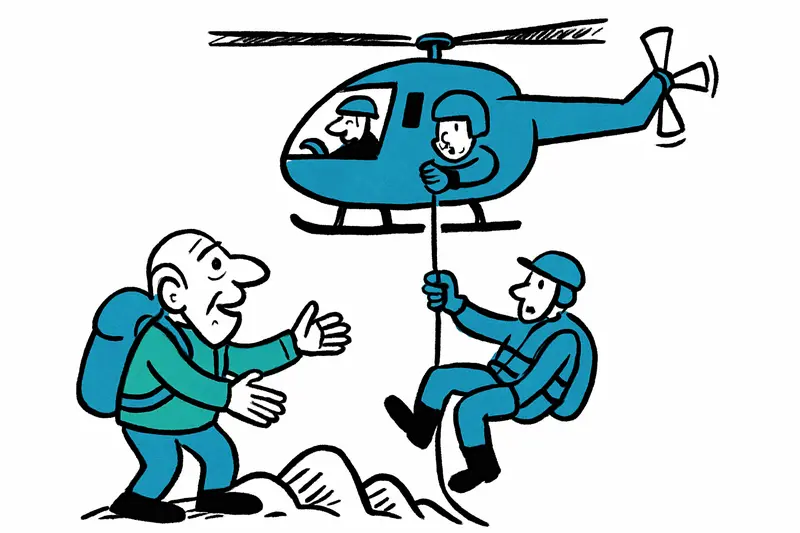
It was one of those quiet evenings in Fornalutx: the church bells had stopped ringing, the scent of freshly brewed coffee rose from the alleys, and cicadas chirped softly in the distance — until a 66-year-old hiker lost his way home. In the area of the Torrent de s'Al·lot Mort one wrong turn is often enough: narrow paths, pines, sudden steps. He ended up on a narrow stretch of mountain and spent the night there until rescuers found him in the morning. (See related report in Spanish: Desorientación nocturna en el Puig Major: por qué un paseo inocente puede volverse peligroso.)
Rescue at Dawn
Around 6:30 a.m. the radios crackled: a ground team had an approximate position and alerted the helicopter Milana. The roar of the rotors cut through the cool morning, crows screeched over the pines, and after a short coordination the man was hoisted out by winch. He was exhausted and freezing, but overall in good condition. On-site treatment was sufficient, and shortly afterwards he was able to return to his family.
The Key Question: How Safe Are Mallorca's Mountain Trails Really?
The incident does not answer questions of blame, but it raises a simple, pressing question: how do we protect people who love our mountains from situations like this? Puig Major, at 1,436 meters, is Mallorca's highest point; the surrounding routes run through the Serra de Tramuntana — a UNESCO World Heritage Site since 2011 — and are spectacular but treacherous. The terrain can become confusing in a short time, especially at dusk or in bad weather.
Aspects Often Overlooked
When people talk about hiking safety, the usual tips often come up: headlamp, water, sturdy boots. That's correct, but not enough. Less discussed are:
1) Mobile signal and battery limits: Many routes have dead zones. A flat battery quickly turns a navigation device or smartphone into an empty jar. Small powerbanks are often more life-saving than a second pair of socks.
2) Multilingual signage and reference points: Parking information boards are often in Spanish or Catalan; many hikers are international visitors. Clear, symptomatic trail markers and numbered emergency points along the route would make searches easier for rescue teams.
3) An aging hiking community: The island has many active older hikers. Fitness and sense of direction change with age — this should be addressed more clearly in information campaigns.
Concrete Opportunities and Solutions
The good news: many solutions are pragmatic and comparatively inexpensive. Some proposals that would quickly help locally:
- Numbered emergency markers: Small, weatherproof signs with a clear identifier and GPS coordinates at critical points. Simple for hikers and enormously helpful for rescue teams.
- Multilingual info points at parking areas: Overview maps, estimated walking times, difficulty ratings and notes on mobile coverage — short and precise.
- Loan devices and charging stations: In popular starting points like Fornalutx or Sóller, tourist offices could lend small powerbanks or provide inexpensive charging points.
- Education and preventive checks: Local hiking groups and mountain hut operators could distribute checklists: time limits (do not start after dusk), an hourly reserve on your battery, tell someone your route.
Local Coordination Works — But It Can Improve
The operation showed that coordination between the ground team and air rescue works well. That is encouraging and deserves recognition. At the same time, the case shows that prevention would often be more effective. In an island community like ours, where locals and visitors use the same paths, every small improvement in organization and information pays off.
In the end it had a happy outcome: no injuries, no medical emergency, just a cold night and a story that will soon be told over a café con leche in Fornalutx. Still, the reminder remains: respect the Serra — and carry a fully charged battery in your backpack. By the way, the coffee afterwards really does taste better, promised.
Frequently asked questions
Is it safe to hike in the Serra de Tramuntana after dark?
What should I pack for a hike in Mallorca mountains?
Why is mobile signal unreliable on Mallorca hiking trails?
When is the best time to start a hike in Mallorca?
What makes Puig Major routes difficult for hikers?
Is Fornalutx a good base for walking in the Tramuntana?
How do rescue teams find missing hikers in Mallorca mountains?
What safety checks should older hikers consider in Mallorca?
Similar News
Release after bloody attack in Palma: Why the court's decision raises questions
An 18-year-old who allegedly inflicted a serious neck injury on a man at Plaza Gomila using a wristwatch wrapped around ...
Kidnappings in Inca: Three young men forced into car trunks and abused in the forest – a reality check
In Inca, three 18-year-old men were forced into car trunks by masked assailants at the Plaça des Bestiar, taken to a for...
Spreading Massification: The Brake That Still Has Much Work to Do
Marga Prohens announces limits on volume tourism. The measures sound harsh — but are they enough to save everyday life, ...
Through the Keyhole onto the Party Yacht: How Daniela Katzenberger Is Planning Her 40th on Mallorca
Daniela Katzenberger turns 40 and wants to celebrate it on the island — likely with a boat, cake and her mother. A relax...
By Boat Instead of the Road: Palma's Water Bus — a Reality Check
The 'Bus Nàutic' launches in two stages — but questions remain over interim operations, fares and environmental requirem...
More to explore
Discover more interesting content

Can Cap de Bou

Townhouse Lleo 72
