
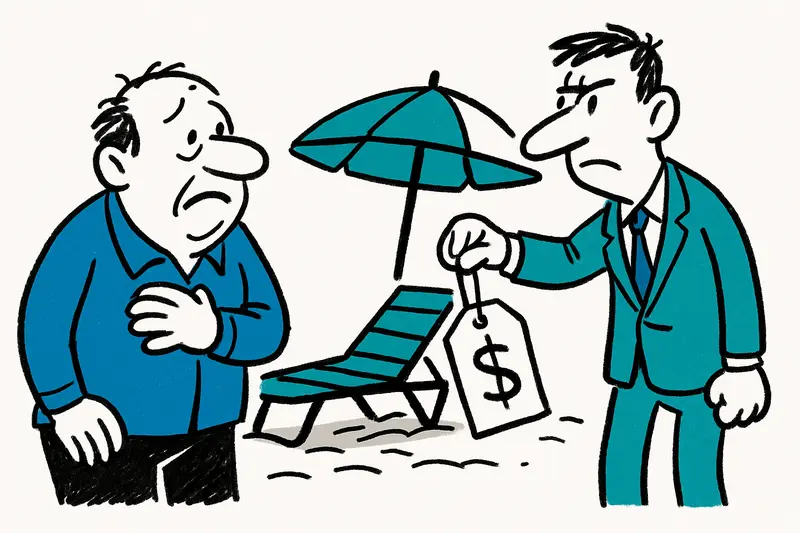
Price shock at the beach? Shell companies threaten the bidding process for sunbeds at Playa de Palma
Price shock at the beach? Shell companies threaten the bidding process for sunbeds at Playa de Palma
In the tender for rental sunbeds at five beaches in Palma, companies appear to be participating that were created solely to win the concession — without paying fees, taxes or providing services. The association Adopuma warns of damage to municipalities and holidaymakers. A reality check with proposed solutions from Mallorca.
Price shock at the beach? Shell companies threaten the bidding process for sunbeds at Playa de Palma
Key question: How can it be prevented that sham bids end up precisely at Mallorca's most visited beaches — and who ultimately foots the bill?
Early in the morning, when the street sweepers are still trundling along the Passeig Mallorca and seagulls steal the first coffee from the beach kiosks, you can clearly observe the scene at Playa de Palma: parasol poles, those creaking wooden sunbeds and vendors folding out tables. It is here that it will soon be decided who will rent out the sunbeds for the season. But behind the piles of tender documents, the association Adopuma warns of a problem: companies that apparently were founded only to place bids and subsequently take on hardly any responsibility, as reported in Price shock at Playa de Palma: Who pays for the beach?.
Adopuma warns that such companies can not only disrupt the promised services but also fail to pay municipal levies and taxes. The examples the association cites are stark: in Calvià outstanding claims are said to amount to around four million euros, and in Son Servera and Ses Salines about 1.2 million euros each. These figures are not an abstract balance sheet — they mean less revenue for municipalities, less beach maintenance and potentially higher prices for bathers, as illustrated by When the Beach Stays Empty: How Mallorca's Sunbed Renters and Chiringuitos Are Fighting to Survive.
Critical analysis: Why is this possible? Public tenders often reward the economically most advantageous offer. If a holding company controlled by shell firms bids, it can win in the short term with low prices and later cut off cash flows. Authorities check formalities — tax identification numbers, insurance, clearance certificates — but practice shows gaps in verifying economic substance and long-term performance capability.
What is missing from the public discourse: there is a lot of talk about generalized corruption risks, but too little about concrete control mechanisms. The debate rarely focuses on day-to-day implementation: who checks the receipt of seasonal fee payments? Who links tender data with social security registers or the tax office? Missing interfaces between administrations create loopholes.
Everyday scene from Mallorca: one Sunday afternoon in February two older residents sit on a bench at the end of the beach, watch the beach workers laying out new mats and aloud wonder whether the new company that disappeared last season will return this year. They are not concerned with legal subtleties, but with cleanliness, prices and the reliability of the service — things that are lost when only paper companies take charge.
Concrete solutions that could work: 1) Mandatory performance bonds: bidders must provide a genuine bank guarantee that covers revenue shortfalls and subsequent claims. 2) Linked solvency checks: tenders only accepted against presentation of current certificates from the tax authority and social security, checked automatically. 3) Additional weighting of experience in the procurement process: proof of past seasons, references and operational sites should count more than the lowest price. 4) Transparency requirement: disclose contracts, payment and audit routes; if a company fails, a rapid replacement mechanism must kick in. 5) Promote regional minimum standards: protect small, locally rooted providers through lot sizes and cooperation models so that beach culture is not taken over by anonymous umbrella companies, as highlighted in Premium sunbeds in Cala Major: Palma under pressure — who protects the beach from commercial greed?.
Politically and administratively, a simple sanctions practice is also needed: no re-granting of concessions to operators with unpaid claims in other municipalities; graduated penalties that act faster than lengthy court processes. And: a central contact point on Mallorca that brings together tender data, outstanding claims and performance guarantees.
Concise conclusion: if the awarding of sunbed concessions becomes a lottery for shell companies, in the end beachgoers and municipalities pay, as echoed by reporting on local decisions in Why Palma is raising beach prices — who ultimately pays the surcharge?. The solution is not rocket science but stricter rules, better data interfaces and more weight for local reliability. The sun at Ballermann remains the same, but those who organize it should not exist only on paper.
Frequently asked questions
Why are sunbed prices on Playa de Palma being discussed so much?
What is a shell company in a beach tender in Mallorca?
How do shell companies affect Mallorca’s beaches and municipalities?
How can Mallorca stop unreliable companies from winning beach concessions?
Why does experience matter more than the lowest bid for Mallorca beach concessions?
What could higher beach fees in Playa de Palma mean for visitors?
Are beach concession problems only an issue in Playa de Palma?
What should beachgoers in Mallorca watch for if a sunbed operator changes?
Similar News

More water than last year: Mallorca's reservoirs breathe easier
September rain refilled the Tramuntana's reserves: overall fill around 35 percent, Cúber at 40.42 percent, Gorg Blau at ...
Three Luxury Hotels in Banyalbufar: Lots of Money, Many Questions
A Danish investor plans three exclusive accommodations in Banyalbufar — including the historic Son Valentí. The announce...
2.1 tonnes of cocaine on sailing yacht off Spain's coast – a reality check for the coastguard
A 14-metre yacht was seized with 2.1 tonnes of cocaine. Who monitors the ports, how does the international hunt succeed ...

Heat Bonus in Mallorca: 100 Euros Extra for Outdoor Staff at MarSenses
MarSenses pays employees who worked outdoors in August an extra €100 as recognition. Lighter uniforms, reduced hours for...
Renovating in Mallorca: What You Really Can Do Without Neighbour Consent
Many think they can do whatever they want in their apartment. That's partly true — but only as long as structural elemen...
More to explore
Discover more interesting content

Can Cap de Bou

Townhouse Lleo 72
