
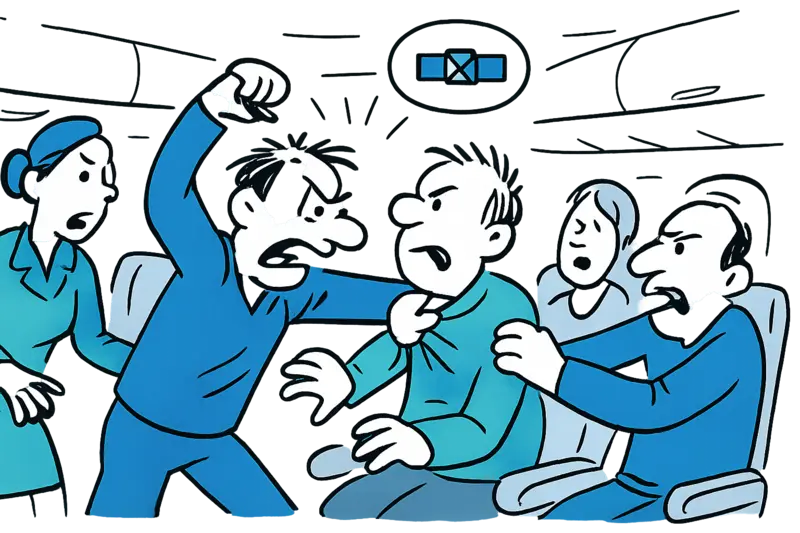
Just before landing: Fight on Ryanair plane — a safety issue on board?
Just before landing: Fight on Ryanair plane — a safety issue on board?
On a flight from London Stansted to Ibiza on October 5 a dispute escalated when a passenger stood up despite the illuminated seatbelt sign. The altercation affected the landing and ended with police intervention at the destination airport. What's missing in the discussion about safety on board?
Just before landing: Fight on Ryanair plane — a safety issue on board?
A passenger stood up even though the seatbelt sign was on. Then the situation got out of control.
On October 5, on a flight from London Stansted to Ibiza, a routine landing fell out of step: a traveler attempted to stand up despite the seatbelt sign being active. Other passengers opposed him, a flight attendant tried to mediate, and several physical altercations occurred until, upon arrival, the police boarded and escorted a man off the plane. Similar episodes include When a Female Martial Artist Strikes On Board.
Key question: Why does current onboard management apparently not suffice to prevent such escalations, and what consequences does this have for the safety of all passengers?
Critical analysis: From what has become public, the problem appears to have several levels. First: the behavior of an individual traveler who ignored the seatbelt sign. An unrestrained stand-up during final approach is not only disrespectful toward fellow passengers, it also creates risks during turbulence and hinders the crew's work (see Frightening Seconds over Palma: Two Flight Attendants Injured). Second: the dynamics of the group. Once multiple passengers get involved and start grabbing or attacking each other, the situation quickly shifts from an isolated incident to a safety disturbance. Third: the crew's reactions. Crew members may and must ensure safety, but they are also obliged to de-escalate — a balancing act when multiple people are involved and time until landing is short.
What is often missing from public discourse: a concrete description of the regulations and how they can be enforced in practice. It is easy to say that "police waited at landing", but that is only a reaction, not protection during the flight. Nor is there much discussion about which powers actually apply in a stalemated situation on board: should airlines create more scope for preventive checks? Compare Carry-On Dispute at the Emergency Exit. What is the relationship between passengers' responsibility and the crew's enforcement rights?
Everyday scene from here: whoever walks by the editorial office on Passeig Mallorca in the morning hears delivery vans honking, sees taxis taking tourists to the airport, and rarely thinks about scenes in the cabin. In cafés on the Plaça de Cort, neighbours discuss flight delays over a café con leche — mostly about connecting flights, seldom about last-minute brawls in the final minutes of a flight. Yet these are exactly the incidents that can trigger chain reactions: delayed luggage, a missed boat, and tempers flare.
Concrete solutions: first, clearer communication before boarding: short, unambiguous notices that the seatbelt sign must not be ignored and what consequences may follow. Second, mandatory de-escalation training for cabin crew with simulations for precisely these landing phases. Third, a clear escalation chain: when should the police be informed already while returning to the gate, not only after landing? See also No boarding to Palma: Ryanair stops intoxicated passenger at Memmingen Airport. Fourth, structural measures: airlines and airports should examine whether frequent conflict situations can be reduced by altered boarding processes, seat assignments, or transparent codes of conduct. Finally: sanctions that really deter — fines or bans that are actually enforced.
Practical steps for travellers: stay calm, follow crew instructions, encourage other passengers to remain sensible — but without putting yourself in dangerous direct confrontation. If possible, alert staff before a conflict escalates. Many think "this doesn't directly concern me" — in reality any small intervention can prevent worse.
Pointed conclusion: A flashing seatbelt sign is not a mere symbol; it is a rule with concrete risks. If police lead people off the plane on the ground, prevention has failed. Mallorca doesn't need moral outrage in cafés, but clear measures on board and on the ground: communication, training, enforcement options — and a culture in which respect for the crew and fellow passengers becomes a matter of course again.
Frequently asked questions
What should I know about seatbelt signs and safety during the final approach on flights to Mallorca?
How do cabin crews handle in-flight conflicts and when should authorities be involved on Mallorca routes?
What steps should I take if I witness a potential conflict on a flight to Mallorca?
Could boarding processes and codes of conduct be adjusted to reduce on-board conflicts near landing for Mallorca routes?
What practical steps should travelers take to ensure safety when flying to or from Mallorca during the final minutes of a flight?
What training or measures could help prevent such incidents on routes to Mallorca?
Are there practical packing tips for Mallorca flights that help reduce stress during boarding and landing?
What is Mallorca's climate like and when is a good time to visit?
Similar News
Construction by the Sea: Why the New Mega Beach Club in Cala Mendia Has Residents So Angry
Residents of Cala Mendia are suing the building permit for a large beach club with around 220 outdoor parking spaces. Sh...
Afterwiesn at Pinos: MM invites to two Bavarian-Mallorcan evenings
Two evenings, Bavarian verve and Mallorcan hospitality: On October 16 and 17 the Pinos restaurant in Sol de Mallorca wil...

When Oil Becomes a Luxury: A Reality Check on Rising Food Prices in Mallorca
On Mallorca staple foods have become drastically more expensive over five years. Who pays the price? A critical look at ...
When a Hammer Comes Out of the Glove Compartment: Violence After a Traffic Dispute in Bons Aires
A midday traffic dispute in Bons Aires escalated: a man pulled a hammer from his car and injured another driver in the l...
Realtor on Set: Marcel Remus in Front of the ZDF Camera in Mallorca
Well-known real estate agent Marcel Remus appears for the first time as an actor in a ZDF feature film; filming is curre...
More to explore
Discover more interesting content

Can Cap de Bou

Townhouse Lleo 72
