
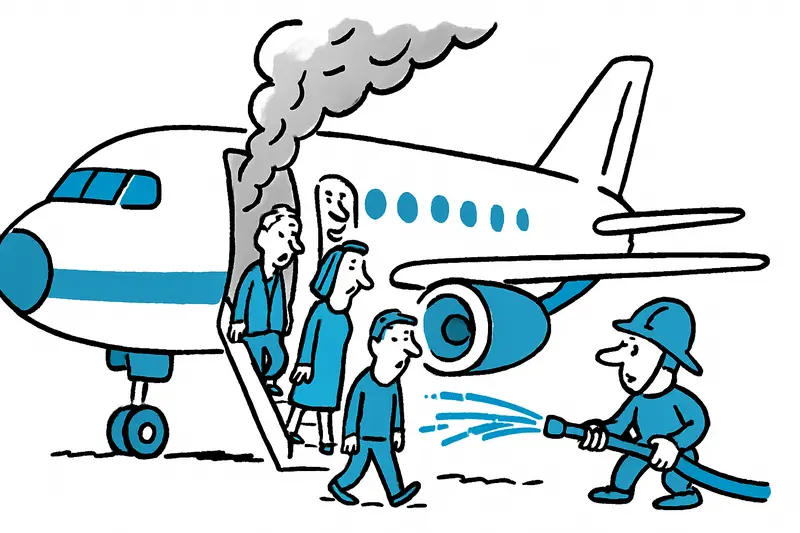
Smoke in the Cabin — What the Incident at Corvera Airport Really Tells Us
A Ryanair flight from London landed in Corvera, passengers disembarked, and later smoke was reported in the cabin. Firefighters cooled the aircraft and the return flight was canceled. Time for a sober look at safety, communication and responsibilities.
Smoke in the Cabin — What the Incident at Corvera Airport Really Tells Us
A flight from London landed, hours later the return flight was canceled. Passengers were uninjured. Now what?
On Saturday morning a plane from London-Luton landed at Corvera Airport. Passengers disembarked as usual. Later the crew or passengers noticed E-cigarette on board: How a small puff causes major disruptions on Mallorca routes. The airport fire service responded and cooled the aircraft. According to the airport operator Aena, there was no fire on airport premises; the planned return to London at 11:10 could not take place with that jet.
Key question
How safe are we when a flight lands without visible incident, but shortly afterward smoke is reported in the cabin and the onward journey must be canceled?
Critical analysis
Two things are immediately noticeable: responsibility for maintenance lies, according to the facts, with the airline — in this case Ryanair. At the same time, the incident shows how dependent the handling and public perception of such events are on a few pieces of information. There was no fire on airport grounds, but there was Smoke in airplane toilet: Guardia Civil intervened after landing in Palma. Whether it was a technical cause in the engine, a heating element, an electrical fault or another defect remains unclear (Back after takeoff: What a 'toilet problem' reveals about flight safety). The aircraft was cooled on site — a sensible immediate measure — but the question of determining the cause and subsequent repair remains with the airline.
For passengers this is frustrating and unsettling: they had already landed, then the aircraft had to be inspected and was ultimately declared unfit for takeoff. The sparse information, reduced to the essentials, helps no one: not the travelers who want alternatives, and not the airport staff who have to coordinate operations.
What is missing from the public debate
The debate often focuses on the dramatic image — smoke, firefighters, flight cancellation — and neglects three practical aspects: first, clear communication about causes and the next steps for affected passengers; second, how the maintenance history and inspection records of such aircraft are transparently controlled; third, responsibility for rebooking or accommodation when a flight is canceled at short notice. Throughout all of this the same gap appears repeatedly: there are no binding information channels for passengers who are not legal experts but must make quick decisions.
An everyday scene from Mallorca
Imagine the scene in Palma: on Passeig Mallorca there is a café, street sweepers are working, a bus honks, tourists carry shopping bags. Someone reads the brief report about the Corvera incident on their phone, shakes their head, orders another coffee. The conversation at the table quickly turns to personal travel plans and the worry whether something like this could disrupt the next holiday. This proximity — the small everyday noise, the smartphone, the thought of the next trip — makes clear: airport incidents are not distant headlines; they touch our daily lives.
Concrete solutions
1) Mandatory information duty: airport operators and the airline should communicate a simple status to those affected within a clearly defined timeframe — for example: “Investigation in progress; expected delay X hours; alternative transport is being considered.” This reduces uncertainty. 2) Passenger choice: in the event of cancellations, clear options should be offered: rebooking on the next available flight, refund or accommodation with documented assistance. 3) Visible maintenance records: airlines must demonstrate maintenance intervals and follow-up work to regulators; one concrete idea would be for airport operators and aviation authorities to publish a short, publicly accessible statement as soon as a technical problem is suspected. 4) Training for ground communications teams: sending the fire service is not enough; gate staff need standardized responses to prevent panic and rumors. 5) Short-haul contingency plans: at busy connecting airports there should be procedures to assess how quickly replacement aircraft or rerouting can be activated so that cancellations do not automatically result in completely dropped connections.
Conclusion — pointed
The incident in Corvera was fortunate because no one was injured. Yet it is a warning sign: technical faults happen, but our response can be improved. Less dramatization, more concrete information, rapid assistance for those affected and consistent follow-up by the airline and authorities — this is not a luxury but practical everyday safety. As long as transparency and service after an incident remain optional extras, travelers will continue sitting with questions in the café on Passeig Mallorca, waiting for answers they rightly deserve in time and clearly.
Frequently asked questions
What is the weather usually like in Mallorca in spring?
Is it warm enough to swim in Mallorca in spring?
What should I pack for a spring trip to Mallorca?
Is spring a good time to visit Mallorca for hiking and sightseeing?
What is Mallorca like in Palma during spring?
Is Sóller a good place to visit in spring?
What is the best time of year to visit Mallorca if I want mild weather?
Are beaches in Mallorca busy in spring?
Similar News
Car accident on the MA-1: Mother and daughter on a bicycle struck by a fellow countryman – Who protects cyclists here?
On the MA-1 between Portopí and the Cala Major exit, a mother and her daughter on a bicycle were struck by a car. A para...
Smoke over the UIB: Who is responsible for the fire on the roof?
On Saturday afternoon a fire broke out on the roof of the Arxiduc Lluís Salvador building at the University of the Balea...
Short Getaway with Sea View: Inmood Aucanada among Spain's Top Hotels for Dinner Breaks
A small hotel on the coast of Alcúdia was highlighted by a Spanish experience platform as particularly suitable for shor...
Cala Pi crowned Mallorca's most beautiful beach: A morning at the rocky cove
The travel portal Holidaycheck praises Cala Pi as Mallorca's most beautiful beach: a narrow, romantic cove, clear water,...
Injured captain, big plans: Germania Mallorca before the away match in Consell
The newly founded FC Germania Mallorca travels to Consell on Saturday. Captain Bastian Müller is out injured, but coach ...
More to explore
Discover more interesting content

Can Cap de Bou

Townhouse Lleo 72
