
Solar Eclipse Stress Test for the Island: How Mallorca Reached Its Limits on Wednesday
Solar Eclipse Stress Test for the Island: How Mallorca Reached Its Limits on Wednesday
The partially or fully expected solar eclipse threw the west coast into disarray: packed viewpoints, closed access roads, overcrowded supermarkets and an activated emergency plan. Was the island prepared?
Solar Eclipse Stress Test for the Island: How Mallorca Reached Its Limits on Wednesday
Key question: Was the island prepared for such an influx of visitors or did the Tramuntana become an avoidable bottleneck?
On Wednesday morning the air smelled of sea and frying heat; Palma reported 37°C, and brakes were squealing on the west coast in the heat. Long before the astronomical peak, narrow viewpoints and harbor streets were filling up. Mirador de Ses Barques, the Nautilus path, Bens d’Avall and even the Mirador de Santa Catalina acted like magnets for people, cars and boats.
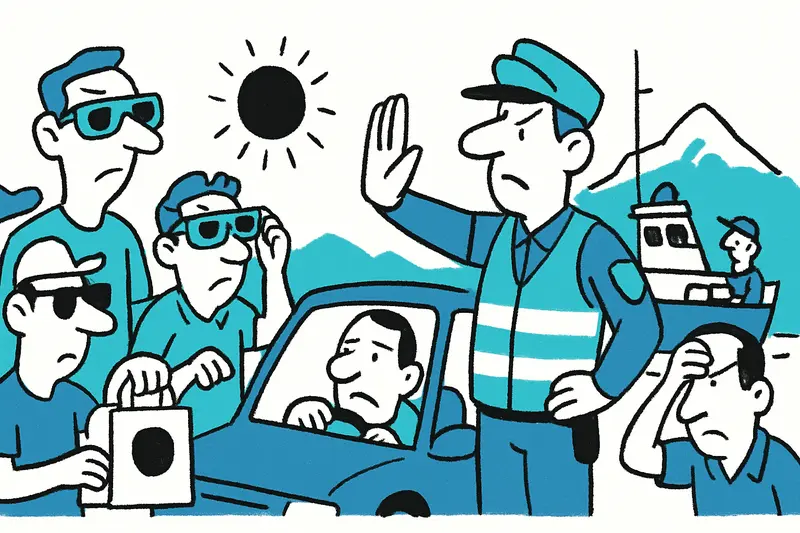
The scene: police officers in reflective vests at the junction to the MA-10, tourists with sunglasses and special eclipse glasses in bags, fishermen getting their aluminium boats ready in Port de Valldemossa, and in Soller a supermarket full of people at 9 a.m. – bread was scarce. Small decisions, big consequences: those who wanted to shop early had to queue because suddenly more visitors than usual were crowding into the town.
In short: the island was tested on an unusual day. The Balearic government activated the ECLIPBAL plan; municipalities, police and civil protection were to cooperate. From 3 p.m. access controls were announced, which depending on traffic could also start earlier. That reassures – and at the same time reveals problems.
Critical analysis: much was reactive rather than proactive. The narrow roads of the Serra de Tramuntana are not designed for peak loads. A jam at a bottleneck quickly blocks the entire route; there are hardly any alternative routes. Added to this is a lack of easily accessible information for arrivals: Where are free parking spaces? Which roads were closed? Who had to turn back?
What is missing from the public debate is an honest discussion about mobility alternatives on such days. Not only barriers and police presence are needed, but concrete offers: shuttle buses from larger parking areas, temporary parking fields outside towns, coordinated boat departures with approved routes and an official app with real-time information on closures and parking availability.
Everyday scenes from Mallorca: at the port of Valldemossa retirees who stroll there every Wednesday shaded their eyes and muttered quietly about honking cars. In the village you could hear the hum of generations: children licking ice cream; craftsmen loading tools into cars; tourists desperately searching for the last free parking space. The heat shortened everyone's patience.
Concrete solutions: First, targeted shuttles from the airport and large parking lots such as Plaça d’Espanya or Inca to key points in the Tramuntana. Second, advance reservations for popular miradors in limited numbers so people can plan. Third, cooperation with port operators for controlled boat excursions for observation from the sea, with a clear number of departure times. Fourth, mobile drinking water and shade stations at critical points, operated by municipalities and volunteers. Fifth, a simple, centrally maintained online map with live information on closures, parking and emergency points.
Another point: supermarkets and service providers in affected towns should be informed and supported early so that supply shortages – like the mentioned empty bread shelf in Soller – can be avoided. Short delivery corridors with time windows for suppliers could help.
Punchy conclusion: the eclipse was a natural event that no one can prevent, but the resulting traffic chaos was partly the result of insufficient preparation. Mallorca has the expertise: traffic plans, port logistics, experienced police and civil protection teams. The lesson of the day is clear and simple: those who plan ahead prevent panicked last-minute measures. And those who want to protect the Tramuntana must channel flows of people, not just cordon them off.
In the end one image remains: the sea calm, the mountains patient, and on the narrow roads the unusual play of locals, visitors and emergency crews. If those responsible develop real procedures from this test, the memory of the eclipse will remain a beautiful celestial event – not a day when the island was stuck in traffic.
Frequently asked questions
What should I expect weather-wise in Mallorca on hot days, and how should I prepare?
How should visitors approach Mallorca’s roads and viewpoints when a surge of visitors arrives?
What practical mobility measures can improve experiences on crowded days in Mallorca?
What should I know about visiting Mallorca’s popular miradors like Ses Barques or Santa Catalina during busy days?
How can towns like Valldemossa and Soller reduce the risk of supply shortages during heavy visitor days?
What does a well-prepared day look like for Mallorca when an unusual event brings crowds?
Is there a central online resource for live updates on road closures and parking in Mallorca?
How can visitors enjoy Mallorca’s rare event without harming local life or the environment?
Similar News
Deià Rations Water: Who Pays the Price for Luxury?
Due to extreme drought, Deià will impose water shutdowns three times a week from August 14. The Hotel La Residencia and ...

Magaluf: Tourist slaps police officer — officer draws service weapon
An incident in Magaluf escalated: a 27-year-old Brit slapped a local police officer in the face and shouted insults — a ...
Eclipse on the Plate: Palma's Pastry Shop Releases 'Pastel de Eclipse'
A small pastry shop on Calle Pascual Ribot baked a limited cake for the sky spectacle: a biscuit base, caramel cream and...
Nights Like an Oven: Mallorca Between Heat Trap and Eclipse
Portocolom reported a minimum temperature of 29 °C. AEMET expects an almost cloudless sky for the solar eclipse, but 30–...
Passport bought via TikTok stopped at Palma airport: How big is the problem really?
A young man tried to fly to Ireland with a passport purchased on TikTok — the deception was uncovered at Palma airport. ...
More to explore
Discover more interesting content

Boat Tour with BBQ along Es Trenc Beach
Private transfer from Mallorca Airport (PMI) to Pollensa
