
Son Banya: The Palm as an Alibi? Why 280 Palms Don't Solve the Problems
Around 280 palms were planted along Camí de Son Banya — and removed a few days later. Was it a green new beginning or just a symbolic coat of paint over deeper problems? A look at costs, responsibility and sustainable alternatives.
Can a green initiative save a neighborhood? The palm as a question of symbolism
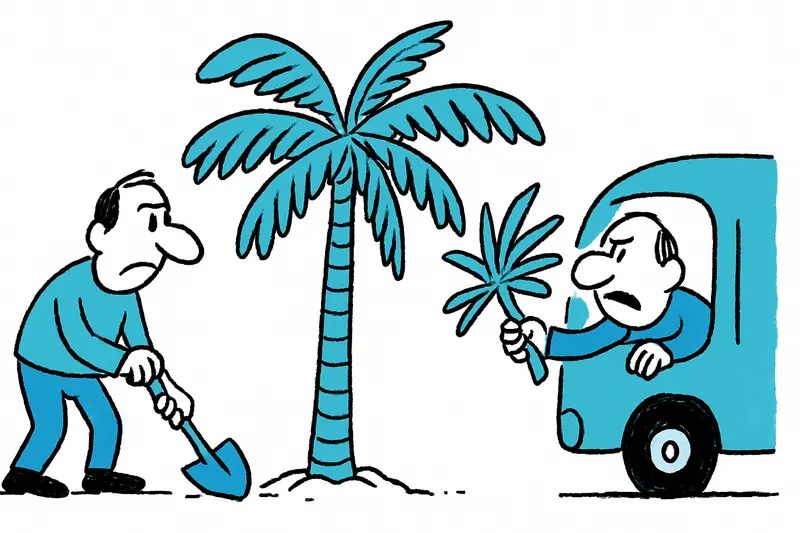
On the Camí de Son Banya — reported in Son Banya: The palms no one wanted to pay for — and what that says about public space — the scene one early morning was familiar: excavators, the clatter of metal, the dull scent of freshly turned earth. Only this time rows of Washingtonia palms and a few potted olive trees lined the street. Around 280 palms — a quick attempt to make the neighborhood appear friendlier from the outside. But the crucial question remains: does a green arrangement change the social fabric, or does it merely cover up what is really missing?
Between benefit and deception
At first glance it looked like a charming improvisation: narrow shadows on the asphalt, a hint of normality. Yet prices leave little room for romance. At an average of just under 100 euros per palm, we're quickly talking about a five-figure sum. Money that came from somewhere — and that no one publicly explained; local coverage explored this in Son Banya: Con 280 palmeras contra la imagen — una iniciativa verde que fracasó. The city removed the shrubs within two days. Police and municipal teams acted without much spectacle, but with determination. The sound of the trucks still echoed when the question faded: who did the action really benefit?
A cosmetic intervention with deeper implications
The debate is not only aesthetic. Authorities see a possible motive to create a normal-looking appearance through greening — and thus to complicate controls. In a neighborhood where informal structures occupy spaces, visual codes can become a strategy. This is often only touched on in public debate: the cityscape is not just decoration, it is an instrument of social and legal negotiation.
The perspective of local residents
“At first glance I thought: finally something green,” says a resident who wishes to remain anonymous. “But the shacks are still there. The rubbish is still there. One palm does not make a home.” Such voices are important. They show that symbolic politics is ambivalent: in the short term palms lift spirits. In the long term they do little if there are no accompanying measures. The rustle of palm fronds cannot replace a regular cleaning crew, the renovation of dilapidated housing, or social services.
What is rarely openly discussed
Beyond the question of funding there are further, often overlooked dimensions: Who would have maintained the plants in the long term? Who is liable if trees get sick or fall? Are exotic, maintenance-intensive Washingtonia palms the right choice for Mallorca's climate and water balance? And how does the removal of the planting affect trust between residents and authorities? These points are not details. They determine whether a measure creates sustainable benefit or only produces short-lived images.
Ecology matters. Many ornamental plants require significantly more water and care than native, drought-tolerant species. Greening without a maintenance concept is as fleeting as a picture from a travel brochure: beautiful for a moment, gone with the next rain or a lack of irrigation.
Concrete opportunities: How to learn from the episode
The action on Camí de Son Banya need not be seen as a mere setback; accounts explain how Son Banya: por qué 280 nuevas palmeras fueron retiradas de repente unfolded and offer lessons for future initiatives.
1. Transparency about financing and responsibilities. Who pays for plants and care? Public spaces need clear accounting. A simple bill creates trust and prevents speculation.
2. Participation as a prerequisite. If residents, neighborhood representatives and social services are involved from the start, acceptance increases. A joint planting and maintenance plan prevents secret rapid actions and strengthens local responsibility.
3. Ecologically sensible selection. Instead of exotic palms, native, drought-tolerant species and robust shrubs would be the better choice. They save water, are less sensitive and strengthen the local ecosystem.
4. Long-term funding for maintenance. Every planting action needs a budget for years — or sponsorship programs supported by the municipality. Without care, an avenue quickly becomes a monument to wasted effort.
5. Integrated policy instead of one-off actions. Cleaning, housing renovation, social work, employment programs and urban greening planning must be interlinked. Green alone is no substitute for structural measures.
Between pragmatism and symbolism
The excavation action made clear how quickly symbolism works — and how sensitive its handling must be. People resort to their own solutions when they feel bypassed. That is understandable, but risky. Bans without offers breed mistrust. At the same time, urban planning must not become a tool for unofficial interest groups.
The avenue on Camí de Son Banya was visible only briefly. What remains is the smell of earth, the echo of the trucks and the question of whether we want real change — or just quick images for the moment.
Frequently asked questions
Do palm trees really improve a neighbourhood in Mallorca?
Why were the palms on Camí de Son Banya removed so quickly?
Are ornamental palms a good choice for Mallorca’s climate?
What should be considered before planting trees in a public space in Mallorca?
Is greening a neighbourhood enough to solve social problems in Mallorca?
What is the problem with symbolic street improvements in Mallorca?
How much can a palm tree cost in Mallorca public planting projects?
What lessons can Mallorca take from the Son Banya palm episode?
Similar News

When coercive fines aren't enough: Could holiday rental owners soon face prosecution?
The island administration is stepping up action against unauthorized holiday rentals: high daily coercive fines up to €5...

Palma Airport on an Expansion Course — Who Decides How Much Growth the Island Needs?
Aena and Madrid are planning multi-million euro investments for Son Sant Joan and project higher capacities. Concern is ...
Who Gets Left Out? Why Overbookings Will Hit Many Mallorca Travelers This Summer
On hot check-in days at Son Sant Joan, frustrated travelers pile up. New figures from Reclamador.es show that a large sh...
When the Handyman Came: How an Engagement Ring Disappeared in Mallorca and What It Says About Trust
During a repair in Andratx a highly personal engagement ring went missing — a case that calls not only for punishment bu...
How Burglars Test Fincas in Mallorca — and What You Can Do About It
The Spanish National Police warn of a simple but effective trick: small markings on doors reveal whether a finca is occu...
More to explore
Discover more interesting content

Can Cap de Bou

Townhouse Lleo 72
