
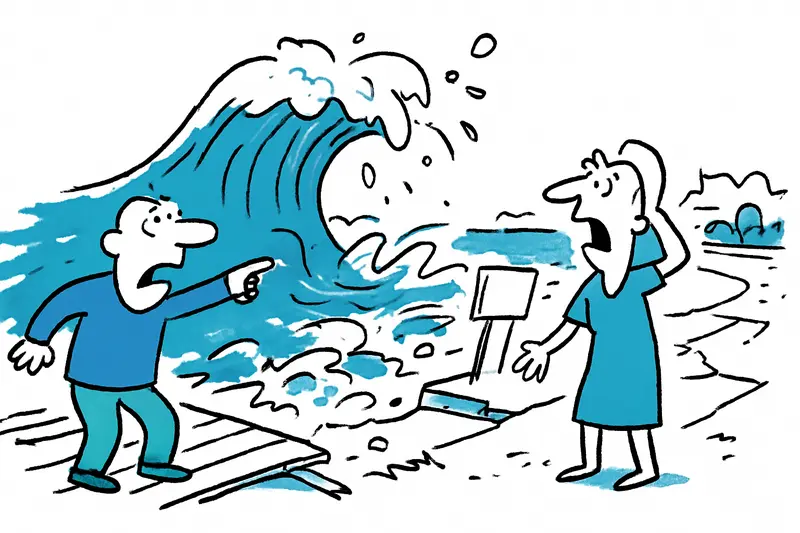
Storm "Harry" tears open the coast: What is happening in Cala Rajada and Son Servera?
Tsunami-like waves damaged beaches and promenades in eastern Mallorca. Why the consequences go beyond broken piers — and what must change now.
Storm "Harry" tears open the coast: What is happening in Cala Rajada and Son Servera?
A critical assessment after tsunami-like waves at Cala Pedruscada, Playa Son Moll and Cala Bona
Key question: Why have the meter-high waves now damaged entire beach sections and infrastructure, and what is missing in the preparation of coastal towns so that such damage is smaller in the future?
On the morning after the storm, sand still lies on the Passeig in Cala Rajada, scattered between empty sunbeds and torn-up floor tiles as a cold wind blows. On the promenade you can hear the clinking of dislodged mosaic pieces; further back, workers in yellow vests push against residual spray that still fills small puddles in side streets. In Son Servera, a two-masted sailing vessel flying the German flag lies in the sand at Playa de Sa Marjal — more than 25 metres of hull, stranded, no crew in sight. Such images stick: not just as a local note, but as a test for our coastal landscape.
The facts are short and harsh: Witnesses observed tsunami-like waves at Cala Pedruscada. Playa Son Moll shows a destroyed wooden jetty and damaged beach structures; a chiringuito has been affected. At Cala Bona parts of the sea wall have been ripped open and tiles knocked away. The national weather service AEMET has extended warnings through Saturday — continuing with strong gusts and high waves, with isolated yellow alerts nationwide. Storm Alert: Is Mallorca Prepared for the Deluge?
Critical analysis: These damages are not just "weather luck." The combination of a higher winter sea level, strong northeast wind directions and years of less dynamically maintained dunes and beach beds means that waves now release more kinetic energy on the coast. Many promenades and sea walls are built for everyday use and tourism, not for waves that flood streets and push boats ashore. The stranded yacht illustrates another shortcoming: missing mandatory securing rules and controls in storm situations, as discussed in Sudden autumn in Mallorca: Are harbors and coasts prepared for short storms?.
What is often short in public debate: first, the question of long-term beach dynamics. If dunes are not maintained and natural beach barriers are not restored, part of the coastal defence is lost. Second, the clarification of responsibility for beach structures and seasonal businesses — who pays for prevention and who for damage? Third: communication in extreme cases. AEMET warnings exist, but they are implemented differently at the local level, as reported in First storm warning, then sun: How well is Mallorca prepared for this changeable weather? The result is uncertainty and delayed evacuations.
A scene from everyday life in the east of the island: A resident walking her dog along the beachfront stops and speaks with a fishmonger. Both film broken tiles with their phones and discuss how often they have had to wait for repairs. A child collects small shells next to splinters from the wooden jetty. Such scenes show: the damage affects people who live and work here and whose livelihoods depend on tourism.
Concrete measures that should be taken now:
1) Systematic inventory of all sea walls, jetties and seasonal structures. The municipalities of Cala Rajada, Son Servera and Cala Bona need short-term safety lists — which structures are acutely at risk of collapse?
2) Natural coastal protection measures such as dune restoration, targeted beach nourishment at core sections and the restoration of natural vegetation belts. This costs less in the long run than constant repairs to concrete promenades.
3) Clearer harbour and mooring obligations for boats during storm warnings: mandatory anchoring checks, clear reporting and evacuation protocols, and defined responsibilities for salvage and disposal phases after the storm.
4) Improved local alarm and information chains so that AEMET warnings are translated more quickly into concrete measures — for example, closures of promenades, secured parking zones and a central emergency phone number for the coast.
5) Financing mechanisms that do not leave smaller municipalities on their own: reconstruction funds, insurance solutions with clear rules for private beach businesses and tourist infrastructure.
Do these proposals sound technical? Yes. But without them we will only keep patching things up. And that is expensive — economically and emotionally. The coming days will show whether wind and waves will increase again; AEMET keeps the warnings in place. Night Storm Hits Andratx and Calvià – Are We Really Prepared? What does not pass by on its own must be tackled politically.
Conclusion: The destruction in Cala Rajada, Son Servera and Cala Bona is a warning shot. The problem is not only "storm" but insufficient adaptation to changed coastal conditions. People living or working in the region already see this in the daily sight of torn promenades and stranded sailboats. It is now crucial to draw consequences from these images: plan, secure, communicate — before the next wave comes.
Frequently asked questions
What kind of damage can strong storms cause on Mallorca’s east coast?
Why are Mallorca’s beaches more vulnerable during winter storms?
Is it safe to go to the beach in Mallorca during a storm warning?
What should boat owners in Mallorca do when a storm is forecast?
What happened at Cala Rajada after the storm?
What damage was reported in Cala Bona?
What happened to the stranded sailboat at Playa de Sa Marjal in Son Servera?
How can Mallorca coastal towns reduce storm damage in the future?
Similar News
New trick at Palma Airport: suitcase stolen from the belt — a reality check
On September 28 a 36-year-old allegedly stole a suitcase from the baggage belt of a 51-year-old German passenger at Palm...
Urgent Clearing of Palma's Torrents: Flood Prevention or Symptom of Short-Sighted Planning?
The city of Palma is responding to storm forecasts and has cleared several torrents. We ask: Is the short-term clearing ...
Evaneos and Mexico: A Reality Check for Sustainable Travel
Travel advertising often reads like a promise: local, sustainable, unique. But how deep do these promises really go? A c...
From Megapark to the Altar: Party Singer Now Offers Weddings in Mallorca
A well-known party artist combines partying and marriage: instead of a traditional church there are ceremonies at the Me...
The Maricarmen Case: Why an Eviction Is Forcing Spain's Housing Debate
Images of an 87-year-old woman on a stretcher have sparked a debate in Spain that also runs deep in Mallorca. Who protec...
More to explore
Discover more interesting content

Can Cap de Bou

Townhouse Lleo 72
