
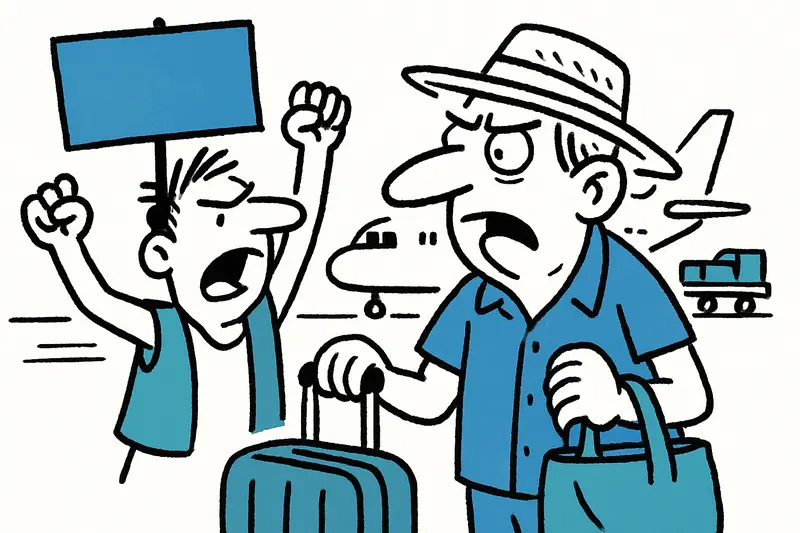
Strike alert at Easter: Why organizers' reassurances shouldn't fully reassure
Strike alert at Easter: Why organizers' reassurances shouldn't fully reassure
Ground staff strikes at Spanish airports raise fears of chaos at Easter. Tour operators play it down — but what does that really mean for travelers in Mallorca?
Strike alert at Easter: Why organizers' reassurances shouldn't fully reassure
Between safety nets and invisible weaknesses: a reality check for Mallorca travelers
Main question: How big is the risk that the announced work stoppages at Spanish airports (see Second Wave of Strikes Hits Mallorca's Airports — Travelers Must Rethink Plans Now) will become a real stress test for Easter arrivals in Mallorca?
At Son Sant Joan airport (read Strike at Son Sant Joan Airport: Three Peak Periods, Major Chaos – What Travelers and Mallorca Need to Know) you hear announcements and suitcases rolling on a normal morning, buses back up on the Vía de Cintura, and café tables on Passeig Mallorca are full of people who have just arrived or are waiting to depart. It is precisely in this bustle that the vulnerability lies: if the people who handle aircraft on the ground stop working, the familiar soundtrack quickly turns into disruption of operations.
The major German tour operators have so far reacted to the current strike threats relatively calmly; background on planned ground staff actions can be found in Ryanair Ground Staff Strikes: What Mallorca Needs to Know. The decisive factor is their organizational advantage: airline-dependent groups that operate their own airlines or have fixed charter contracts are less vulnerable because they have internal ground-handling networks or contractually bound service providers. Providers without their own airline are more dependent on airport processes and see higher risks of longer waits at check-in and baggage claim.
Critical analysis: These reassurances are not wrong — but they are selective. They explain where the system's vulnerability lies but say little about practical protections for travelers. Statements like "expect occasional delays" or "some guests are unaffected" may calm people, but they do not replace transparent risk communication: who exactly is affected? Which flights could be canceled? What alternatives exist in the event of longer delays?
What is missing in the public debate: clear information for individual passengers and visible contingency plans. Authorities and airport operators often name only generic minimum services; the question of how long late-evening arrivals will be handled under staff shortages due to strikes often remains unanswered. There is also a lack of simple orientation for travelers in Palma about which airlines are secured internally and which are not.
Everyday scene: Imagine you are standing with a carry-on bag at the taxi rank in front of your hotel on Avinguda Joan Miró and hear a notification on your phone: "Check your airline, possible delays." Around you, a parade of families with prams moves past the café tables. This is where the practical concern begins: time pressure, lack of information, and taxi prices that can quickly become a painful factor in stressful situations.
Concrete solutions: For travelers the first rule is to allow buffers. Two hours at the airport instead of one may feel unusual, but it can save your trip. Digitally: subscribe to push notifications from the airline and the tour operator. Small kit: chargers, medications, hygiene items in your carry-on. Insurance: cancellation coverage or protection against delays is more worthwhile than ever this year.
At the institutional level, authorities and airport management should be required to specify which minimum services are guaranteed at what times. Airlines and tour operators could jointly introduce simple labels ("own handling" vs. "external service providers") — that would immediately create more transparency for customers. Additionally: temporary zones with extra staff at check-in and baggage claim, mobile information booths along arrival routes, and expanded bus and taxi contingents for peak times.
Conclusion: Panic is unnecessary, but prudence is advisable. The organizers' statements are reassuring because they are based on real advantages of certain business models. However, they do not remove the structural weakness: the dependence of many processes on external ground staff. Those who plan early, stay informed and allow buffer time will avoid most problems. For the people responsible on site, the task remains to create transparency and offer visible measures — then Mallorca can be reached even during a strike-hit Easter weekend without the journey becoming the unwelcome part of the holiday.
Frequently asked questions
Will Easter flights to Mallorca be delayed because of airport strikes?
How early should I arrive at Palma airport during strike risk?
Which airlines are less exposed to airport strike disruption in Mallorca?
What should I pack in my hand luggage for a disrupted Mallorca flight?
Is travel insurance useful for Mallorca trips during strike season?
Why does Son Sant Joan airport feel especially vulnerable during a strike?
How can I stay informed about my Mallorca flight if strikes are announced?
What practical problems can strikes cause for arrivals in Palma?
Similar News
Palma, Palma de Mallorca, Palma‑Mallorca: What is it really about?
The debate over the city's name is more than grammar: it concerns identity, law and branding policy. A sober reality che...
Warning to Bathers: Nipping Fish in Cala Major and Other Coves — a Reality Check
In Cala Major and several beaches around Mallorca, bathers report painful “nips”. Who are the animals, why are they gett...

Rental Car Theft in El Arenal: What This Incident Reveals About Our Gaps
A teenager steals a running rental car in El Arenal, flees on foot, climbs over walls and is caught by the Guardia Civil...
Red Rope in Palma's Library: What Helps Against Selfie Tourism — and What's Missing
Palma's city library cordoned off an area with a red rope to keep selfie tourism away from reading and working activitie...
Fort San Carlos: Museum, Harbor Dispute — and a Conflict That Demands Answers
The military museum at Fort San Carlos sits right on Palma's harbor, with unexpectedly quiet rooms filled with cannons a...
More to explore
Discover more interesting content

Can Cap de Bou

Townhouse Lleo 72
