
SUV fire on the Vía de Cintura at Pont d'Inca: Lucky — and what now?
SUV fire on the Vía de Cintura at Pont d'Inca: Lucky — and what now?
A grey SUV caught fire on the ring road at Pont d'Inca on Monday morning. Two occupants escaped and there were no injuries. Why do cars burn out so quickly and what is missing in Mallorca to make such incidents less dangerous?
SUV fire on the Vía de Cintura at Pont d'Inca: Lucky — and what now?
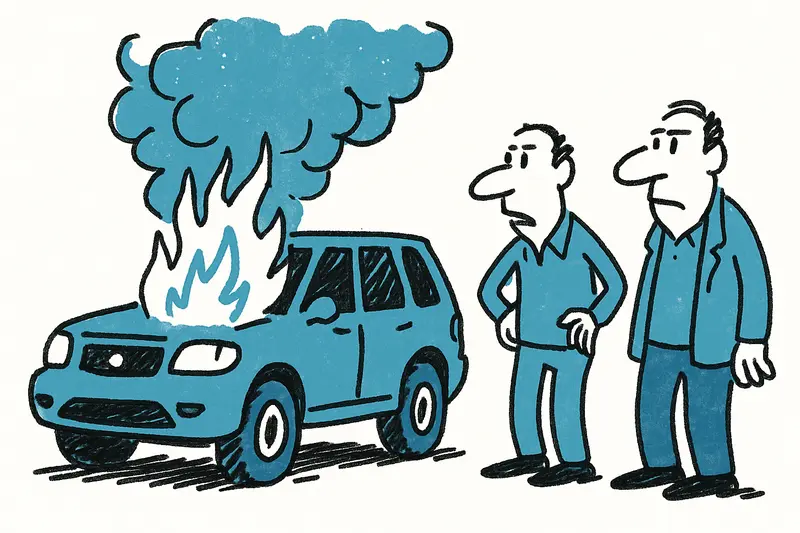
Around 11:30 a.m. on Monday morning smoke rose from the hood of a grey SUV while the vehicle was traveling on the Vía de Cintura at the Pont d'Inca exit. The two occupants pulled onto the hard shoulder, got out and alerted the emergency services. Firefighters from Palma and the local police arrived within a short time; they were able to bring the fire under control after about 20 minutes using stronger extinguishing agents. Property damage to the vehicle, but no personal injuries — a result to be thankful for.
Key question
How well are drivers and emergency services on Mallorca really prepared when a car on the busy ring road suddenly bursts into flames?
Critical analysis
The operation apparently ran routinely: drivers reacted correctly, parked on the shoulder and called for help. Police and the road maintenance service regulated traffic, one lane remained passable. That the flames could not initially be put out with handheld extinguishers is not surprising — modern vehicle fires can very quickly reach high temperatures and extreme fuel demands. The fire service therefore used other, more powerful extinguishing agents. All this corresponds to what one expects from a functioning system, but the devil is in the details.
Public debate and debriefings rarely address the causes: was it a technical defect, a leak in fuel or fluid lines, an electrical problem or simply lack of maintenance? Without these answers prevention remains piecemeal, as recent coverage such as Car on the Paseo Marítimo in Flames – Bang, Smoke and Many Questions shows. Also little considered is which extinguishing agents are most effective in which situations — water is often not enough for burning oil or fuel.
What is missing from public debate
1) Clear instructions for drivers: many do not know how to behave correctly in the event of an engine fire — turn off the engine, keep a safe distance, do not try to open burning parts. 2) Vehicle equipment: a simple fire extinguisher in the car is still not a matter of course. 3) Infrastructure: on heavily used routes like the Vía de Cintura there are in some places insufficiently designated emergency bays or visible information for first responders. 4) Transparency: statistics on vehicle fires and their causes are rarely publicly evaluated, so lessons for inspection centres or workshops are lacking.
Everyday scene from Palma
Anyone who drives along the Vía de Cintura in the morning knows the mixed picture: construction noise, buses, delivery vans, the whir of motorcycles. On the day of the incident there were lines of cars, a faint smell of petrol hung in the air, people got out and looked at the smoking hood. Such scenes seem banal — until they are not; similar episodes are documented in local reporting such as Fire on the Paseo Marítimo: A Blaze, Many Questions.
Concrete solutions
- For drivers: regular basic checks before long journeys (oil level, hoses, visible leaks), a handy ABC fire extinguisher in the vehicle, high-visibility vest and warning triangle within reach. If smoke is detected: turn off the engine, lock the doors, move to a safe distance and call 112. - For authorities and road operators: more clearly marked emergency bays on the ring road, signage with behaviour tips at critical points, regular exercises between fire brigade, police and road maintenance. - For emergency services: ongoing training on modern vehicle fires (hybrid/electric and combustion engine cases) and sufficient supplies of suitable extinguishing agents, including foam and special agents for fuel fires. - For workshops and inspection services: publicly accessible analyses of causes of fires, mandatory checks of critical lines during the main inspection.
Conclusion
Fortunately the fire at Pont d'Inca ended without injuries. But that should not obscure the fact that prevention and public education on Mallorca can be improved. A burning car is rarely an accident — it is often the combination of small oversights. One simple insight that can save lives and nerves tomorrow: a fire extinguisher in the trunk, a clear head in an emergency and better coordination of emergency services across the city's traffic lights.
Frequently asked questions
What should drivers do if a car starts smoking on Mallorca roads?
How dangerous are vehicle fires on the Vía de Cintura in Palma?
Are car fire extinguishers useful for drivers in Mallorca?
Why do car fires happen so quickly?
Is it safe to keep driving if smoke comes from under the bonnet in Mallorca?
What happened in the Pont d'Inca SUV fire on Mallorca?
What should drivers check before long trips around Mallorca?
Why are emergency bays and clear signage important on the Vía de Cintura?
Similar News
When the Wallet Becomes a Danger: Attack in Peguera and Lessons for Mallorca
In Peguera, two women are said to have stolen the wallet from a 75-year-old German couple. When the victim intervened, t...
Plata stays Plata: Young people take over, Llonguets remain
A small bar on Carrer de l'Argenteria will continue: Tolo Serra hands the place over to young Mallorcans at the end of t...
Unnoticed in the Luggage Compartment: How a Boy Traveled More Than 100 Kilometers in a Team Bus
A minor traveled in the undercarriage of a team bus for more than 100 kilometers until his cries for help were heard. A ...

Cap Vermell Grand: Second Michelin Key – a Gift for the East
The Cap Vermell Grand in Capdepera has been awarded its second Michelin key. For the region this elevates the luxury off...
Eurowings lets four aircraft carry names – a friendly idea that also reaches Mallorca
Eurowings is launching a campaign: four Airbus A320s are to carry the first names of people who help others in everyday ...
More to explore
Discover more interesting content

Can Cap de Bou

Townhouse Lleo 72
