
When Tents Return by the Sea: Palma Between the Congress Palace and Sleeping Places
When Tents Return by the Sea: Palma Between the Congress Palace and Sleeping Places
Tents repeatedly appear in Albert Camus Park and on the beach at Can Pere Antoni. Why don't evictions solve the problem — and what alternatives exist so people don't have to keep moving on?
When Tents Return by the Sea: Palma Between the Congress Palace and Sleeping Places
Guiding question: Why don't the tents disappear permanently after evictions — and where are people supposed to go?
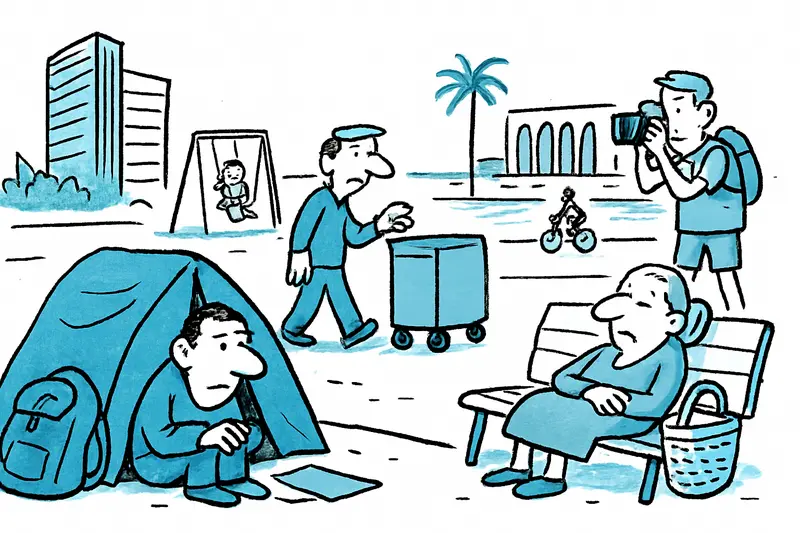
On Saturday, October 24, 2026, at around 3:30 p.m., people can be seen again on the narrow strip between the distinctive Gesa building and the Palau de Congressos, having set up their night camp in tents, on cardboard boxes, or on park benches. A few meters away children swing on the playground, municipal gardeners trim hedges, and the distant roar of the surf at the Passeig Marítim mixes with the click of high heels. The scene feels like a double reality: everyday life and distress side by side.
In short: evictions are an intervention, but rarely a solution. Tents disappear, some encampments are moved to another location, and weeks later a tent appears again — this time perhaps on the edge of Can Pere Antoni, or near Parc dels Ceibos or the so-called Parque Pocoyó. Those affected, as observed here, are not only people without any prospects but also workers who apparently cannot find affordable housing, as reported in When Work Isn't Enough: Palma and the Growing Number of Homeless People. Plastic bags, a few possessions, wet sleeping mats, and the reserve when approached make clear how precarious the situation is.
Critical analysis: the classic response — police-led evictions, cleaning, media reports — treats symptoms. It shifts the problem, creates temporary order, and often leads to new encampments elsewhere. Social services, when involved, work in a piecemeal way; the offers are fragmented and often lack long-term follow-up. On the street this means: those who do not fit into an available emergency bed or refuse help return shortly afterwards. The city's infrastructure — emergency shelters with limited places, day centers with opening hours, a fragmented supply of social housing — is not sufficient to provide permanent housing alternatives for everyone.
What is missing from the public discourse: an honest inventory of vacant apartments, seasonal tourist vacancies outside peak times, and the actual need for permanent, affordable housing. There is also too little open discussion about the causes: stagnant wages alongside rising rents, precarious employment in the hospitality sector, and a lack of transitional offers for people who want to leave emergency situations. Coordinated case-management teams that truly integrate healthcare, addiction treatment, and psychiatric services are likewise rarely discussed; the wider scale of the problem is documented in Mallorca's Streets Are Growing Longer: Why More Than 800 People Are Homeless and Nothing Solves It by Itself.
An everyday scene from Palma: a young man in a small tent packs up around midday, pulls a tarp over his bag, rolls up the sleeping mat and disappears toward the Passeig Marítim. An older woman sleeps across a park bench, her shopping basket standing beside her, a situation described in Homelessness on Paseo Mallorca: When the Park Bench Becomes the Final Address. Tourists photograph the promenade; a delivery driver honks. Such observations are not sensationalist but show a recurring everyday reality that is familiar to many.
Concrete solutions: in the short term the city should expand mobile services — warm showers, laundry vans, health and social teams that work regularly on site and not only appear during evictions. In the medium term there need to be binding agreements to use vacant apartments for social programs, accompanied by legal advice and rent subsidies for occupancy periods. Municipal incentives to convert seasonal apartments into long-term housing, an expansion of low-threshold day centers with case management and employment programs for those affected, and transparent monitoring of available places and waiting lists would be important. Central is: do not criminalize homelessness, instead provide binding transitional offers.
Conclusion: clearing the tents from Albert Camus Park or Can Pere Antoni can create short-term order. But as long as structural deficiencies remain — a lack of affordable housing, fragmented social services, precarious wages — distress will remain visible and mobile. Palma needs a strategy that does not treat evictions as the final act, but as a starting point for binding, integrated assistance. Without such steps the island will repeatedly see the same distress in the same places.
Frequently asked questions
What factors drive recurring encampments in Palma, Mallorca?
What short-term steps can Palma take to help people living in tents near the Palau de Congressos?
Why do tents keep reappearing after evictions near Can Pere Antoni?
How could vacant apartments be used to address housing needs in Mallorca?
What are the broader social and policy gaps contributing to homelessness in Mallorca?
What role do seasonal tourism and the housing market play in Palma's housing crisis?
What medium-term actions could Palma implement to reduce homelessness?
Why is it important not to criminalize homelessness in Palma?
Similar News

Palma's Subway Project: Environmental Review Begins — More Questions Than Answers
The environmental review for Palma's planned subway extension to Son Espases has started, raising concerns and unanswere...
Alleged Rape in Palma: How Home Videos Changed the Investigation
A woman reports an assault in Palma. Secretly recorded videos are said to have supported her account. Why migrant women ...

After Major Partners Exit: Palma Rewrites the Rules for the Waterbus
The port authority has changed the rules for the planned waterbus: removal of rigid minimum revenue guarantees, higher u...
Rats in Llucmajor: How Uncollected Garbage Became a Health Problem
In Llucmajor, uncollected trash bags, overflowing containers and rain are leading to increased rat sightings. An assessm...
Sly Distraction Scam at Ballermann: How Tourists Became Targets — and What Must Be Done Now
Five suspected pickpockets were arrested. Their method: distract, secure the loot, return the wallet — without the cash....
More to explore
Discover more interesting content

Can Cap de Bou

Townhouse Lleo 72
