
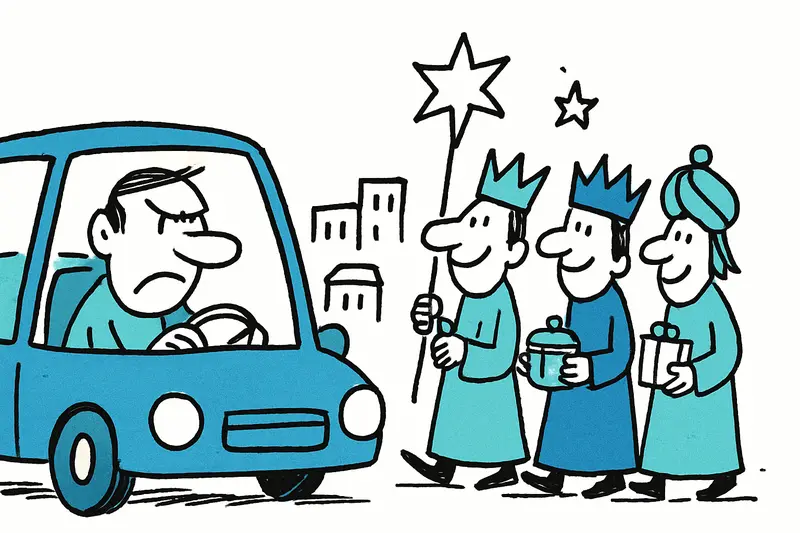
Three Kings Parade in Palma: What Drivers Need to Know Today
Three Kings Parade in Palma: What Drivers Need to Know Today
The Three Kings parade starts at 6:00 PM. Road closures will be in effect from 1:00 PM in the city centre, with further restrictions on the Paseo Marítimo from 4:30 PM. Guidance, criticism and everyday tips.
Three Kings Parade in Palma: What Drivers Need to Know Today
City centre closed, questions remain — a reality check
Anyone driving through Palma on January 5 will feel the festive atmosphere in the air: children with paper crowns, music from loudspeakers and the usual vendors handing out the last sweets on Passeig des Born. At the same time this means: motor traffic will be significantly restricted. The parade officially starts at 6:00 PM, but the first road closures come into effect as early as 1:00 PM in the core area of the city.
Several central axes are affected: Antoni Maura in both directions, Jaime III, the Born, Unió, Plaza Weiler, La Rambla, Baró de Pinopar as well as the inner Paseo Mallorca. Parts of Vía Alemania and Vía Portugal will also be closed. From 4:30 PM closures around the Paseo Marítimo will be added, specifically between Avenida Argentina and the Congress Palace; as a result, many bus lines will be rerouted, similar to disruptions during the triathlon and cycling tour, and exits at some city-centre car parks are blocked from midday, as with the Fira del Variat and night run. According to the schedule, the Paseo Marítimo should be reopened from 7:00 PM and the Avenidas by 9:00 PM; the Cabalgata is expected to finish around 10:00 PM.
Key question: Are the information and traffic measures sufficient for residents, commuters and visitors to get around safely and with minimal stress? Our answer: hardly.
Critical analysis: Times, precise as they may sound, are of little use if they are not linked to clear maps, bus diversion plans and information on parking options. Some closures take effect already in the early afternoon; people who work in the centre or need to bring children to school suddenly face closed exits. This leads to last-minute detours, crowded side streets and stressed drivers. Public transport users often only learn about diversions at the stop — which is suboptimal in a city with many tourists and changing passenger flows.
What is missing from the public discourse: a simple, central information source in an easily readable format. It is not the fault of any single app, but the lack of standardized maps that show what applies when for pedestrians, cyclists, motorists and public transport users. There is also little communication about which car parks will allow exits or whether temporary no-parking zones apply. For people with reduced mobility, precise information about accessible routes is particularly important — and here there is often radio silence.
Everyday scene from Palma: On Plaça del Mercat you can see Maja, the florist, securing her stalls early and waiting for the delivery van to be allowed in, which has been cordoned off. On the Rambla an older man with a rollator tries to find a detour while trumpets in the background already announce the start of the procession. Such small scenes repeat themselves today in several streets — charming, but a logistical powder keg when information is missing.
Concrete solutions that would help immediately: 1) Provide a freely accessible map that visualizes closure zones by time and is updated regularly (as a PDF and on municipal social media channels). 2) Clearly mark car parks that allow exits with notices and online updates. 3) Set up temporary shuttle services from the outskirts or designate park-and-ride areas so visitors can leave their cars outside the core. 4) Inform bus drivers and passengers early at main nodes about diversions, ideally with replacement stops. 5) Ensure accessible routes and communicate them visibly.
Practical tip for drivers today: Park outside the centre and use short walks; check in advance whether your car park allows exits; plan significantly more time; and — if possible — prefer bike or tram to the car. If you are a resident: check with your building management whether an exemption permit is in place or whether delivery times can be shifted.
Conclusion: The Three Kings parade is part of Palma like the smell of roasted chestnuts on winter evenings. But holiday spirit and traffic safety only go together if organisers, the city and transport companies improve communication and take practical precautions. Otherwise the Epiphany romance will be reduced to a honking concert on the detour routes. A little planning and clear guidance would be enough to make the celebration nicer — for spectators and for those on the move.
Frequently asked questions
Will Palma city centre be closed for the Three Kings parade on January 5?
Which streets in Palma are affected by the Three Kings parade traffic restrictions?
Can you drive or park in Palma near Passeig des Born during the Three Kings parade?
How late do the Three Kings parade road closures last in Palma?
Are buses in Palma diverted during the Three Kings parade?
What is the best way to get around Palma on Three Kings Day if I need to drive?
Is the Paseo Marítimo in Palma affected by the Three Kings parade?
What should residents in central Palma check before the Three Kings parade?
Similar News
Mistaken identity with fatal consequences: Brutal assault in S'Aranjassa — what's missing in the follow-up?
At S'Aranjassa a visitor to a finca was tied up, beaten and thrown out of a van. Three men have been arrested, including...
High heel slips, car accelerates: accident on Camí de Son Hugo
A woman lost a high-heeled shoe on the forecourt of the sports facility at Camí de Son Hugo. The car accelerated, mounte...
Phone Scam: How Two Hotel Employees at Playa de Palma Lost Thousands of Euros
One morning in September, two reception employees at Playa de Palma were pressured by alleged alarm-company staff — in t...
When the Wallet Becomes a Danger: Attack in Peguera and Lessons for Mallorca
In Peguera, two women are said to have stolen the wallet from a 75-year-old German couple. When the victim intervened, t...
Plata stays Plata: Young people take over, Llonguets remain
A small bar on Carrer de l'Argenteria will continue: Tolo Serra hands the place over to young Mallorcans at the end of t...
More to explore
Discover more interesting content

Can Cap de Bou

Townhouse Lleo 72
