
Too Many Boats, Too Little Sea: Why Mallorca's Coasts Are Reaching Their Limits
Berths, buoys and Posidonia: Mallorca faces a conflict between maritime freedom, the tourism economy and nature conservation. A critical assessment with concrete solutions.
Too Many Boats, Too Little Sea: Why Mallorca's Coasts Are Reaching Their Limits
Key Question
How can the high demand for berths and anchoring spots be reconciled with the protection of valuable seabeds, without stifling recreational skippers, rental operators and coastal municipalities?
Critical Assessment
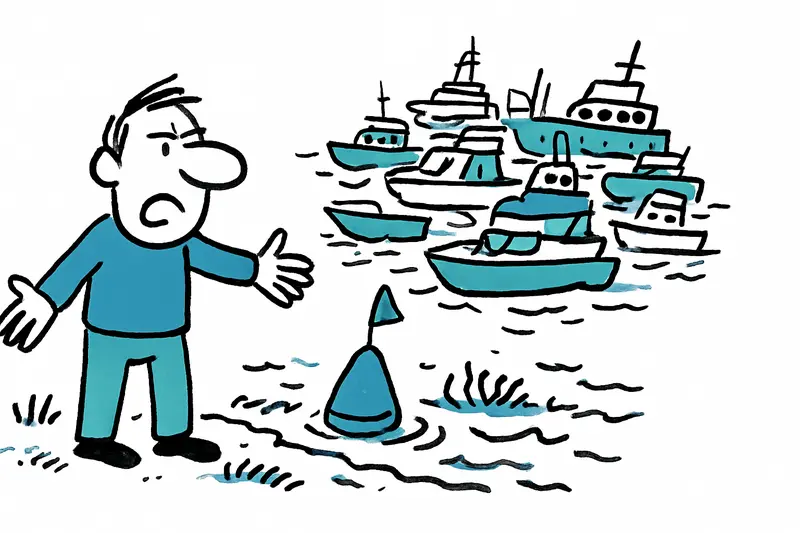
If you walk along the Passeig Marítim in the morning, you hear engines, the shouts of harbor workers and the clinking of fenders. On the horizon, sails, RIBs and rental boats crowd the queues at harbor entrances. The Balearic Islands have tens of thousands of berths and more than 1,500 kilometers of coastline — and yet space is insufficient. For private individuals, waiting times for permanent berths are no longer uncommon; isolated reports mention waiting lists that last years, in extreme cases decades. At the same time, the boating sector has an economic dimension: nearly a thousand nautical businesses, revenues in the billions and thousands of jobs make the sea a tightly calculated economic factor.
The port system is organized in layers: national major ports, regional facilities under Ports IB and private marinas or club náuticos. Each layer follows its own rules: availability, prices and access differ greatly. Those who are in a hurry pay more in private facilities — those who can wait join public waiting lists. This coexistence creates injustices and distorts markets, as recent incidents such as When the Catamaran Came in Too Far: Banyalbufar and the Question of Who Shares Mallorca's Coasts show.
What Is Often Missing in Public Discourse
Public debate usually focuses on individual measures — more buoys here, stricter controls there. Important questions are often left out: who really owns the concessions, how transparent are allocations and waiting lists, and who actually benefits from new berths? The fleet of short-term rentals and their regulation is also rarely discussed; see Between Waves and Berth: Mallorca's Problem with 'Floating Holiday Rentals'. Private rentals bring additional boats into sensitive coves without clear controls or responsibilities in many cases, as documented in Drunk Boats, Battered Bays: When Private Boat Rentals Put Mallorca's Coasts at Risk.
The Ecological Side: Posidonia and Buoy Fields
Underwater lie the main reasons for restrictions: Posidonia seagrass meadows are ecosystems that stabilize the seabed, bind CO2 and protect beaches. Anchoring over these meadows is prohibited; instead, authorities increasingly install buoy fields in protected areas or popular coves. Buoys are meant to save the seabed, but they are limited and designed for seasonal use. In national park zones like Cabrera, the central administration decides on availability; in other coves, Ports IB or yacht clubs do. This means spontaneous anchoring during the high season becomes practically impossible.
Everyday Scene
A Friday in June: a patrol boat circles Cala Formentor, two charter bosses nervously negotiate a last-minute cancellation, and three families search in vain for a free buoy. On the shore an old fisherman swears because his exit at dusk is blocked. Such scenes are now normal and show how regulation, demand and limited space collide, and they echo reporting on landings and community pressure such as South Coast at the Limit: When Boats and Plastic Overwhelm Communities.
Concrete Solutions
1. Short term: Greater transparency in allocations and waiting lists. Ports IB and municipalities should maintain digital registers, openly accessible and with clear criteria for priorities (professional fishers, rescue services, long-term berth holders). 2. Medium term: Capacity planning through a marine spatial strategy. Instead of expanding buoys piecemeal, an island-wide network is needed that protects sensitive areas and designates less burdened zones. 3. Regulation of short-term rentals: A clear licensing requirement, limited daily quotas per owner and mandatory insurance could curb illegal models. 4. Economic steering: Dynamic berth fees during peak times and incentives to shift to less sensitive ports — e.g. reduced rates in the low season or for sustainable operators. 5. Technology and service: Smart buoys with sensors for occupancy, real-time online reservation systems and more shuttle services from the harbor to the shore reduce spontaneous congestion. 6. Social compensation: A quota of reserved berths for local professional fishers and small coastal communities prevents economic interests from dominating all spaces.
What Needs to Happen
The island administration, Ports IB and the municipalities must cooperate instead of regulating only on a case-by-case basis. Independent monitoring of the capacity limits of coastal waters, combined with a publicly accessible plan for new infrastructure, would make speculation and non-transparent concessions more difficult. At the same time, stricter sanctions against illegal charter models and better controls at sea are needed — not only as punitive measures, but as part of a comprehensible system.
Concise Conclusion
Mallorca cannot create unlimited berths nor keep every cove open for spontaneous anchoring. The choice is not simple: either usage is organized more clearly and fairly — with economic and ecological signals — or we accept that marine space continues to be allocated to the highest bidder. A transparent marine spatial plan, coupled with fair rules for rentals and concessions, is not a luxury project — it is the prerequisite for still finding the same coast in 20 years that we photograph today.
Frequently asked questions
Why is it getting harder to find a berth in Mallorca?
Can you still anchor freely in Mallorca’s coves?
What is Posidonia and why does it matter for boating in Mallorca?
How do buoy fields work in Mallorca?
What is the situation like at Cala Formentor in the high season?
Why are private boat rentals a concern in Mallorca?
What changes are being suggested to manage Mallorca’s coast better?
Why does Mallorca need a marine spatial plan?
Similar News

Four goals, heart-stopping moments, a message: Germania Mallorca takes three points in Consell — questions remain
The new German club on the island won its first away game in Consell 4:3. Celebration, a 4:0 lead, then a nervous finish...

Mueller continues expanding in Mallorca: Artà in 2026, Can Picafort in early summer 2027
The drugstore chain Mueller is opening two new stores in Mallorca: a 1,400 m² shop in Artà on 5 November 2026 and a bran...

The Painter Who Lived Mallorca: Franz Taussig and His Century-Old Secret
A hundred years ago a young Viennese arrived in El Terreno, sketched the island and called himself Francis Caron. Today ...

Airport dispute: Bridge, forecasts and the question of responsibility
A video by the Spanish transport minister has ignited the dispute over DORA figures, capacities and local governance pow...

The Painter Who Invented Himself: How a Young Viennese Drew Mallorca
A hundred years ago a 19-year-old draftsman arrived in El Terreno. His diary and sheets, long known under the pseudonym ...
More to explore
Discover more interesting content

Can Cap de Bou

Townhouse Lleo 72
