
Too Many Pools, Too Little Water: Why Mallorca's Municipalities Must Act Now
Too Many Pools, Too Little Water: Why Mallorca's Municipalities Must Act Now
In nine years 10,680 new swimming pools were built on Mallorca. What looks like luxury is a growth problem for water, landscape and municipal coffers. Who decides — and who pays the price?
Too many pools, too little water: Why Mallorca's municipalities must act now
Key question: How long can each municipality still decide alone whether a new swimming pool may be built — even though the water ultimately belongs to everyone?
If you walk along the Passeig Marítim on a hot September afternoon, you hear lawn mowers, the hum of air conditioners and somewhere the splash of a private pool. Children are paddling. Automatic sprinklers spray the small gardens. The scene is familiar, almost taken for granted. But the figures now being circulated sound different: in the past nine years 10,680 new swimming pools have been added — that is 23 each week. Adding up all inventories, activists speak of more than 73,000 pools on the island.
The problem cannot be dismissed as a matter of aesthetics or taste. Each pool takes up space, consumes construction and installation materials, in many cases uses drinking water — and constantly loses water through evaporation. In hot summers, when water scarcity is most noticeable, this becomes especially visible: terraces with pools sparkle while fountains somewhere else are restricted. In many municipalities the share of drinking water coming from desalination plants is rising; that is technically feasible, but expensive and energy-intensive, as detailed in When the Tap Runs Scarcer: Mallorca Between a Tourism Boom and a Dwindling Water Source.
So why are permits still being granted? The answer lies not only in personal convenience. Municipalities finance a large part of themselves through building permits, and housing developments bring long-term tax revenues. If a neighbor gets a permit, it is hard for the local mayor to say no. Added to that is political pressure: politicians who want votes hesitate to block construction projects that at first glance promise income and jobs.
What is missing from the public debate is a sober cost accounting: who pays the additional operating costs of desalination, who bears the ecological bill for lost water reserves and sealed surfaces? There is a lack of transparency about the actual water consumption of private pools, a lack of a central inventory and a lack of island-wide rules that prevent distortions of competition between municipalities.
Another blind spot: social justice. A community pool in a housing development burdens the supply network less than hundreds of small private pools in peripheral areas. Nevertheless, individual pools are often treated as a private matter, not as a resource with public relevance.
What should be done concretely: first, a compulsory pool registry at the Balearic level, so that it is clear where how much water is tied up. Without data, any policy remains piecemeal. Second, permit rules that require water budgets: for every new pool it must be demonstrated how water will be saved or compensated — for example through rainwater harvesting, the use of greywater for garden irrigation or by foregoing lawns.
Third, fiscal incentives/charges: small pools on narrow plots could be taxed higher, while the creation of jointly used swimming pools could be supported, which reduces land consumption and creates social balance and relates to changing practices such as hourly pool use described in From Designer Pouch to Chlorine Bath: How Hourly Pool Rentals Are Changing Everyday Life in Mallorca. Fourth, binding technical requirements: pool covers, efficient filters, automatic refill limits and mandatory annual leak tests reduce evaporation and losses.
Fifth: a regional framework. As long as each municipality decides alone, uncontrolled growth occurs, and some of the pressure could be relieved by island-wide measures rather than patchwork responses, as local initiatives show in reports such as When the Tap Becomes a Luxury: Seven Municipalities Tighten Water Rules in Mallorca.
And yes: the expansion of renewable energy, linked to targeted desalination projects, belongs on the agenda. But that must not be a free pass to continue consuming land and drinking water unchecked. Technology is part of the answer, not the whole answer. Those who rely on large desalination plants must calculate honestly: electricity demand, cost per cubic meter, ecological footprint.
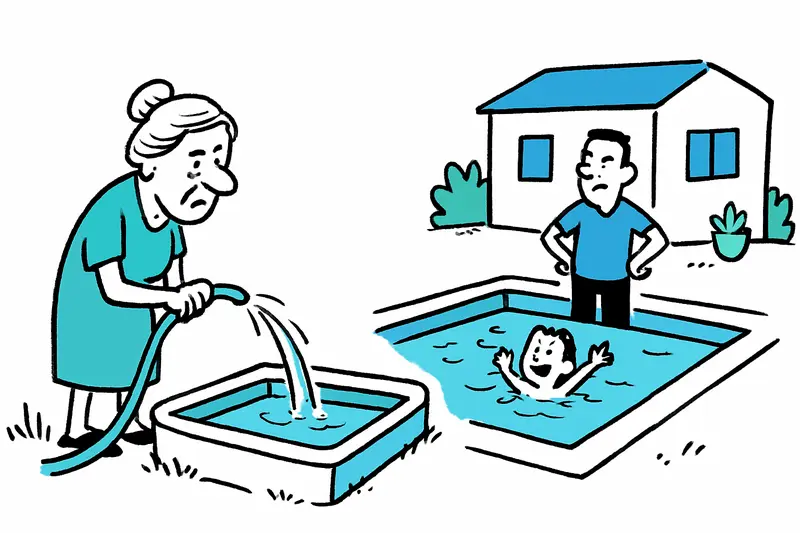
On the street it looks like this: an elderly woman in Coll d’en Rabassa waters her small front garden with a hose while opposite a new development fills its communal pool. The woman pays the price indirectly, in the form of restricted fountains and higher drinking water prices, a dynamic seen elsewhere in emergency situations such as Water Emergency in Valldemossa: When the Wells Whisper. Anyone who sees this should ask: will my municipality continue to allow everyone to build their own mini-bath, or will we set priorities?
A pointed conclusion: authority over pools is no longer harmless local politics. It determines how scarce water will be in ten years — and who pays the bill. Municipalities can act quickly: with a pool registry, water budget checks, minimum technical standards and an island-wide regulation. Those who do nothing bear responsibility for rising costs and dried-out landscapes. Those who want to be elected should explain how they intend to share that responsibility — not just how many building permits they have issued.
Frequently asked questions
Why are private pools considered a water issue in Mallorca?
How many pools exist on Mallorca and why does that matter for water use?
What concrete policies could help Mallorca manage pool water use?
Why would an island-wide pool regulation benefit Mallorca?
What practical steps can Mallorca pool owners take to save water?
How do climate and desalination factor into Mallorca's pool water debate?
Why do some Mallorca municipalities still grant pool permits despite water scarcity?
Could shared or community pools offer a fairer path for Mallorca’s water use?
Similar News

End of October: Can you still swim in the sea in Mallorca?
The late-autumn sun still warms the air and the sea has retained its summer heat—many people don't pack away their swimw...
Years of abuse in Costa de la Calma – Neighbor calls Guardia Civil
In a villa in Costa de la Calma a neighbor alerted the Guardia Civil: a 19-year-old woman reported years of violence by ...

Schauinsland Takes Over Management of the Morito in Cala Millor – a Reality Check
From March 2027 the German tour operator Schauinsland will manage the Morito hotel in Cala Millor. The Batle Erikson fam...

Still bathing season? Why Mallorca still invites a plunge into the sea at the end of October
The air is mild, the beaches quieter — and the water surprisingly warm. We have summarized the current temperatures and ...

A Spanish Evening at the Auditorium: Guitar, Colors and the Sea in Palma
Rodrigo, Ravel, Albéniz — and a new work by the guitarist: the second subscription concert brings Spanish music in a lar...
More to explore
Discover more interesting content

Can Cap de Bou

Townhouse Lleo 72
