
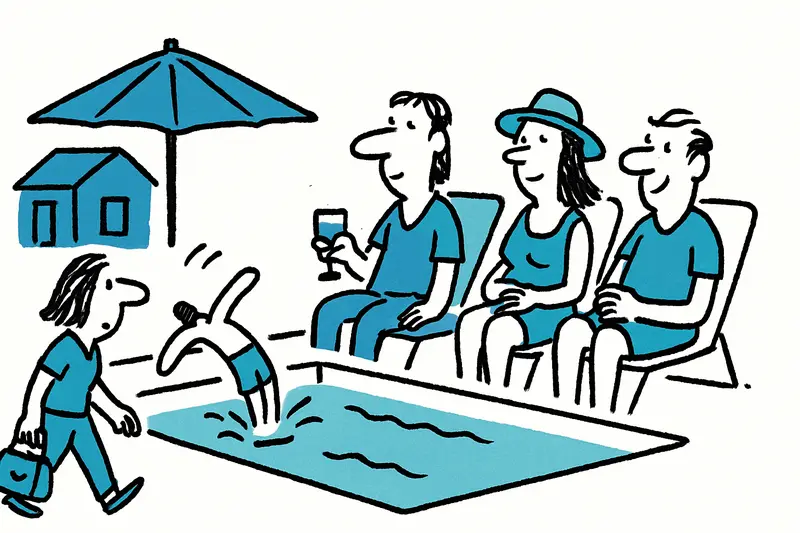
From Designer Pouch to Chlorine Bath: How Hourly Pool Rentals Are Changing Everyday Life in Mallorca
Short-term private pool bookings are booming: a brief escape from a small apartment, an Instagram moment — and new conflicts over water, parking and neighborhood peace. What remains when the filter is turned off?
A little villa for three hours — but at what cost?
Last Saturday at the Portixol bus station, between the clatter of old buses and the smell of freshly brewed coffee, I spoke with a woman who had just booked five hours of pool time. "We just wanted to get out of the small flat, a bit of sun and quiet," she said, while seagulls cried in the background. This is the new normal in Mallorca: those who don't own a villa borrow the feeling of living in one for a few hours. But the central question remains: how sustainable is this short-term luxury for the island and its neighborhoods?
Prices, packages and the illusion of luxury
On intermediary platforms, a private pool hour can already be booked from about €30. For around €200 you often get the whole package: terrace, loungers, sunshades, barbecue, Wi‑Fi and sometimes a small service package with towels and chilled drinks. For some providers, a grill master or styling props for Instagram even belong to the standard offering. The result: an afternoon break turns into a short trip into celebrity feeling — at least on the phone photo. This rise in hourly private pool rentals is documented in private pools rented by the hour in Mallorca.
Many properties do indeed look like they came out of a home magazine: bougainvillea, ceramic tiles, views of the Tramuntana hinterland. But the illusion is time‑limited: after a few hours it's back to the suburban flat. The aftertaste is not only chlorine; it extends to the question of who pays for water, electricity and possible disturbances.
Quiet complaints, loud consequences
A renter from Santanyí described the dilemma like this: "It's convenient, but some groups already claim the best spot at dawn. As soon as the hour is up, the frantic packing begins." Neighbors complain about noise, sidewalks are temporarily turned into parking spaces, and homeowners report extra cleaning work. This early-reservation behaviour is part of the morning towel ritual at Mallorca's pools, which compounds local tensions.
The downside cannot be filtered out: water consumption is a real issue on an island that often comes under pressure in hot summers. Municipalities have already asked that pools not be filled with drinking water. If private providers top up large quantities several times a week, tensions arise — especially on hot August days when the mains are already at their limit. Local reporting on Mallorca's water shortage has highlighted these tensions.
The key question: who pays for the water — and who regulates it?
Behind the trend are concrete problems: frequent refills, chemical and energy consumption, street use and rubbish. Public administrations face the question of whether to allow, regulate or limit this. And the island community asks itself: do these short luxury moments serve quality of life — or do they create new inequalities and burdens? This debate intersects with the broader phenomenon of the rise of vacation rentals in Mallorca, which also tests local infrastructure and neighbor relations.
Concrete solutions for a reasonable middle ground
The discussion must become practical. Some proposals that repeatedly came up in conversations with hosts and residents:
1. Water and energy saving certificate: A voluntary or mandatory label for pools that use rainwater, greywater recycling or cisterns and have solar-assisted heating. This makes it visible which offers are resource‑conserving.
2. Limited booking frequency: Municipal rules could stipulate how often a pool may be rented out by the hour per week. That reduces daily top-up needs and the temporary burden on the neighborhood.
3. Standard packages for hosts: Clear arrival and departure times, noise limits, parking instructions and a mandatory cleaning fee. A simple code of conduct helps prevent conflicts.
4. Pilot projects and local levies: Model projects in affected municipalities could show how a balance works. Small fees could also be conceivable, flowing into renovation projects or water treatment.
Alternatives for those on a budget
For those who do not want or cannot afford an hourly pool rental, there are sensitive alternatives: the municipal swimming pool with day tickets, early laps in the Mediterranean — saltwater instead of chlorine, wind instead of Wi‑Fi — or sharing with relatives who have a garden. The sea remains the most honest option: free, open and always there.
Conclusion: Hourly rented private pools are an understandable response to lack of space and the desire for privacy. They offer short, occasional detachment from everyday life. At the same time, they show how closely resource issues, neighborhood relations and tourism are interwoven. More transparency is needed — and local rules that protect both hosts and residents. I'll keep listening: at the kiosk, at the bus stop and of course at the pool edge, when the chlorine still smells of summer and the bougainvillea trembles in the wind.
Frequently asked questions
How much does an hourly private pool rental in Mallorca usually cost?
Are hourly pool rentals in Mallorca worth it for a short break?
Do hourly pool rentals in Mallorca use a lot of water?
What problems do hourly pool rentals cause in Mallorca neighborhoods?
Is there any regulation for hourly pool rentals in Mallorca?
What are some water-saving options for private pools in Mallorca?
What are cheaper alternatives to an hourly pool rental in Mallorca?
What should you know about hourly pool rentals in Portixol, Mallorca?
Similar News
The End of the Cheap Ride? Why Mallorca Is Hit Harder by the Fuel-Price Shock
Gasoline and diesel average close to two euros per liter. What this means for commuters, supply chains and renters in Ma...
Relaxed liquid rules in Munich: What Mallorca travelers will notice
At Munich Airport the 100-milliliter rule will be lifted at all checkpoint lanes — thanks to new CT scanners passengers ...

For 45 Years on Mallorca — and Then This: How a Market Visit in Santa Ponsa Became a Lesson
A woman who has lived on the island for decades lost money and important documents at the Mercat Setmanal in Santa Ponsa...
10 percent surcharge on the beach: How legal and transparent is the extra charge at Playa de Muro?
A German part-time resident noticed days after a restaurant visit in Playa de Muro that the bill included a flat ten per...

Body near the Llevant Market: What this death says about our city
A man was found dead on Sunday afternoon near the Llevant Market. Police say the death appears natural. The scene raises...
More to explore
Discover more interesting content

Can Cap de Bou

Townhouse Lleo 72
