
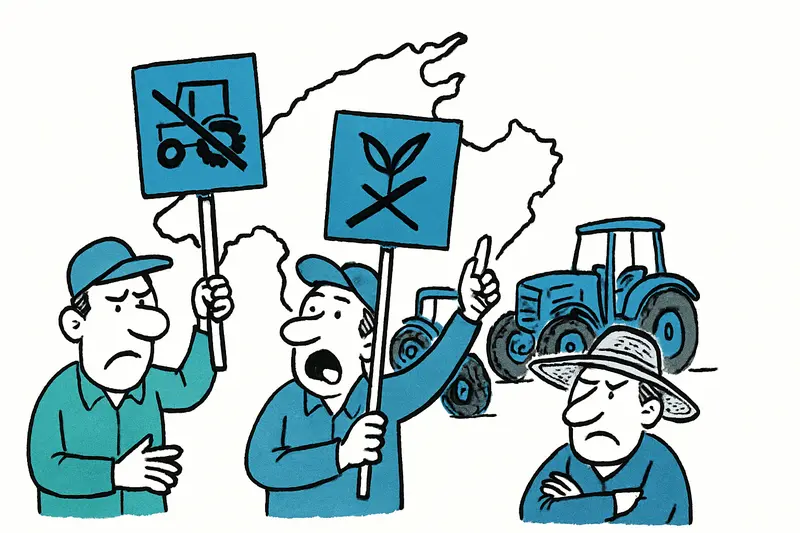
Tractors on the island: Mallorca's farmers protest against EU rules and Mercosur
Tractors on the island: Mallorca's farmers protest against EU rules and Mercosur
On January 29 dozens of tractors rolled from Ariany and Son Fusteret. The demand: protection for local agriculture against falling prices and increased imports.
Tractors on the island: Mallorca's farmers protest against EU rules and Mercosur
Split formation in Ariany and Palma, destination: dairy processing plant and wholesale center
On the morning of January 29, the air over Plaça Major in Ariany was cold; the smell of diesel mixed with strong coffee and the quiet voice of a farmer who was still shaking a thermos. On a restaurant parking lot tractors stood lined up. At the same time, vehicles were parked on the large area of Son Fusteret in Palma, and shortly before ten a long, rumbling convoy set off heading for the dairy AGAMA and the wholesale center Mercapalma.
Key question: How can an island economy with a high dependence on local agriculture maintain fair prices and competitiveness when large trade agreements and EU regulations put additional pressure on producers?
The protests are not a walk against abstract politics; they are the reaction to the direct sensations of the people who work in the fields every day. It is about competitive conditions, about products from long transport chains pushing onto the market, while the season, climate and production costs on Mallorca are hardly negotiable. That the farmers specifically headed for AGAMA and Mercapalma is tactical: processing and distribution points are the hubs where price pressure becomes noticeable.
What needs critical scrutiny is the communication about causes and consequences. Public discourse is dominated by headlines about demonstrations and traffic disruptions, less by the concrete structural problems in the island's agriculture. Clear figures on the development of import volumes, reliable comparisons of local production costs and an understandable presentation of how EU rules actually affect small and medium-sized farms are missing.
What often gets lost: The protesters are not only against an abstract "Mercosur" or an "EU policy", they face everyday practical problems. Example: A small dairy farmer near Sa Pobla's pushback against rail plans calculates his barn while watching milk prices; an olive grower in Alaró must weigh the effort for irrigation and harvest against falling returns. Such calculations are not dramatic political debates — they are everyday life.
Missing elements in the discourse are concrete: transparent origin labeling in trade, mandatory minimum prices in certain public tenders, clear support lines for conversion costs linked to the new agricultural law and a system for short-term crisis assistance. There is also little discussion about the effect of logistical dominance: large importers and central hubs can push down prices because they bundle quantities and distribute margins.
Concrete solutions that could work in Mallorca are pragmatic and down-to-earth: 1) Public procurement on the island should favor locally produced food through binding origin clauses; 2) Strengthen regionally connected cooperatives so that smaller farms gain negotiating power in the market; 3) Promote transparent price formation along the chain, for example through standardized cost surveys; 4) Targeted investments in cooling and processing infrastructure so more value creation remains on the island; 5) Short-term relief funds for adaptation to new standards and import pressure.
Of course these are not quick fixes. Some measures require coordination with regional, national and EU bodies. But they are concrete enough to be put on the table at the next negotiating rounds — and to move the discussion away from the pure conflict image "farmers against Brussels" toward a constructive plan.
On site it was noticeable: the mood was serious, but not aggressive. Traders at the edge of Son Fusteret shook their heads over the traffic disruptions, the road shimmered from the light rain, and a saleswoman in a small kiosk brought farmers thermoses with warm water. Such scenes show how strongly protest and everyday life are intertwined here. No loudspeaker only reads out demands — these are people trying to be heard before farms are closed and jobs disappear.
Anyone who now only points to Söder or Brussels overlooks the middle level: island politics, the municipalities, the cooperatives, the processors. There needs to be a debate about purchasing policy, logistics, regional storage capacities and transparency in trade chains.
Conclusion: The tractor demonstrations on January 29 are a loud wake-up call. They show a burning concern, the everyday reality of many family farms and the gap between major trade decisions and local consequences. If Mallorca does not want to experience only short-term traffic restrictions but wants to preserve its rural structure in the long term, politics, trade and citizens must discuss concrete measures — not just assign blame. Otherwise, in the end only resentment will remain in the parking lot. Mallorca 2035: Between Bed Reductions and a Return to Small-Scale Farming
Frequently asked questions
Why are farmers in Mallorca protesting with tractors?
How do EU rules and Mercosur affect farmers in Mallorca?
Why did the tractor convoy in Mallorca go to AGAMA and Mercapalma?
What are the main problems facing small farms in Mallorca?
What would help protect local agriculture in Mallorca?
What was the atmosphere like during the Mallorca tractor protest?
What does the protest in Ariany mean for Mallorca’s rural areas?
Can Mallorca’s farmers stay competitive against imported food?
Similar News
Injured captain, big plans: Germania Mallorca before the away match in Consell
The newly founded FC Germania Mallorca travels to Consell on Saturday. Captain Bastian Müller is out injured, but coach ...
Palma, Palma de Mallorca, Palma‑Mallorca: What is it really about?
The debate over the city's name is more than grammar: it concerns identity, law and branding policy. A sober reality che...
Warning to Bathers: Nipping Fish in Cala Major and Other Coves — a Reality Check
In Cala Major and several beaches around Mallorca, bathers report painful “nips”. Who are the animals, why are they gett...

Rental Car Theft in El Arenal: What This Incident Reveals About Our Gaps
A teenager steals a running rental car in El Arenal, flees on foot, climbs over walls and is caught by the Guardia Civil...

Red Rope in Palma's Library: What Helps Against Selfie Tourism — and What's Missing
Palma's city library cordoned off an area with a red rope to keep selfie tourism away from reading and working activitie...
More to explore
Discover more interesting content

Can Cap de Bou

Townhouse Lleo 72
