
Traffic jam on the Ma-20: Two incidents bring Palma's ring road to a temporary standstill
Traffic jam on the Ma-20: Two incidents bring Palma's ring road to a temporary standstill
A rear-end collision and a stalled vehicle caused nearly an hour-long standstill towards Palma on the Vía de Cintura this morning. A reality check explains why such situations escalate so quickly and what is missing on site.
Traffic jam on the Ma-20: Two incidents bring Palma's ring road to a temporary standstill
Why a rear-end collision and a breakdown on the Vía de Cintura could paralyze the entire opposite direction
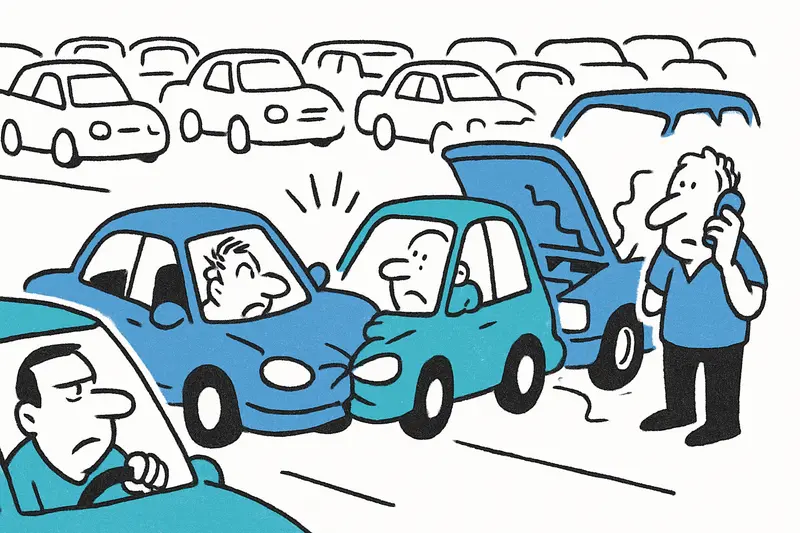
On Monday morning around the Son Hugo exit on the Ma-20 there was what can become everyday here: honking, screeching tires, the smell of brakes and fuel, and people stepping out of their cars in the jam to make phone calls. At around 11:30 a.m. a collision of several cars in succession occurred at kilometer 3 – a typical chain reaction that often happens when a speed spike in dense traffic meets an insufficient clearance profile. Shortly afterwards another vehicle at kilometer 4.5 blocked a lane because it apparently broke down. Combined, this meant that traffic towards Palma was intermittently at a standstill for almost an hour. This mirrors earlier coverage in Ma-20 Blocked: A Truck Breakdown and the Vulnerability of Palma's Roads.
The traffic unit of the Guardia Civil responded, as did two ambulances. According to initial reports there were no serious injuries; nevertheless, those involved were medically checked on site. However, the situation reveals less medical luck than structural weaknesses: on a heavily used ring road a single incident can create chaos within minutes.
Key question: Why do such jams escalate so quickly on the Ma-20 and which routine problems often remain invisible in public discourse? The simple answer is: narrow lanes, high traffic density and a lack of fallback plans for the rapid removal of obstacles. In addition, broken-down vehicles often cannot find a safe escape on the Ma-20 and thus fully block traffic lanes.
Critical analysis: The chain reaction in the accident points to insufficient safety distances and sudden braking maneuvers in mixed commuter and work traffic. If a second vehicle then fails within a short time, the route behaves like a string of pearls: every interruption triggers the next. Technical aids such as automatic traffic-jam warning systems in vehicles are only partially widespread, and dynamic traffic management along the Vía de Cintura still appears to have gaps. The response time for tow services and clearance teams was also noticeable – in practice, there are often no quickly available resources to remove stalled vehicles immediately. A similar rear-end collision on the Ma-13 underlines how quickly such bottlenecks can form: Severe rear-end collision on the Ma-13: Why the stretch between Inca and Palma often becomes a bottleneck.
What is often missing in public discourse: concrete numbers on average clearance times, information on how often breakdowns are the main cause of prolonged closures, and how well traffic control devices actually work. It is rarely discussed how much traffic is already burdened by public transport failures or construction work – this makes the ring road more sensitive to disruptions, as shown when a stalled truck halted the morning commuter traffic on the Vía de Cintura.
An everyday scene: In front of a kiosk in Son Hugo taxi drivers discuss the best detour, a bus driver nods tiredly and points to the bulky jam over the Pont d'Inca. An older woman gets out of her car, smooths her jacket and says, "Today I could have walked." Such small observations show how quickly frustrated mobility can throw a day off course.
Concrete proposals: First, more fixed or flexible emergency bays should be planned on the Ma-20, clearly signposted and arranged so that stalled vehicles can be moved off the carriageway quickly. Second, a binding, well-equipped rapid tow service with prioritized deployments on the ring road is needed, financially secured by the authorities. Third, traffic guidance systems (traffic lights, variable signs, apps) must be better networked so that causes of congestion and alternative routes can be communicated to drivers immediately. Fourth: strengthen enforcement of minimum distances and defensive driving during peak times – including short-term speed adjustments via automatic signs. Finally: pragmatism in infrastructure planning: emergency lanes, intelligent signal control at access points and more proactive communication during incidents would significantly reduce cascade effects.
Conclusion: The incident on the Ma-20 was not an unusual isolated event but an example of how vulnerable Palma's ring road is. It is not only technology that is lacking but coordinated processes: rapid recovery, clear information and simple refuge spaces for stalled vehicles. If we do not tackle this, morning and midday traffic jams will remain part of everyday life. At least on one point there is consensus: nobody wants the sound of honking to be their morning bell; a few smart measures would already bring a lot of calm.
Frequently asked questions
Why does traffic on Mallorca's Ma-20 get backed up so quickly?
What should I do if my car breaks down on the Ma-20 in Mallorca?
Is the Ma-20 in Palma often affected by rear-end collisions?
How serious is a traffic jam on the Vía de Cintura in Palma?
Is it better to avoid the Ma-20 during morning commute hours in Mallorca?
What improvements could help reduce traffic chaos on the Ma-20 in Palma?
What kind of emergency response is used after accidents on the Ma-20 in Mallorca?
Why can one accident block the opposite direction on the Ma-20?
Similar News
Palma, Palma de Mallorca, Palma‑Mallorca: What is it really about?
The debate over the city's name is more than grammar: it concerns identity, law and branding policy. A sober reality che...
Warning to Bathers: Nipping Fish in Cala Major and Other Coves — a Reality Check
In Cala Major and several beaches around Mallorca, bathers report painful “nips”. Who are the animals, why are they gett...

Rental Car Theft in El Arenal: What This Incident Reveals About Our Gaps
A teenager steals a running rental car in El Arenal, flees on foot, climbs over walls and is caught by the Guardia Civil...
Red Rope in Palma's Library: What Helps Against Selfie Tourism — and What's Missing
Palma's city library cordoned off an area with a red rope to keep selfie tourism away from reading and working activitie...
Fort San Carlos: Museum, Harbor Dispute — and a Conflict That Demands Answers
The military museum at Fort San Carlos sits right on Palma's harbor, with unexpectedly quiet rooms filled with cannons a...
More to explore
Discover more interesting content

Can Cap de Bou

Townhouse Lleo 72
