
69 Dead, One Missing Mallorcan: What Needs to Be Asked After the Toledo Train Crash
69 Dead, One Missing Mallorcan: What Needs to Be Asked After the Toledo Train Crash
Sixty-nine people died in the head-on collision of two high-speed trains in the province of Toledo. A 26-year-old woman from Inca is still missing. The central question is why it is taking so long to establish clarity.
69 Dead, One Missing Mallorcan: What Needs to Be Asked After the Toledo Train Crash
Key question: Why do so many uncertainties remain for victims' families and the public?
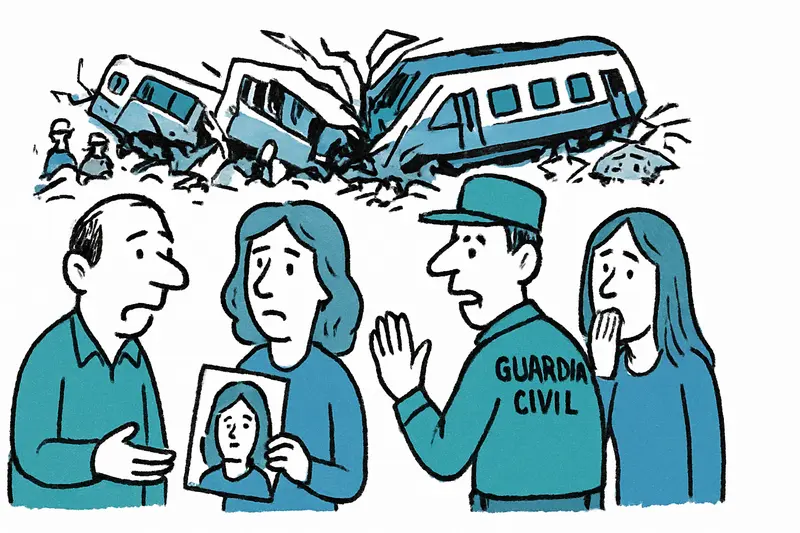
The image is disturbing: wreckage, rescue workers, and families living in uncertainty. In the head-on collision of two high-speed trains in the province of Toledo, 69 people have died according to official figures; hundreds were injured. Among the victims is the former Labor Minister Fátima Báñez. At the same time, relatives from Mallorca are searching for their 26-year-old daughter Mari Carmen G. from Inca. These facts are clear. What is missing is a definite answer as to why basic information is so hard to obtain.
A critical assessment reveals several bottlenecks: the identification of the injured and the dead is ongoing, families receive contradictory information, and social networks fill the information gaps with calls for help. The search for Mari Carmen is being coordinated by the Guardia Civil; drone teams, mountain rescuers, forensic units and tracking dogs are deployed. Nevertheless, relatives cannot be reassured because hospital lists, passenger data and search reports are not being brought together quickly enough.
What is often missing from the public debate is the organizational perspective: how are information flows between rail companies, hospitals and emergency services regulated? Who maintains a central list of everyone transported, and how is it ensured that unidentified people admitted to clinics are immediately registered and assigned a code so families can find them? Answers to these questions are largely lacking so far.
An everyday scene from Mallorca makes the impact personal: Inca is unusually quiet this Thursday, market traders are packing away fruit and garlic, and the church bell strikes the half hour. On Plaça d'Espanya two parents stand who flew from Son Sant Joan to Madrid in the morning; they have hardly slept and are constantly on the phone. They recount how, at the first reports, the regional authority said their daughter had been found injured – then silence followed. Moments like these show how vulnerable relatives are when institutional information is missing.
Key problems can be addressed technically and organizationally. In the short term families need reliable points of contact: a central, multilingual victims' and relatives' office that brings together patient data, train manifests and identification reports and provides daily updated information. Clinics must have clear protocols for unexpectedly admitted, unidentified people: visible registration codes, photographic documentation with consent or judicial authorization, and standardized handovers to investigators.
In the medium term improvements to passenger management are necessary. Rail companies could be required to keep complete, accessible passenger lists that can be consulted by emergency services and the judiciary in an emergency. Interfaces between private operators and state authorities must be defined so that information does not remain siloed. Regular emergency exercises involving all actors should also be on the agenda so procedures work in real crises.
One non-technical point must not be underestimated: psychological support. People like the woman who, according to helpers, already survived a train accident in January and is now traumatised again need immediate, low-threshold help. Mallorca has strong neighborhood networks; these local structures should be quickly activated together with professional services so that those affected are not left alone.
The investigations into the cause of the accident should be in independent hands and conducted transparently. Independent forensic analyses, published in an understandable form, reduce speculation. At the same time politicians must ask whether existing safety regulations, signalling technology and operational procedures are sufficiently controlled. This is not about assigning blame in headlines, but about concrete measures to prevent relatives from being left in uncertainty for days after a disaster.
Concise conclusion: Relatives need not only sympathy but comprehensible information and functioning procedures. Anyone going about their daily life in Inca or Palma feels the shock across the island. The coming days must show whether authorities and rail operators take responsibility and close the practical gaps that have made this tragedy so much harder for many people.
Frequently asked questions
How are missing relatives supported after a major rail accident, and what does that mean for families in Mallorca?
How should hospitals handle unidentified patients after a disaster, especially for Mallorca residents waiting for news?
What lessons about information sharing after a rail emergency could also benefit Mallorca?
How can psychological support after a disaster be organized quickly, and what role could Mallorca's networks play?
What long-term steps can improve transparency for families after a disaster, with Mallorca in mind?
Why is independent, transparent investigation important after a disaster, and what does that mean for Mallorca residents following the news?
What practical travel tips can Mallorca residents learn when relatives travel to Madrid or elsewhere?
Why is daily, comprehensible information important for Mallorca communities like Inca or Palma after a disaster?
Similar News
Biniamar Worried: Bar Mayorga Closes, Santa Tecla Church Closed — What Now?
In the village centre of Biniamar a 37-year bar era ends and the Santa Tecla church is closed due to cracks. A reality c...
Rent shock in Mallorca: Almost every apartment now costs over €1,500 — how long can this last?
New figures show: on the Balearic Islands almost 90 percent of rental listings are over €1,500 per month. People who wan...
Train accidents in Spain: Why the list of disasters seems longer than the answers
From Adamuz to Urda: In a short time, one serious railway accident follows another. Who asks why this is happening — and...
Fall in the Torrent de Pareis: Who Protects Hikers?
A hiker fell in the Torrent de Pareis from about three metres and was airlifted to Son Espases. Key question: Are warnin...

Who will bake the bread tomorrow? Ca'n Xiscos, Pina and the question of the village center
Pina's only bakery is up for sale. For many residents it is more than a shop — it is a meeting place and a social networ...
More to explore
Discover more interesting content

Can Cap de Bou

Townhouse Lleo 72
