
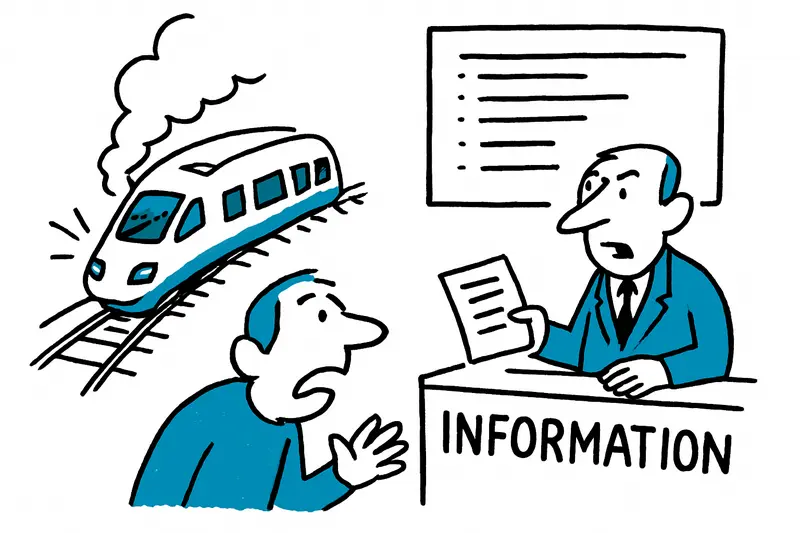
Train accidents in Spain: Why the list of disasters seems longer than the answers
Train accidents in Spain: Why the list of disasters seems longer than the answers
From Adamuz to Urda: In a short time, one serious railway accident follows another. Who asks why this is happening — and which measures really help?
Train accidents in Spain: Why the list of disasters seems longer than the answers
Key question: Why have severe train accidents in Spain accumulated in such a short time — and what is missing from the public debate to prevent future disasters?
Brief summary of the situation
Since the beginning of the year, several serious accidents have shaken the country: In January, a high-speed train near Adamuz moved onto the opposite track and collided with an Alvia train; 45 people died. Two days later, on the R4 in Catalonia a train derailed after a landslide, a driver was killed and dozens were injured. Now, with the accident in Urda in the province of Toledo, Spain faces the question again of how safe its railways are. These events fit into a long series: Angrois (2013) with 80 dead, O Porriño (2016), Valencia (2006) and historical disasters going back to 1944 in Torre del Bierzo — where casualty figures remain disputed to this day.
Critical analysis: technology, personnel, climate — and the system between
The accidents have different immediate causes: excessive speed, pushed obstacles or human error. But the emerging pattern is systemic: reliable technical safeguards are not installed everywhere, routine inspections appear irregular, and emergency plans are practiced differently by region — a point tested by Serious Accident Near Porto Cristo: When a Holiday Day Becomes a Test of Emergency Response. Added to this are new risks from extreme weather events: landslides or flooded tracks occur more often. The interaction of aging infrastructure, patchy automation and increasing climate-related stress makes the situation more vulnerable.
What is often missing from the public debate
Reports understandably focus on casualty numbers and questions of blame. Rarely, however, is attention directed to three points: first, the prioritization of safety investments along regional lines; second, independent, transparent investigations that disclose technical details; third, the concrete preparation of communities along the routes. The voices of commuters, small station operators and maintenance crews — those who see everyday gaps — are often missing.
A daily scene from Palma
Early in the morning at the Estació Intermodal in Palma: commuters with thermos coffee, an old timetable sign, the kiosk owner discussing the news at the counter. No one there believes Mallorca would be completely spared from such accidents if a risk occurred at the island connections. The voices at the station call for regular signal checks, better securing of level crossings and faster information during disruptions. These small demands reflect exactly the gaps visible on the mainland as well.
Concrete solutions — pragmatic and immediately applicable
There is no silver bullet, but a number of actionable measures that together can significantly reduce risk: 1) Rapid retrofit of critical track sections with automatic braking and signalling systems (ETCS level where possible). 2) Mandatory, independent safety audits of all operators — publicly accessible and with deadlines for fixing deficiencies. 3) Systematic inspection and securing of level crossings; at heavily used locations, physical barriers instead of just signs. 4) Regional risk checklists for extreme weather, including vegetation management and drainage rehabilitation. 5) Better training and regular emergency drills for staff — not only within operations but together with communities and rescue services. 6) Transparent communication after accidents: quick facts, ongoing updates, no speculation, a demand echoed after Fatal accident in Alcúdia: Who is responsible — and what needs to change?.
How Mallorca can contribute concretely
The island can also take specific steps: operators in Mallorca should rehearse their emergency plans at the Estació Intermodal and other stations regularly with fire services and the Red Cross. Technical checks of switches and signals, which here are often exposed to salt-laden air, must be carried out more frequently. In addition, a local reporting system can be strengthened to allow commuters to anonymously report unusual noises or damage — these are often the first warning signs (see Three serious accidents in one night: What's wrong with Mallorca's country roads?).
What to avoid now
It would be a mistake to reduce the discussion to blaming and then quickly move on with business as usual. Debates about perpetrators or systems without concrete measures achieve little. Equally dangerous is calming rhetoric without verifiable numbers and deadlines for improvements.
Concise conclusion
The sad list of historical accidents shows: Spain has suffered tragedies that can recur if technology, funding and transparency do not go hand in hand. It is not enough to grumble about safety on the platform every day — concrete investments, independent inspections and a lived willingness to take local risks seriously are needed. Anyone who truly wants to change things must ask after Adamuz, Angrois and Urda: which tracks are still vulnerable, who is responsible for securing them — and by when will visible deficiencies be remedied?
The people at Palma's Estació Intermodal want to drink their coffee in the morning and get to work safely. This simple expectation is a good guide for all decision-makers: safety must be visible in infrastructure, in plans and in responsibility — otherwise the list of names will never get shorter.
Frequently asked questions
Why have serious rail accidents in Spain happened in a short time, and what does this imply for Mallorca's rail safety?
What concrete safety measures could reduce rail risk in Spain and on Mallorca?
Why are independent safety audits important for rail operators?
How does extreme weather influence railway safety, and what can be done to reduce risk?
What role do communities play in Mallorca's rail safety?
What steps can Mallorca's Estació Intermodal take to improve emergency readiness?
Why is transparent information after rail accidents important, and what should it include?
What specific infrastructure checks are suggested for Mallorca to prevent disruptions?
Similar News
Fall in the Torrent de Pareis: Who Protects Hikers?
A hiker fell in the Torrent de Pareis from about three metres and was airlifted to Son Espases. Key question: Are warnin...

Who will bake the bread tomorrow? Ca'n Xiscos, Pina and the question of the village center
Pina's only bakery is up for sale. For many residents it is more than a shop — it is a meeting place and a social networ...
Flu season in Mallorca: Why getting vaccinated now is wise
Flu vaccinations have been available in the Balearic Islands since October 19. Anyone in Palma who smells roasted chestn...
Blue Shark Ashore: What the Incident on Menorca Means for Our Beaches
A roughly two-and-a-half-metre blue shark was spotted near Son Parc and Arenal d’en Castell. Rescue teams acted quickly ...

Mallorca's Gastro Night: Awards for Traditional Bakers, Top Chefs and Island Favorites
At the fourth edition of the Premis Gastronòmics, around 1,000 guests celebrated the island's cuisine on Palma's seafron...
More to explore
Discover more interesting content

Can Cap de Bou

Townhouse Lleo 72
