
Train stoppage Palma–Es Pont d'Inca Nou: Who pays the price of the weekend?
The Palma–Es Pont d'Inca Nou route will be closed over the weekend due to installation work at Verge de Lluc. What this means for commuters, shopkeepers and people with reduced mobility — and how the damage can be limited.
Train stoppage at the weekend — what is really happening
On Saturday, November 8 and Sunday, November 9, the rail connection between Palma and Es Pont d'Inca Nou will be completely suspended. The reason is the installation of a new pedestrian bridge at the Verge de Lluc stop. Cranes, workers and a constant soundscape of drilling and hammering will mark the scene along the tracks — you can hear the bustle days in advance when standing on the platform and the salty wind blows a few leaves across it.
The key question: Who bears the cost of the construction site?
The central question this weekend is simple but uncomfortable: Will the restrictions mainly be borne by commuters, or will local businesses and people with limited mobility be hit at least as hard? At first glance it's about loss of comfort — longer travel times, possible delays, the need to look for alternatives. At second glance it's about real money: fewer spontaneous customers for small shops around the shopping center (Palma at the Weekend: Closures, Detours and What Residents Should Know), additional taxi costs and uncertainty for those who rely on barrier-free connections.
The replacement solution — and why it is not enough
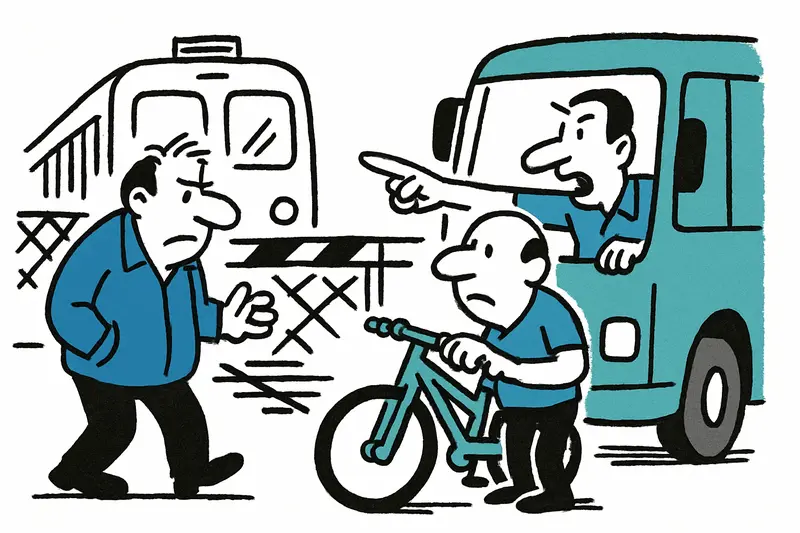
The operators are deploying a rail replacement service (SEV): buses run at similar intervals to the trains. On paper a neat solution. In practice there are problems: buses take longer, especially on the access roads to the shopping center and around Palma, where there is traffic even on weekends. Service frequency suffers from congestion, traffic lights and delivery traffic. And for many commuters the ban on bringing bicycles on the replacement buses is a real problem. Mallorca depends on short everyday journeys — the bike is not a leisure item here but a means of transport. Anyone who locks their bike to a lamppost risks theft or damage.
Aspects that are rarely discussed
A few issues that are often missing in typical reporting: First, the bicycle question. A temporary ban on taking bikes on SEV buses increases parking pressure at stations, leads to insecure parking practices and indirectly to more cars. Second, communication: timetable changes are communicated online, but many occasional users — older people, people without smartphones or tourists — only find out about the closure at the station. Third, coordination with road traffic: if replacement buses are constantly stuck in traffic, the main advantage of public transport is lost. And fourth, the social dimension: changes are particularly stressful for people with reduced mobility if it is not guaranteed that SEV vehicles are wheelchair-accessible or that accompanying assistance is offered.
Concrete, immediately implementable measures
The installation of the bridge is necessary and will make transfers safer in the long term — especially in rain or for children. But accompanying measures could be much better. Concrete proposals that would help in the short term:
Temporary, supervised bicycle parking: Secure, covered bike parks at the affected stations would reduce the risk of theft and prevent ad hoc improper parking.
Bicycle trailers or bike racks on selected SEV buses: A small trailer or a limited number of bike mounts on some buses at weekends would offer cyclists an alternative to using a car.
Prioritized bus lanes and traffic light priority: Temporarily reserved bus lanes in critical areas and traffic light prioritization could significantly increase the reliability of SEV trips.
Better, direct on-site communication: Loudspeaker announcements at stations, information booths at weekends, printed notices in supermarkets and at bus stops around Es Pont d'Inca Nou would reach those who are not informed online.
Accessibility must not be an afterthought
One point often overlooked as a corrective measure: when replacement buses are used, they must be wheelchair-accessible. Support services — for example a transport service for passengers with reduced mobility or free seats on certain buses — should be communicated. Otherwise there is a danger that a necessary construction project quickly becomes an exclusion exercise for a part of the population.
Looking ahead — seize opportunities, minimize frustration
The works at Verge de Lluc are scheduled to continue until December; the affected weekend is part of a longer phase of construction. The good news: the new bridge will make transfers safer in the future. The bad news: without additional measures the weekend will remain a nuisance for many. A pragmatic plan that considers bicycle commuters, local traders and people with disabilities would not be a luxury but a necessary gesture of public service.
My advice to commuters: allow extra time, check the official timetables (TIB/Tren) before departure, consider alternative routes (for example see More trains, less traffic: How to get to the Patronal Festival in Palma) and ensure safe bicycle parking. And a small, very untechnical everyday tip from here: take an extra coffee with you — a warm sip surprisingly soothes the mood during delays.
Frequently asked questions
Why is the train between Palma and Es Pont d'Inca Nou stopped at the weekend?
What is the replacement bus service like during the Palma train closure?
Can I take my bike on the replacement buses in Mallorca?
How should I get around Palma if the train is not running?
Is the Palma–Es Pont d'Inca Nou disruption difficult for people with reduced mobility?
Will shops near Es Pont d'Inca Nou feel the impact of the train closure?
How long will the Verge de Lluc bridge works affect train travel in Mallorca?
What is the best way to prepare for the Palma–Es Pont d'Inca Nou train stoppage?
Similar News

Maribel: Five Decades of Service – Housekeeper from Peguera Celebrated with a Special Honor
Over 50 years in the hotel business: María Isabel “Maribel” Molinos was honored in Palma at the Nit del Turisme by Unive...

Orange Alert over Parts of Mallorca: Are We Prepared?
Dark clouds and an announced wet spell have triggered an Orange alert in parts of Mallorca. A reality check: what's miss...

Sundair & Co.: Sale speculation and what it could mean for Mallorca
Rumors about a possible sale of the airlines Sundair and Fly Air 41, which belong to Schauinsland-Reisen — and whether b...
Anne Wünsche in Mallorca: A job offer with a catch — who fits the role of personal assistant?
Influencer Anne Wünsche has left Berlin and is urgently looking for a full-time personal assistant in Mallorca. Why the ...

Daily from New York: Palma Between Boom and Strain
United will increase the Newark–Palma route to daily flights in 2027 using Boeing aircraft (231 seats). What does the in...
More to explore
Discover more interesting content

Can Cap de Bou

Townhouse Lleo 72
