
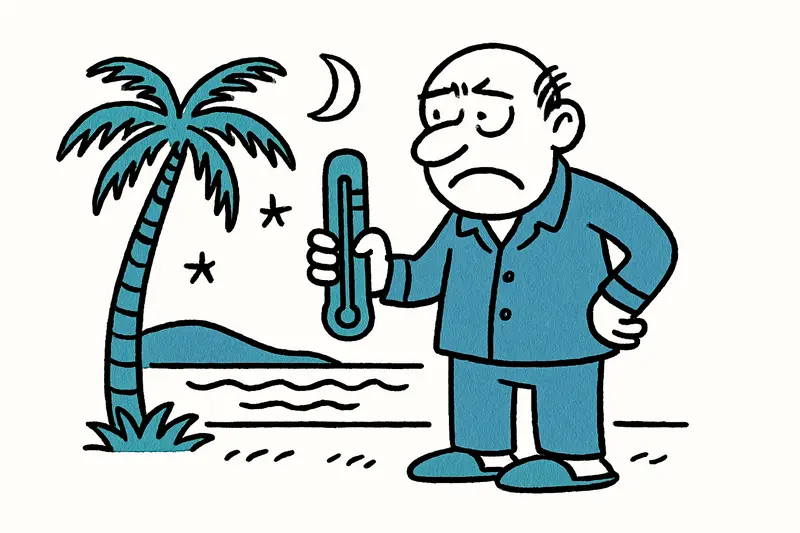
Tropical night in February on Mallorca: what the unusual warmth should tell us
Tropical night in February on Mallorca: what the unusual warmth should tell us
In parts of Mallorca the overnight lows did not fall below 20 °C. A reality check: what's behind it, what's missing from the debate and what helps locally?
Tropical night in mid-February – a reality check for Mallorca
Why did the temperature barely fall below 20 °C, and what is rarely discussed?
On Wednesday night several measuring stations on Mallorca recorded unusually high temperatures. At stations in Muro, Port de Pollença and Pollença the minima did not fall below 20 °C; at other locations such as Palma (Portopí/University), Sa Pobla and at the Capdepera lighthouse values were around 19 °C. During the day, local readings reached up to 24 °C, for example in Muro. The measurements speak for themselves – but what questions should we be asking now?
Key question: Is this a one-off meteorological outlier or an early sign that island climates are changing permanently and that we must prepare for new extremes?
The sober analysis begins with the mechanisms: mild air masses from southern latitudes, föhn-like effects related to pressure systems and the warm sea surface can together prevent nocturnal cooling. On Mallorca, local factors also play a role: evening maritime influences, the suction effect of coastal locations and wind directions that carry warmth from the mainland. The recorded 20 °C is unusual — especially in deep winter — but meteorologically explicable.
What rarely appears in the public discourse so far is the distinction between weather extremes and long-term climate development. A single warm February night is not proof of a new normal, and weather extremes also include cold snaps such as 0 Degrees in Campos. However, more frequent mild nights change ecosystems, vegetation cycles and daily rhythms, as recorded during the island's third-warmest summer since 1961. Flowering phases of olive or almond trees can shift, pests benefit from milder winters, and allergen exposure for people changes.
Another blind spot in the debate is local vulnerability. In Palma's old town or in narrow mountain villages, few people consider nights a health risk — the focus is usually on summer heat. Yet even in February prolonged mild nights can disturb sleep, affect older people or alter routine medical situations (for example with nocturnal medication reactions). Support services, warning levels or simple guidance in municipal bulletins are often missing.
Those who walked along the Paseo Marítimo in the morning this week heard the quiet hum of boat engines in the harbor, a few late fishermen folding nets, and the streetlights glowing longer than usual. In cafés on Passeig des Born people sat outside in light jackets, waiters washed plates without steam rising into the air — scenes that reveal: the feeling of winter is currently absent for many residents.
That brings us to concrete local actions. First: strengthen the measurement network. More publicly available station data and better-distributed sensors in urban valleys and on the coast would help understand microclimates. Second: adapt urban planning. Street trees, shaded public spaces and water-retaining surfaces dampen temperature fluctuations — this applies not only to hot summers but also to milder nights that increase nighttime frequency. Third: agricultural support measures. Advisory services should inform farmers about potentially earlier flowering phases and pests and suggest adjusted planting calendars. Fourth: expand healthcare preparedness. General practitioners, pharmacies and social services could provide targeted advice to risk groups during mild periods — for example on sleep hygiene or medication storage in unusual warmth.
At the political level there is no need for alarm, but clear responsibilities: who observes, who warns and who helps? Municipalities, the island council and meteorological services should link data and action recommendations more closely. This also means that urban emergency plans must not be aimed solely at heatwaves in July but must be flexible to respond to seasonal shifts, as during the short heatwave that brought late-summer warmth.
What sticks in everyday life? Those living near the Mercado de Santa Catalina notice changes first in the schedule of market stalls, in bakeries that bake outdoors earlier, in children who stay on the playground late in light T-shirts. Such small observations are not alarm bells, but they are early indicators.
Conclusion: The tropical night in February is a pronounced weather event with tangible local effects. It is not scientific proof of a new climate rule, but it is a wake-up call: more monitoring points, adapted municipal strategies and practical support for farmers and vulnerable people would make Mallorca more resilient. In short: act not only according to the calendar, but according to the actual nights. And on your next walk along the harbor, keep an eye on the thermometers — they tell you more than the calendar label "winter".
Frequently asked questions
Why can Mallorca have a tropical night in February?
Does one warm night in Mallorca mean the climate is changing?
Is it normal to sleep badly during warm February nights in Mallorca?
What should farmers in Mallorca watch out for after a mild winter night?
Which areas of Mallorca notice warm nights first?
Why was it so mild in Muro and Port de Pollença at night?
How can Palma prepare for more unusually warm nights?
What should residents in Mallorca do during an unusually warm night in winter?
Similar News

Are the Balearic Islands the Southern Border of Europe? A Reality Check on Immigration
The Balearic Islands are again calling for EU aid after a sharp rise in arrivals by sea. Conflicting priorities between ...

"Expensive chaos" and many open questions: What clients can do when a lawyer suddenly stops responding
Several clients complain that a well-known German lawyer in Mallorca has been unreachable for months. Key question: What...

TV tip: 'The Last Problem' — Mallorca as the setting of a classic crime
A classic whodunit on Mallorca: A new miniseries set in spring 1959 brings storm, an isolated hotel and a dense web of s...

Nipping Sea Creatures: Why Bathers in Cala Major and Elsewhere Should Be Cautious
In Cala Major, bathers have reported being nipped by small fish. What is behind it, how can problems be avoided — and wh...
Forced eviction in Santa Catalina: When a 65-year-old slept in her car and showered on the beach — a question of responsibility
The story of Pilar López from Santa Catalina represents a problem affecting many Mallorcans: How can an island with a bo...
More to explore
Discover more interesting content

Can Cap de Bou

Townhouse Lleo 72
