
Two German Shepherds Disappear Without a Trace: Why the System on Mallorca Fails
Two German Shepherds Disappear Without a Trace: Why the System on Mallorca Fails
Two German Shepherds disappeared on the road to Sóller. The owner is calling for help — and raises uncomfortable questions about how missing animals are handled in Mallorca.
Two German Shepherds Disappear Without a Trace: Why the System on Mallorca Fails
Key question: Why is there no reliable, fast reporting chain when animals disappear in residential areas?
Early on Friday morning, on the stretch between Palma and Sóller, just near Son Sardina, two German Shepherds disappeared. The dogs belong to motorcycle racer Pakita Ruiz; one is a long-haired male and the other a short-haired female. Both are microchipped. The owner is desperately searching and is asking the neighborhood for information. Phone numbers for tips are 697 729 444 and 691 448 557.
The feeling many locals describe is a strange imbalance. On the one hand there is the clear fact that the animals are registered and could theoretically be identified by any veterinarian or the police. On the other hand there is practically nothing: no public missing notice, no visible coordination by the responsible authorities, and little help from places where one would expect it. Ruiz says she immediately contacted various police stations and also checked whether the animals were at the Son Reus animal shelter—without result.
What stands out in this specific case is less the tragedy itself than what the incident reveals: in a densely populated island area like ours there are gaps in reporting and searching for missing pets. Son Sardina is in the morning a place full of small traffic bottlenecks, bus lines, scooters and delivery vans; a separating but at the same time permeable infrastructure where animals can disappear quickly. People watch the road here, hear the roar of an engine, see the bus light change—but who coordinates the search for a runaway dog across several municipalities?
Critical analysis: authorities, animal shelters, veterinarians and digital platforms often seem to operate side by side rather than networked. A microchip is only as good as the database that is read and checked, and as good as the people who remember to look for a chip in an emergency. Animal shelters often have routine intake checks, but if no report has been filed the search remains patchy. Police jurisdictions change, phone lists are long, and half an hour without coordinated action can already determine the fate of the animals; similar coordination failures have been seen in cases such as Neglected Horses in Son Gual: Why Animal Suffering on Mallorca Often Remains Hidden.
What is missing in the public debate is a discussion about how islands like Mallorca should systematically handle missing pets. There is a lack of a central, easily accessible reporting platform, a fast information chain between municipalities, and clear procedures that help laypeople and dog owners immediately. There is often a lack of awareness: many people do not know that a microchipped animal can be identified by any veterinarian and in some cases the owners contacted immediately—but only if someone checks.
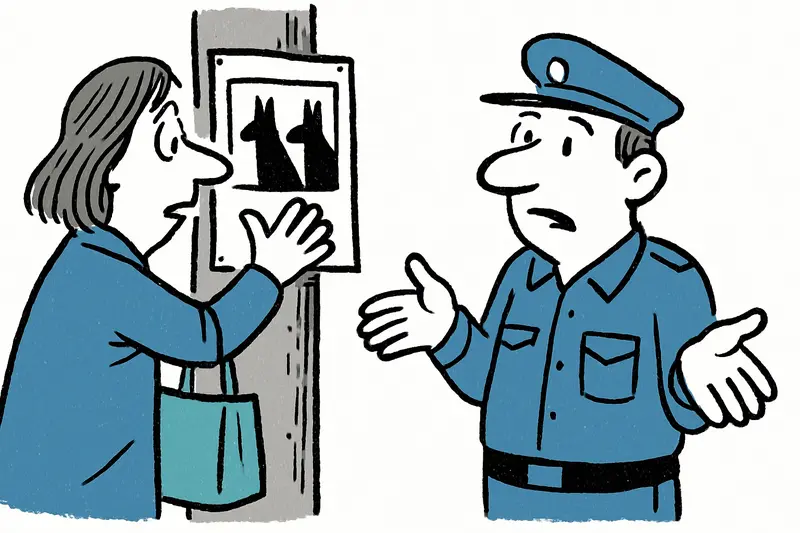
An everyday scene: it is early morning, the shops on Son Sardina's main street open, the smell of coffee hangs in the air, bus 1 stops at the bus stop, two neighbors talk about the crosswalk. A woman with a shopping bag sees a poster on a lamppost, a photo of two shepherd dogs, one of them looking almost questioning. Exactly those posters, quickly printed and hung where people wait or pass by, would help. Likewise, people waiting at the street corner with a flashlight and perhaps water bottles would increase the chances of finding the animals.
Concrete solution proposals that would take effect immediately: 1) A mandatory, central online reporting platform for the island for lost and found animals, with automatic push notifications to registered veterinarians, police stations and animal shelters. 2) Clear reporting procedures for police stations in all municipalities: when a call about missing animals is received, a form should be automatically generated and sent to all relevant parties. 3) Training for police officers and shelter staff on how to check microchip numbers and how to inform owners in a privacy-compliant way. 4) Simple templates for posters and social media posts that dog owners can use quickly. 5) A local hotline outside normal office hours that coordinates reports specifically.
These measures do not cost much compared with the benefit: reduced search times, fewer stressful days for owners, and a higher return rate for animals. Another practical suggestion: veterinarians should, when a found animal is brought in, immediately arrange for the chip data to be checked and the owners contacted, and send the information in parallel to the central platform. The same applies to animal shelters—intakes should routinely be uploaded to the platform with a photo and the location where the animal was found.
What everyone can do: stay calm, search locally, put up posters at bus stops and supermarkets, ask the neighborhood and call vets and shelters. If you have animals: regularly check microchip data, keep phone numbers up to date, and consider reflective leashes and GPS tags when walking. For the municipality, a small multilingual guide would be useful so tourist communities can respond quickly as well.
Bottom line: the loss of Pakita's dogs is first and foremost a personal tragedy. At the same time it is a wake-up call for the island administration and local civil society. Those who live in Mallorca know the narrow paths, the short distances and the quick mixing of people, cars and animals. For that reason we need simple, reliable procedures—otherwise beloved animals can be gone faster than you can say "Son Sardina." Tips about the two animals can be given to the owners at 697 729 444 or 691 448 557.
Frequently asked questions
What should I do if my dog goes missing in Mallorca?
How useful is a microchip if a pet disappears in Mallorca?
Where should I report a missing dog in Mallorca?
Why are missing pets sometimes hard to trace in Mallorca?
What is the best way to search for a lost dog around Son Sardina in Mallorca?
Do vets in Mallorca check microchips for found animals?
What should I put on a missing pet poster in Mallorca?
How can Mallorca improve the way missing pets are handled?
Similar News

Fewer Airlines, Fewer Destinations: What Palma's Winter Flight Schedule Means for Mallorca
Analysis shows: Winter at Son Sant Joan Airport will be quieter, with significantly fewer airlines and destinations. Who...
German tourist dies in Sa Calobra – a reality check for emergencies on Mallorca's beaches
A 40-year-old tourist died at the Torrent de Pareis. The emergency call, a doctor who happened to be present, a defibril...

Deadly Tractor Accident in Bunyola: What Needs to Be Done Now
In a work accident on an estate near Bunyola, a roughly 40-year-old man lost his life. His wife and a small child were o...
Head-first dive into the shallow part of Cala Fonoll: An accident and the unresolved question of responsibility
A young tourist dove into Cala Fonoll and was seriously injured. Key question: Why are clear warning signs missing at da...
Mistaken identity with fatal consequences: Brutal assault in S'Aranjassa — what's missing in the follow-up?
At S'Aranjassa a visitor to a finca was tied up, beaten and thrown out of a van. Three men have been arrested, including...
More to explore
Discover more interesting content

Can Cap de Bou

Townhouse Lleo 72
