
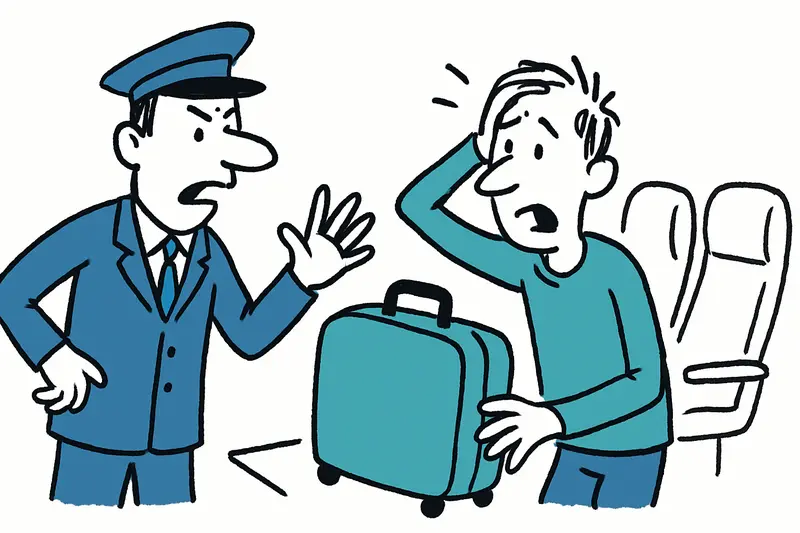
Unknown suitcase on board – how a piece of luggage forced an Ibiza jet to Toulouse
A Eurowings flight from Ibiza to Düsseldorf had to make an unscheduled stop in Toulouse because a piece of luggage on board could not be linked to any passenger. Two hours of delay, a later landing in Cologne/Bonn and a ground transfer to Düsseldorf: time for a reality check of baggage procedures.
Unknown suitcase on board – how a piece of luggage forced an Ibiza jet to Toulouse
Incident on flight EW9503: security check, night flight curfew and 156 passengers rerouted
An Eurowings Airbus A320 registered D‑ABZN, en route from Ibiza to Düsseldorf (flight EW9503), had to make an unscheduled landing in Toulouse after a checked bag appeared on board that could not be matched to any boarding pass. The aircraft remained on the ground and underwent a security inspection – the machine only departed again after about two and a half hours. The story did not end at the destination: due to Düsseldorf's night flight curfew, the jet ultimately landed at Cologne/Bonn; the 156 passengers were transported by bus to Düsseldorf.
Key question: How can a system that moves thousands of suitcases every day prevent luggage without an associated passenger from still getting on board — and what are the consequences for travellers?
Critical analysis: Formally the matter is clearly regulated in Europe (Regulation 2015/1998). Unaccompanied checked baggage is considered a security risk and must not remain on board; therefore it must be unloaded and rechecked if suspected. In practice, however, the incident revealed weak points along the chain: handling, baggage tracking, checks before loading and the final boarding-pass control must all work seamlessly. If one component fails, the consequences go far beyond a half-hour delay: disruptions to staff schedules, missed slots, diversions due to night flight rules and stressful nights for passengers.
What is often missing in public debate: responsibility is not an abstract term. Who was responsible for loading? Was a system error detected or was it human error? Are affected passengers informed clearly and promptly? Also rarely discussed is how borderline cases are handled financially – who pays for extra transport, hotels or missed appointments?
An everyday scene from Palma that makes the problem tangible: on a Tuesday morning a family with four suitcases sits in a café on Via Roma. They listen to the clattering of the luggage trolleys from a nearby hotel. A waiter casually tells of an acquaintance whose suitcase ended up on the wrong plane months ago – three phone calls and a week later it returned. Such conversations show: for many on Mallorca, lost or misloaded luggage is not a distant statistic but a recurring nuisance that disrupts holidays and work plans.
Concrete solutions: First, seamless electronic tracking. RFID tags on luggage are technically feasible and reduce mismatches. Second, clear accountability protocols during loading – a second verification before the door is closed, documented by video and timestamp. Third, training and routines for ground staff that emphasize care as well as speed. Fourth, transparent passenger notifications – automatic updates via SMS/email when a security check threatens or a diversion is likely. Fifth, concepts to socially and financially cushion forced landings due to night curfews (e.g. pre-defined transfers or vouchers), so that the local consequences are not borne solely by travellers.
For Mallorca as a holiday and commuter destination this matters: many guests start or end their journeys here in the evening; a diversion to an inland airport 70 kilometres away can ruin the first night of a holiday. Airports, airlines and service providers on the island should therefore proactively work on interfaces – from baggage handling to information policies.
What should happen now: after every incident there needs to be a clear review with a timeline and clarification of responsibility. Simply stating that a suitcase was “unknown” is not enough. Paths for recourse, potential fines and operational consequences must be transparent, as well as simple rules for compensating affected passengers.
Punchy conclusion: a single suitcase can disrupt more than a change in the weather. As long as people and machines do not work together cleanly, travellers pay the price – in time, nerves and sometimes money. Anyone travelling with luggage on Mallorca should keep that in mind; and airports and airlines should use the opportunity to streamline procedures before the next suitcase causes trouble.
Frequently asked questions
What is the best time of year to visit Mallorca for outdoor activities?
Can you swim in Mallorca outside the summer season?
What should I pack for a comfortable Mallorca trip?
What are the best ways to get around Mallorca?
Are there any cultural etiquette tips for visitors to Mallorca?
What local dishes should I try in Mallorca?
What family-friendly activities does Mallorca offer?
How does Mallorca's weather affect outdoor plans and safety?
Similar News

New Cappuccino in Port d'Andratx: Larger Terrace and Views of Harbor Life
After more than a year of renovation, an expanded Cappuccino Grand Café has opened in Port d'Andratx. The terrace, inter...
Fatal knife attack in Son Gotleu: Young man dies after dispute in bar
In Son Gotleu a young man was stabbed to death after an argument in a bar. The Policía Nacional arrested a suspect short...
Autumn approaches on the island: Still sun, but a rain band will soon bring relief
The last warm days on Mallorca are still here – around 30°C by day, just under 20°C at night. According to AEMET, a rain...
TV documentary on the Mediterranean: How threatened is Mallorca really?
A new television documentary follows marine research off Mallorca and shows: sea temperatures are rising, and farmers ar...
After Ceuta: Intelligence Activities in Mallorca – A Reality Check
The CNI, National Police and Guardia Civil have intensified their surveillance in Mallorca. What does this mean for isla...
More to explore
Discover more interesting content

Can Cap de Bou

Townhouse Lleo 72
