
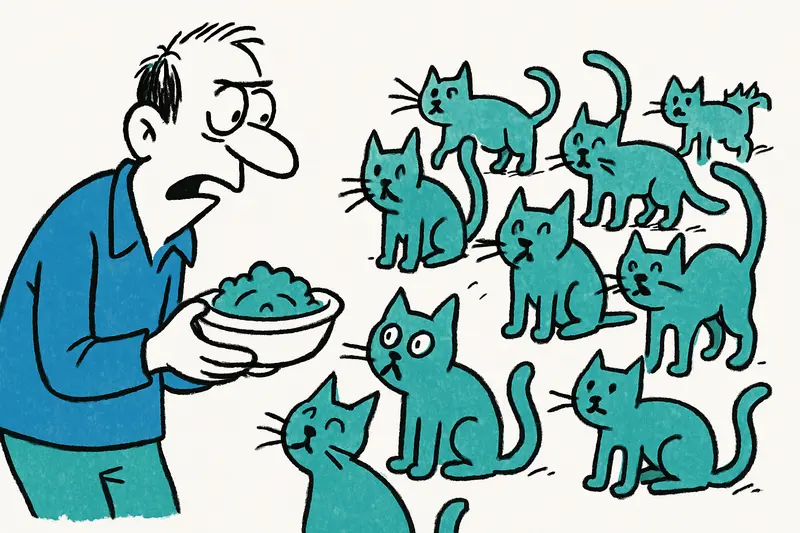
When the 'mümmels' are no longer manageable: Stray cats at Ballermann and what to do now
Residents near Playa de Palma report rapidly growing cat colonies. Between vacant lots, beach bars and the highway, feeding spots, lack of neutering and unclear responsibilities cause disputes. A humane, coordinated strategy with TNR campaigns, hotspot mapping and clear rules for those who feed could be the solution.
Between chair-clattering and gull cries: The cat colonies are growing — and nobody feels properly responsible
When the beach bars stack their chairs early in the morning and the cleaning crews sip their first coffee at Playa de Palma, the cat migrations begin along the embankments. Groups of animals, sometimes 5, sometimes 20, appear — between badgers, vacant plots and the highway toward Llucmajor. Residents who have lived on the coast for years say: it has become noticeably faster in recent months, as reported in Residents' complaints about cats at Ballermann.
The central question: How do you prevent compassion from becoming a colony?
The problem is not purely an animal control issue, but a social puzzle. People bring food scraps — out of pity, out of habit, because they seek a piece of home abroad. Some residents in makeshift accommodations in Can Pastilla or Las Maravillas set up permanent feeding spots to prevent hunger. That is understandable. But these very spots act like magnets: they enable colonies, increase reproduction rates and create conflicts with neighbors.
The consequences are concrete: increased droppings on paths, nighttime territorial fights with loud squabbling, traffic accidents when a cat crosses the road — and a neighborhood that grows weary because morning hygiene and sleep are disturbed. Many do not call for drastic measures, but for control and responsibility. The guiding question remains: Who takes responsibility — the city, animal welfare organizations, or the feeders themselves?
What is often overlooked
Two things are seldom discussed in public debate: first, the role of social poverty and homelessness as drivers of feeding, and second, the organizational hurdles faced by small animal welfare groups. People who travel outside the city to feed cats often seek human contact as well. Those living in precarious housing set up fixed spots out of care. At the same time, many local protection groups simply lack the funds for large neutering campaigns — and coordination with the Ayuntamiento is sluggish.
Another blind spot: feeding stations run without rules attract not only cats but also rats if not kept clean. This brings hygiene into focus, and neighborhoods quickly feel overwhelmed.
Concrete, humane solutions — and why they could work
One path is TNR (Trap-Neuter-Return) — trapping, neutering, returning. Technically proven, effective and comparatively inexpensive if organized. But TNR needs structure: mobile neutering actions, priority-setting for hotspots and a database of who feeds where.
Proposal for a pilot project at Playa de Palma:
1. Hotspot mapping — Use community lists from neighborhoods to map hotspots. The photos and reports neighborhood groups are already collecting are worth their weight in gold.
2. Mobile neutering clinic — A vehicle or temporary station supported by municipal grants and veterinarians offering low-cost surgeries. Student help from veterinary departments could assist.
3. Registered feeding stations — Instead of bowls everywhere, establish a few controlled feeding spots: with wind protection, waste containers and clear cleaning rules. Those who feed must be registered and take responsibility.
4. Education and social work — Training for feeders, raising awareness about hygiene and, instead of fines, prefer social work that offers alternative support — for example for people in precarious accommodation.
5. Transparent targets — Measurable KPIs: reduction of unneutered animals by X percent within a year, fewer complaints about noise or droppings, fewer traffic accidents in affected sections.
What the city must do — and what the neighborhood can contribute
The city administration can initiate programs, but it needs local backing: volunteers to care for feeding spots, local businesses providing spaces for mobile clinics, and clear communication. Neighborhoods, in turn, must be willing to accept uncomfortable truths — for example, that short-term feeding worsens the long-term problem.
An example from other regions, such as Llubí's ordinance requiring cat neutering and pet limits, shows: if all parties cooperate, colonies can be stabilized and conflicts significantly reduced. In Mallorca this could mean: fewer cats dashing across the road, less nighttime quarrelling and cleaner paths — without cruel methods being used anywhere.
It takes courage to coordinate and a bit of neighborhood spirit. If the bowls keep being left out, the whole community will ultimately pay the price — in noise, hygiene and quality of life.
Frequently asked questions
Why are stray cats becoming a problem in Playa de Palma and Ballermann?
What is the most humane way to control stray cats in Mallorca?
Is it a bad idea to feed stray cats in Mallorca?
What problems do stray cat colonies cause for residents in Mallorca?
Who is responsible for stray cats in Mallorca — the city or animal welfare groups?
What would a stray cat pilot project at Playa de Palma look like?
Why do unregulated feeding stations attract rats in Mallorca?
What can residents in Mallorca do if they want to help stray cats responsibly?
Similar News

When the Wallet Becomes a Danger: Attack in Peguera and Lessons for Mallorca
In Peguera, two women are said to have stolen the wallet from a 75-year-old German couple. When the victim intervened, t...
Plata stays Plata: Young people take over, Llonguets remain
A small bar on Carrer de l'Argenteria will continue: Tolo Serra hands the place over to young Mallorcans at the end of t...

Unnoticed in the Luggage Compartment: How a Boy Traveled More Than 100 Kilometers in a Team Bus
A minor traveled in the undercarriage of a team bus for more than 100 kilometers until his cries for help were heard. A ...

Cap Vermell Grand: Second Michelin Key – a Gift for the East
The Cap Vermell Grand in Capdepera has been awarded its second Michelin key. For the region this elevates the luxury off...
Eurowings lets four aircraft carry names – a friendly idea that also reaches Mallorca
Eurowings is launching a campaign: four Airbus A320s are to carry the first names of people who help others in everyday ...
More to explore
Discover more interesting content

Can Cap de Bou

Townhouse Lleo 72
