
Water salute goes awry: Iberia A350 collides with fire truck monitor arm in Guayaquil
Water salute goes awry: Iberia A350 collides with fire truck monitor arm in Guayaquil
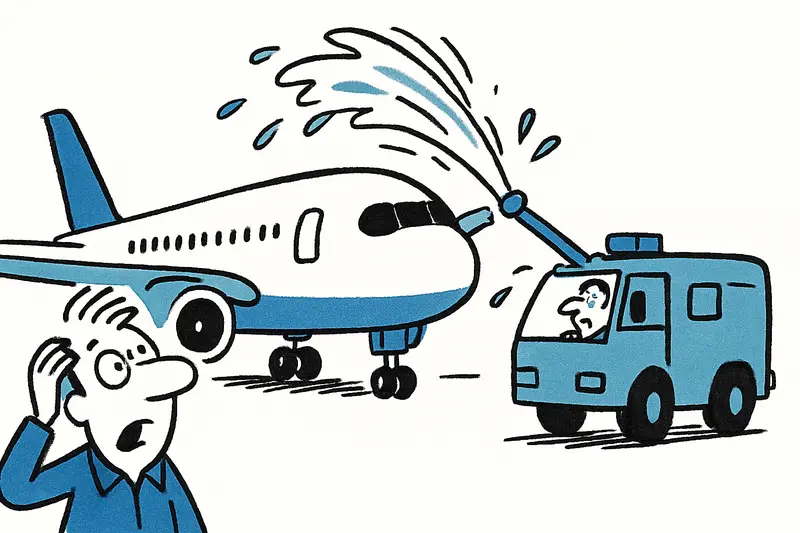
During a water salute in Guayaquil an Iberia Airbus A350 (EC-NXD) passed under the water arch and its left wingtip struck the monitor arm of a fire truck. No injuries were reported, but the flight to Madrid could not depart as planned.
Water salute goes awry: Iberia A350 collides with fire truck monitor arm in Guayaquil
Guiding question: How safe are these honorary salutes — and what rules apply when a larger aircraft is operated on a route for the first time?
On Thursday, June 4, something went wrong at an airport in Ecuador that is normally carried out solemnly and routinely: an Airbus A350 of the Spanish carrier Iberia, registration EC-NXD, taxied under a water arch produced by two airport fire trucks. As it passed through, the left wingtip grazed the monitor arm of one vehicle. All passengers and crew were unharmed, but the jet could not operate the scheduled flight IB132 to Madrid and remained grounded for the time being.
Water salutes are an established tradition in aviation. They celebrate a new route, the introduction of an aircraft type on a route, or notable service anniversaries. Two vehicles face each other, spray arches of water, the aircraft slowly taxis through and cameras click. It is charming. But charm is not safety management.
My guiding question therefore remains: Are such ceremonies always planned on a case-by-case basis — and do they actually take into account the dimensions, maneuverability and movements of the specific aircraft? An A350 has different wing dimensions and winglets than an A330-200. If a route previously served by A330s suddenly receives an A350, the starting point for ground maneuvers and clearance requirements changes.
Critical analysis: In the video circulating on social media you can see the jet's nose initially pass under the water arch unharmed. Contact with the monitor arm occurs as the wings pass. This points to three possible weaknesses: insufficient spatial calculation before the salute, inadequate communication between cockpit, ground staff and the fire brigade, and the absence of simple rules of thumb for lateral and vertical clearances for different aircraft types. None of these elements is a mere technical detail; they arise in day-to-day ground operations — at check-in, during push-back and in the final coordination before taxiing. Incidents such as Smoke in airplane toilet: Guardia Civil intervened after landing in Palma illustrate these operational consequences.
Public discussion often overlooks who is responsible for the concrete risk assessment. Is the airport fire service automatically involved in the planning, or does the decision rest solely with the station manager of the airline? What role does air traffic control play, and are there binding minimum clearances that must be observed when different aircraft types are involved? Transparency is also lacking in follow-up: How quickly is a damaged aircraft inspected, who decides on technical releases, and how are affected passengers informed? Local reporting like Water chaos in Terminal C: Who protects the pipes — and passengers? has highlighted similar questions of accountability.
A scene from Palma: Early in the morning I stand in a café on Passeig Mallorca, hear the hum of buses to Son Sant Joan airport and watch suitcases clattering along the pavement. People here know the frustrations of flight disruptions: appointments, family visits, reservations — everything depends on on-time departures. Such disruptions were documented locally in Hydraulic Leak in Palma: Blue Lights, Questions and What Should Happen Now.
Concrete proposals that could make a difference: First, mandatory checklists before any ceremony that take aircraft type, wingspan and fire vehicle positioning into account. Second, a mandatory briefing involving the pilot, the station manager and the airport fire service commander. Third, distance sensors on monitor arms or simple markings on the apron to visualize minimum clearances. Fourth, when a new aircraft type is introduced on a route, the first rollout should be conducted without a public salute — i.e., a trial operation under real conditions without added risks. Fifth, clear communication channels for passengers if a flight cannot depart; transparent information reduces anger and speculation.
What is often missing from the public debate is attention to small organizational levers: three extra minutes of coordination at the gate cost nothing but can prevent damage. Equally underappreciated is the difference between tradition and operational safety. Celebrations are fine, but not at the price of avoidable risks.
Punchy conclusion: The incident in Guayaquil does not indicate the exclusive failure of one person, but a gap in the interaction between ceremony and operational reality. Anyone watching at Mallorca airport as pilots board, passengers wave and fire trucks park should wish for: less show, more checklist. That way the images remain beautiful — and the aircraft undamaged.
Frequently asked questions
What is the weather usually like in Mallorca in spring?
Is Mallorca warm enough to swim in early summer?
What should I pack for a trip to Mallorca in autumn?
Is Mallorca a good destination for walking and hiking outside summer?
What is Alcúdia like for a beach holiday in Mallorca?
Is Palma de Mallorca a good base for a city break?
What is Sóller like for visitors to Mallorca?
When is the best time to visit Mallorca for good weather and fewer crowds?
Similar News

Short Getaway with Sea View: Inmood Aucanada among Spain's Top Hotels for Dinner Breaks
A small hotel on the coast of Alcúdia was highlighted by a Spanish experience platform as particularly suitable for shor...

Cala Pi crowned Mallorca's most beautiful beach: A morning at the rocky cove
The travel portal Holidaycheck praises Cala Pi as Mallorca's most beautiful beach: a narrow, romantic cove, clear water,...
Injured captain, big plans: Germania Mallorca before the away match in Consell
The newly founded FC Germania Mallorca travels to Consell on Saturday. Captain Bastian Müller is out injured, but coach ...
Palma, Palma de Mallorca, Palma‑Mallorca: What is it really about?
The debate over the city's name is more than grammar: it concerns identity, law and branding policy. A sober reality che...
Warning to Bathers: Nipping Fish in Cala Major and Other Coves — a Reality Check
In Cala Major and several beaches around Mallorca, bathers report painful “nips”. Who are the animals, why are they gett...
More to explore
Discover more interesting content

Can Cap de Bou

Townhouse Lleo 72
