
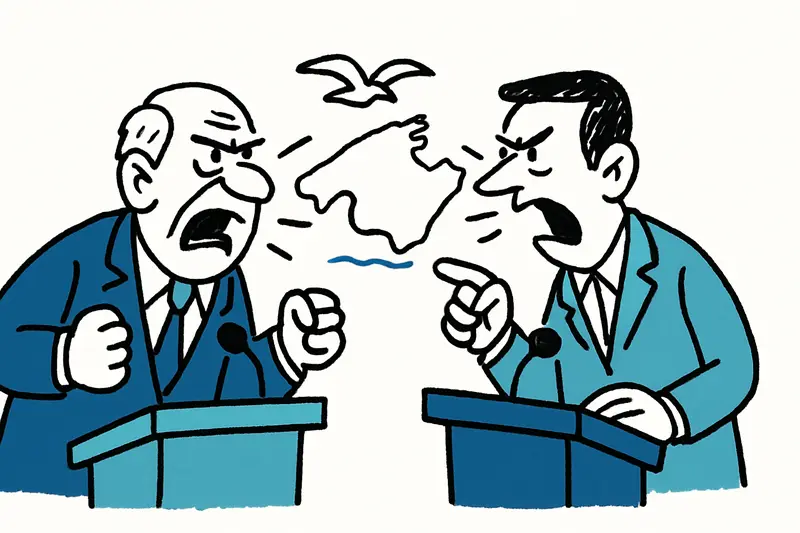
When Diplomacy Gets Loud: Why the Dispute Between Washington and Madrid Also Affects Mallorca
When Diplomacy Gets Loud: Why the Dispute Between Washington and Madrid Also Affects Mallorca
US president versus Spanish government: the clamor from Washington hits more than just Moncloa. Key question: What consequences does the escalation have for the island and how can it be mitigated?
When Diplomacy Gets Loud: Why the Dispute Between Washington and Madrid Also Affects Mallorca
Key question: What consequences does the verbal exchange between Washington and Madrid have for Mallorca — and how can the situation be calmed?
On the Paseo Mallorca, near the town hall, the city bus rolls by, seagulls cry out, and on a cool March evening light still flickers in the cafés: Palma feels this normal, despite the reports coming these days from the capital and overseas; see Merz in Madrid: Why political differences with Sánchez are also felt in Mallorca.
What is it about? In short: Madrid has made it clear that it will not support military operations it considers wrong. Embedded in this political reaction is a fundamental conflict about responsibility, alliance obligations and the deployment of forces. From Washington comes sharp criticism: among other things, accusations of insufficient loyalty within the alliance and too-low defense spending. The debate centers on whether states in the alliance are obliged to cover all military operations militarily — or whether there is room for political and moral reservations (see Trump threatens NATO expulsion: What Spain's defense row means for Mallorca).
What is missing in the public debate? First: a sober risk assessment for the island. Many people here earn their living from tourism, ports are located here, and merchant ships and occasional naval units regularly call (Who Owns the Island? Sánchez Brings the EU into Play Against the Second-Home Boom). The possibility of economic countermeasures against Spain is often cited only as a political threat; hardly anyone explains concretely which sectors in Mallorca would be most vulnerable and how quickly that would show. Second: little attention is paid to the role of regional governments. The Balearic government and municipal authorities must answer practical questions in a crisis — from supply chains to information policy toward visitors — as discussed in Why Palma's 'Persona non grata' Resolution Raises More Questions Than Impact.
Critical analysis: The tone from Washington creates two problems. On the one hand, it narrows the debate to a simple dichotomy: team player or outsider. That is politically convenient but strategically shortsighted. States make decisions for complex reasons — domestic political stability, international reputation, legal assessments of operations. On the other hand, there is a lack of a coordinated European response: if Madrid decides differently, the burden falls to other NATO partners. That can increase tensions within the EU and, in the long term, hamper the ability to act together.
An everyday scene in Palma shows how close the issue is: at the harbor fishermen and tour guides sit and discuss possible effects on the season. A restaurant owner at Cala Major says half-jokingly that he fears fewer British guests — but really means economic uncertainty. Such conversations reflect that international politics ultimately arrives in small incomes.
Concrete approaches: First, more transparent communication. Madrid, Washington and Brussels should clearly explain which scenarios would lead to which measures — and what is excluded. Second, an EU-NATO forum in which political differences over deployments are debated in a structured way, instead of being played out in public blame games. Third, regional emergency plans: the Balearics should now examine how supply chains, airports and ports can be protected in times of political tension. Fourth, defense spending must not be the sole yardstick; qualitative contributions and logistical support should be given greater recognition.
What is missing from the public discourse is pragmatism: the question should not be who is morally on top, but how alliance partners deal with each other responsibly without ignoring local vulnerabilities. Civil society on the islands must also have a seat at the table — business owners, port operators, care homes: they all have an interest in stable lines of communication.
A final look outside: sometimes an aircraft carrier lies in the Bay of Palma, the sea is calm, the cathedral bells mingle with the cries of the seagulls. The idyll is sensitive to big political scenes, but it is not powerless. With clear crisis management, regional preparations and honest communication, loud diplomacy can be turned into something manageable.
Conclusion: The public dispute between Washington and Madrid is more than an exchange of words. It touches real livelihoods on Mallorca. Instead of public accusations there is a need for transparent scenarios, European coordination and local protection plans — only then can the island be taken out of the line of fire.
Frequently asked questions
How could the dispute between Washington and Madrid affect Mallorca?
Could a political dispute with the US affect Mallorca’s tourism season?
Why are Mallorca’s ports mentioned in discussions about Spain’s political tensions?
What could local authorities in Mallorca do if international tensions escalate?
Is Mallorca at risk of supply chain problems if Spain comes under pressure?
What would a dispute between Washington and Madrid mean for NATO and Mallorca?
What does the situation in Palma say about how Mallorca reacts to international politics?
Can Mallorca do anything to reduce the impact of political tensions abroad?
Similar News
Palma, Palma de Mallorca, Palma‑Mallorca: What is it really about?
The debate over the city's name is more than grammar: it concerns identity, law and branding policy. A sober reality che...
Warning to Bathers: Nipping Fish in Cala Major and Other Coves — a Reality Check
In Cala Major and several beaches around Mallorca, bathers report painful “nips”. Who are the animals, why are they gett...

Rental Car Theft in El Arenal: What This Incident Reveals About Our Gaps
A teenager steals a running rental car in El Arenal, flees on foot, climbs over walls and is caught by the Guardia Civil...

Red Rope in Palma's Library: What Helps Against Selfie Tourism — and What's Missing
Palma's city library cordoned off an area with a red rope to keep selfie tourism away from reading and working activitie...
Fort San Carlos: Museum, Harbor Dispute — and a Conflict That Demands Answers
The military museum at Fort San Carlos sits right on Palma's harbor, with unexpectedly quiet rooms filled with cannons a...
More to explore
Discover more interesting content

Can Cap de Bou

Townhouse Lleo 72
