
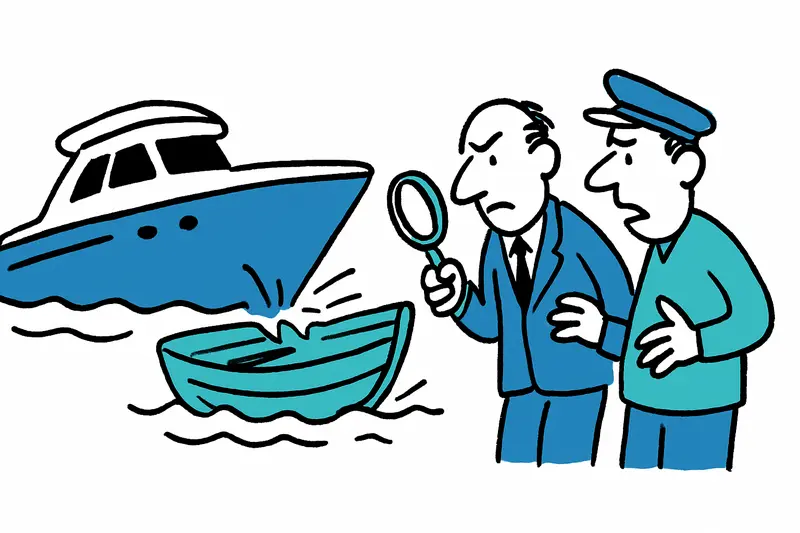
Who is responsible — and what is missing: The case of the collision off Cala Bona under legal scrutiny
In August 2024 a 21-year-old angler died off Cala Bona; investigations have since targeted the German skipper of the yacht “La Luna”. Our reality check asks: What can actually be proven legally, and which safety gaps remain unaddressed in the debate?
Who is responsible — and what is missing: The case of the collision off Cala Bona under legal scrutiny
Key question: Who could have prevented the collision on 23 August 2024 — and what evidence does a court need to determine this?
It was one of those hot summer nights after which, in the morning, you can see the nets at the Cala Bona pier, fishermen with coffee on the harbor wall, and the crash of waves and engines. On 23 August 2024 the nearly 21‑metre yacht “La Luna” collided with a small open boat of about 3.2 to 3.4 metres. The 21‑year‑old Mallorcan Guillem Comamala died in the accident. Two years on many facts have been established, but the legal decision remains complex.
In short, the following core points currently stand: Investigators from the Guardia Civil see a form of gross negligence on the part of the German skipper; the vessel is said to have been travelling at around 25 knots and there was a lack of necessary attention in the cockpit. The defence confirms approximately the same speed, but assesses it as typical and harmless for this type of vessel and stresses that there was no legal speed limit at the accident site at the time. In addition: the small boat apparently had no required all‑around lighting — which greatly reduced its visibility in the dark.
Critical analysis
A court must not judge here by numbers alone. Two technical problems make the matter difficult: yachts of this class do not have a “black box” that logs every course and speed value; the Guardia Civil’s reconstruction is based on data, trace analysis and simulations. There are two relevant reconstructions that provide different perspectives: one analysis gives time windows of seconds within which an evasive manoeuvre might have been possible; a re‑enactment in June using a roughly 20‑metre police launch as a stand‑in produced visibilities that, depending on lighting, ranged between about 146 metres and more than 1.6 kilometres. This range shows how strongly results and interpretation depend on the chosen model.
The defence exploits this: 24.7 knots are presented as technically plausible and not per se criminal behaviour. The investigators counter that even at an admissible speed there was a duty of appropriate vigilance — that is, the question whether lookout, watchkeeping and reaction met the standard of a responsible skipper.
What is missing in the public discourse
The media discussion quickly focused on blame and on the person of the skipper — origin, wealth and lifestyle made headlines. Much less discussed was: How reliable are today’s reconstructions without permanent recording devices? What minimum equipment and duties apply to yachts of this size at night off the coast? How often does the coast guard actually check the lighting of small boats at night? And: which standardized re‑enactment methods apply so that measurements are comparable?
There is also a lack of sober consideration of identifiable traces at the accident site: marks in the hull, paint abrasion, the position of rudder and engine at the moment of collision — all of which often decide whether an evasive manoeuvre was still possible.
Everyday scene in Mallorca
On a late summer evening in Portocolom you can see the large yachts lying at their moorings, crew with lamps on the jetty, fishermen hauling small boats ashore. People here know the risks: anglers who hunt for squid at night have done so for generations — but they do it with lanterns, experience and often a second person at the stern acting as lookout. If a small boat is out without lights, the old timers say, it is like cycling without a rear light on the Passeig des Born — an invitation to disaster.
Concrete solutions
Those who want such incidents to happen less often should shift the debate from questions of blame to prevention. Some possible measures:
- Mandatory equipment of large private yachts above a certain length with a simple voyage data recorder or a speed/course log that retains several hours and can be read out for court purposes.
- Clear night cruising zones and speed limits close to the coast for night operations, combined with more visible buoy markings.
- Stricter checks of small recreational boats for lighting and equipment, especially during the high season; increase mobile night patrols.
- Simple technical aids for small boats: mandatory radar reflectors, affordable all‑round LED lights and information campaigns for hobby fishermen.
- Standardized methods for reconstructions: uniform checklists, documented re‑enactments and independent expert assessors so courts can reliably compare findings.
- Expansion of awareness‑raising: harbour masters, boating schools and tourist offices should actively promote night‑time safety.
These proposals are partly technical and partly political. They require money, controls and a debate in Mallorca that does not dissolve into personal attacks.
Punchy conclusion
The case off Cala Bona will be decided in court — with experts, specialists and conflicting models. But even if the proceedings take months or years, one simple, bitter insight remains: technology, rules and vigilance must work together. An unlit boat is dangerous. A fast yacht without systematic watchkeeping can be too. The justice system can assign guilt, but the island could also learn from the tragedy: mandatory recordings, stricter controls and a sober discussion about night‑time safety standards would actually save lives — that is the question we must ask now.
Frequently asked questions
When is the best time to visit Mallorca for sunny weather and outdoor activities?
Is it safe to swim in Mallorca’s seas and beaches?
What should I pack for a Mallorca trip to cover different activities?
Which areas around Palma are good for day trips?
What outdoor activities are popular in Mallorca for active travelers?
How does Mallorca's climate vary across the year, affecting beach days?
Are there family-friendly options for a Mallorca holiday?
Is Alcúdia a good base for exploring Mallorca's north coast?
Similar News
8,000 People in Santa Ponsa: Who Thinks About Safety, Traffic and the Environment at Mallorca's Sky Spectacles?
The Guardia Civil's overflight video shows tightly packed people under beach umbrellas in Santa Ponsa. The scene was imp...
Reality Check After the Eclipse: What Mallorca Needs to Learn from the Night
The total solar eclipse was a spectacle — and at the same time a stress test for Mallorca's infrastructure, environmenta...

Sky show over Mallorca: How we will experience the total solar eclipse on August 12
A hot August evening, a special flight above the cloud cover and dozens of viewing spots across the island — the total s...
Solar Eclipse Stress Test for the Island: How Mallorca Reached Its Limits on Wednesday
The partially or fully expected solar eclipse threw the west coast into disarray: packed viewpoints, closed access roads...
Deià Rations Water: Who Pays the Price for Luxury?
Due to extreme drought, Deià will impose water shutdowns three times a week from August 14. The Hotel La Residencia and ...
More to explore
Discover more interesting content

Boat Tour with BBQ along Es Trenc Beach

Private transfer from Mallorca Airport (PMI) to Pollensa
