
Why does the MA-10 keep sending vehicles over the edge? One case, many questions
Why does the MA-10 keep sending vehicles over the edge? One case, many questions
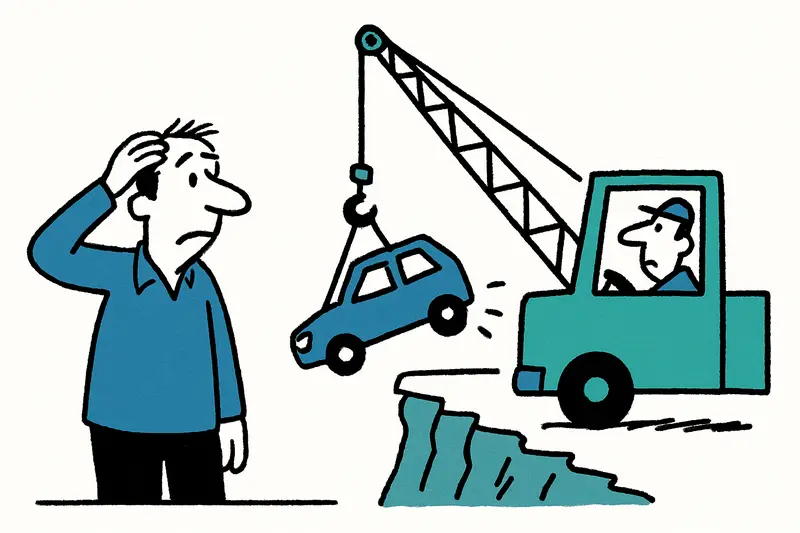
A truck slid down the embankment at Port d'es Canonge, its cab half pressed into the ground. The driver was uninjured. Why are such accidents accumulating on the MA-10 — and what needs to change?
Why does the MA-10 keep sending vehicles over the edge? One case, many questions
Key question: What components are missing so that one of Mallorca's most beautiful roads does not continue to become an accident trap?
Late in the afternoon it was already dusk when a lorry on the narrow coastal passage at Port d'es Canonge left the roadway and slid several meters down the embankment. The cab struck the ground so hard that, according to eyewitnesses, it was pressed almost half a meter into the soil. Remarkably, the driver was able to exit the vehicle unaided. Recovery could not be completed in the dark; the following morning the Guardia Civil, the local police and a large crane from the company Pol arrived to lift the truck from the ravine. Three anchoring points and a heavy strap were sufficient, and the vehicle was finally returned to the MA-10.
The image of the crashed vehicle in the middle of the Tramuntana slopes stayed in the minds of many residents. On the terrace of the small café on the edge of Banyalbufar people spoke quietly about it while the wind from the sea rustled the olive trees. A pile of gravel, a distant tractor horn, the clack of a crane winch: such small things make up everyday life here — and at the same time show how close danger and the ordinary lie together.
In short: a spectacular accident, a fortunate outcome for the driver — and yet this is only the latest episode in a series of incidents at this very spot. In past years vehicles have fallen many meters on the MA-10; some accidents were fatal, others resulted in minor injuries. The pattern is worrying, as other incidents such as the MA-10 under scrutiny: Head-on collision between intercity bus and delivery truck near Esporles demonstrate.
Critical analysis
On the MA-10 tight curves, steep drops and occasionally poor visibility come together. Where space is scarce, lane widths quickly become a test of nerve. Heavy vehicles on narrow stretches, combined with dusk, gusts of wind or wet roads — that dramatically increases the risk. Human factors add to this: fatigue, underestimating the route, unfamiliarity with the local topography. Technical protection measures such as guardrails are not present everywhere or offer only limited protection against a multi-ton vehicle that leaves the lane.
The recent recovery operation shows something else: the rescue was possible, but elaborate. A large crane, multiple emergency personnel and a full working day were needed to stabilise the situation. That costs not only money, but ties up resources of the Guardia Civil and local services — time that is then missing elsewhere, as happened during the Crash on the MA-10: Bus collides head-on with a truck — What does this say about our roads?.
What is often missing from public debate
Too often, after an accident the discussion focuses on individual driving behaviour as if that were the sole cause. There is little public discussion about structural shortcomings: missing or inadequate guidance systems, unclear weight restrictions for heavy vehicles, insufficient visibility markings at night, no systematic risk maps for lorry drivers. It is also rarely discussed how roadworks, temporary traffic arrangements and tourist peak times interact. The question of whether certain sections should be permanently restricted for heavy commercial vehicles is hardly debated openly, and incidents such as the Serious Head-On Crash in Paguera: Why Does the MA-1 Remain So Dangerous? raise similar questions about lighting, enforcement and road layout.
An everyday scene that makes the problem tangible
Imagine this: a minibus squeezes around a sharp bend, a delivery van parks half on the hard shoulder, and behind the next rock a tractor-trailer appears — suddenly everyone is forced to brake or swerve. At the Banyalbufar market a hundred meters away vendors exchange glances when another crane rolls by; this is now as familiar as the smell of coffee and freshly baked ensaimada. These small scenes show that the problem is not an abstract statistic but affects daily mobility.
Concrete solutions
1) Review traffic restrictions for heavy vehicles: Orders to close certain sections temporarily or permanently to lorries above a defined tonnage would be an immediately effective measure. 2) Supplementary technical protection measures: Where space allows, robust guardrails, crash cushions and additional restraint systems could be installed. 3) Improve visibility and guidance systems: Reflective markings, better lighting at critical points and clearly visible warning signs before tight curves reduce surprises. 4) Digital risk information for drivers: Feed maps into navigation systems that mark narrow sections and recommend alternative routes to freight operators. 5) Regular risk audits: Independent inspections and simulations in cooperation with the municipality, police and drivers to identify hotspots.
Why it is worth acting now
One measure alone is not enough. A combination of traffic regulation, structural changes and awareness raising makes sense. Anyone travelling the MA-10 — locals, tourists, professional drivers — benefits from clearer rules and visible protective measures. Fewer accidents mean fewer costly recoveries, fewer blocked roads and above all less risk to human life.
In the end a striking image remains: the small coastal road connects places, people and work. It is part of island life, but it is also a danger zone. When the tractor coupling clicks at the market and the west wind blows, the road should not become a lottery. It is about creating safe conditions — and that is possible if authorities, police and residents work together.
Conclusion: The truck accident at Port d'es Canonge is not an isolated incident but a warning signal. Instead of looking for culprits, we must look at the road itself: technical safety measures, clear rules for heavy vehicles and better information for all road users. Otherwise the MA-10 will continue to produce stories no one wants to tell.
Frequently asked questions
Why is the MA-10 in Mallorca considered such a dangerous road?
What makes truck accidents on the MA-10 more likely?
Is the MA-10 safe to drive in Mallorca at dusk or in bad weather?
What should drivers know before taking the MA-10 in Mallorca?
What happened in the truck accident at Port d'es Canonge on the MA-10?
Why do accidents on the MA-10 in Banyalbufar and nearby villages cause so much concern?
What safety improvements are being discussed for the MA-10 in Mallorca?
Should lorries be restricted on parts of the MA-10 in Mallorca?
Similar News
Fewer Airlines, Fewer Destinations: What Palma's Winter Flight Schedule Means for Mallorca
Analysis shows: Winter at Son Sant Joan Airport will be quieter, with significantly fewer airlines and destinations. Who...
German tourist dies in Sa Calobra – a reality check for emergencies on Mallorca's beaches
A 40-year-old tourist died at the Torrent de Pareis. The emergency call, a doctor who happened to be present, a defibril...
Deadly Tractor Accident in Bunyola: What Needs to Be Done Now
In a work accident on an estate near Bunyola, a roughly 40-year-old man lost his life. His wife and a small child were o...
Head-first dive into the shallow part of Cala Fonoll: An accident and the unresolved question of responsibility
A young tourist dove into Cala Fonoll and was seriously injured. Key question: Why are clear warning signs missing at da...
Mistaken identity with fatal consequences: Brutal assault in S'Aranjassa — what's missing in the follow-up?
At S'Aranjassa a visitor to a finca was tied up, beaten and thrown out of a van. Three men have been arrested, including...
More to explore
Discover more interesting content

Can Cap de Bou

Townhouse Lleo 72
