
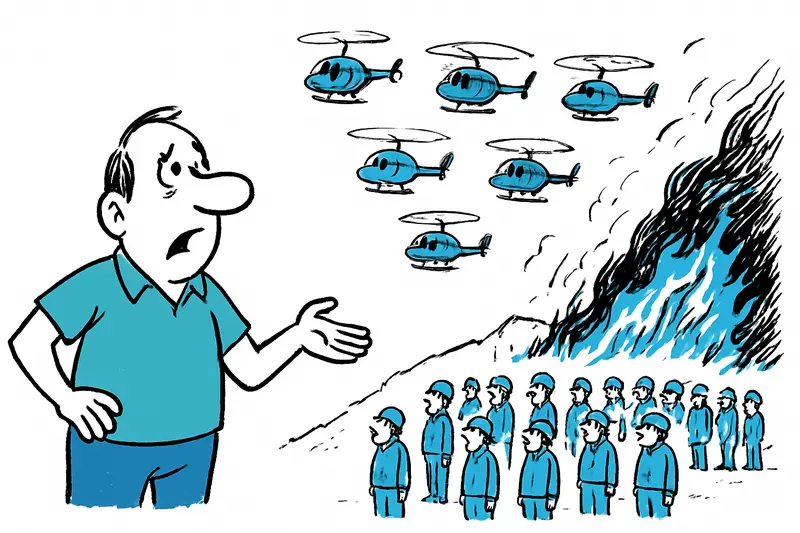
Fire in the Tramuntana: Nine helicopters, 27 firefighters — is that a sufficient response?
Fire in the Tramuntana: Nine helicopters, 27 firefighters — is that a sufficient response?
A fire flared up in Puigpunyent on Monday evening. Air support with nine helicopters and planes and 27 ground personnel helped contain the blaze. A reality check: what can the response chain achieve — and what is missing in prevention?
Fire in the Tramuntana: Nine helicopters, 27 firefighters — is that a sufficient response?
A reality check after the fire at Son Fortesa (Puigpunyent)
Leading question: Is the rapid deployment of aircraft and the small ground contingent enough to permanently control the new fire risks in the Tramuntana?
On Monday evening a fire broke out at Son Fortesa on the western slope of the Serra de Tramuntana that quickly demanded the attention of the incident command. Within a short time nine helicopters and water-dropping aircraft were operating over the burn area, and up to 27 specially trained wildland firefighters worked on the ground — including four operational specialists and personnel from the environmental agency Medi Ambient — supported by three fire engines. Around 9:45 p.m. the forces reported the situation as stabilised; a night watch of roughly 25 people remained on site.
This is rapid, visible help. The aerial operation is impressive: the thrum of rotors over the ridges, the splashing of water drops, the bright searchlights as machines prepare to land, a scene reminiscent of the Dramatic Helicopter Rescue at Puig Major: Lessons from an Afternoon in the Tramuntana. For residents of Puigpunyent and those on the MA-10 it is an image seen increasingly often in hot summers — and it raises the question whether reactive operations alone are sufficient.
Critical analysis: Air support is expensive and acts quickly, but it does not permanently replace ground presence and prevention. Nine aircraft send a strong signal, yet if only a few dozen people can secure the night, vulnerability remains high. The Tramuntana is steep and difficult to access: paths are narrow, water extraction points scarce, and the heat-dried undergrowth ignites quickly. Such conditions test any response strategy.
The public debate often lacks discussion of permanent risks: it is not enough to react when alarms sound. Less visible are questions about maintaining firebreaks along road edges, regularly removing stacked wood and brush on private properties, establishing permanently available water reservoirs in strategic locations, and clear, locally anchored evacuation plans for small villages. Similar roadside fires have occurred elsewhere, such as the Field fire near Manacor: What the operation on the Ma-15 reveals about Mallorca's fire risk.
An everyday scene: residents in Puigpunyent reported an evening when the smoke tasted in the air, the lanterns in the village square flickered, and helicopters circled the Tramuntana like large dark birds. Doors stayed open because the kitchen heat pressed through; cats sought shade under cars; an old farmer drove by in his pickup, stopped briefly, looked up to the mountains and shook his head. Such looks speak louder than any statistic: people here live with the risk — and with the expectation that help will come when it burns.
Concrete approaches (not just appeals): 1) Link early warning systems: AEMET weather data, local sensors and drones can together supply thresholds that automatically raise prevention measures. 2) Significant investment in permanent water reserves at critical points in the Tramuntana — cisterns that can be refilled independently of the power grid. 3) Expand local, seasonal readiness: more registered, trained volunteers with specialised equipment and clear deployment pathways. 4) Regular maintenance of protective strips along key access roads such as the MA-10 and immediately around hamlets; this reduces the speed of advancing flames. 5) Public information campaigns with clear behaviour rules during heat periods — and binding bans on barbecues and open fires in high-risk times. The need for better protection was underscored by the Field fire in Inca: An injured firefighter and the question of better protection.
What helps in the short term: better permanent coordination between Medi Ambient, IBANAT and local municipalities so resources (water, vehicles, teams) can be pre-positioned before major incidents arise. This echoes concerns raised after the Wildfire in s'Albufera: Six Fires Quickly Extinguished — but Questions Remain. In the medium and long term it is about landscape management: less fuel, more structured access points for responders, and a different awareness of privately owned mountain land.
Concise conclusion: The operation in Puigpunyent showed that Mallorca can react quickly and decisively — nine helicopters are not a given. But jets fighting fires are no substitute for lived prevention. People in the Tramuntana villages do not only want night watches; they want daytime measures that prevent larger flare-ups. Son Fortesa was a warning signal. It should finally be taken as an occasion not only to extinguish, but to prevent.
Frequently asked questions
What is the best time of year to visit Mallorca for good weather and reasonable crowds?
Is Mallorca a good place for swimming and beaches?
What should I pack for a Mallorca trip?
What is the easiest way to get around Mallorca without a car?
Are there family-friendly beaches and towns to visit in Mallorca?
What are some must-see towns or villages to visit in Mallorca?
What language and currency should I know about when visiting Mallorca?
Are there good hiking or cycling options in Mallorca, and when should I go?
Similar News

Adrien Brody strolls through Mercat de l'Olivar – celebrity visit leading to Sa Pobla
Actor Adrien Brody was casually spotted at the Mercat de l’Olivar: tapas, fish stalls and later a stop in Sa Pobla spark...
Who can pick up whom? The complicated life of Mallorca's taxis
Three years after the inter-municipal service, empty runs are rarer — but there is a lack of equal treatment, transparen...

When the Tap Only Runs Sometimes: Why Municipalities in the Balearic Islands Are Now Rationing Water
Deià, Valldemossa, Esporles, Sóller and several places on Menorca are scaling back water supply. Who is responsible, why...

Battle for the Ramp: Why Cala Gamba Needs More Than Enforcement
The Guardia Civil intervened in Cala Gamba — residents breathed a sigh of relief, but unease remains. Key question: Are ...

He dances at the Duty-Free: How an airport employee brings a smile to Palma
A Duty-Free employee at Palma Airport created a viral TikTok with dancing breaks. Why the scene is more than just an int...
More to explore
Discover more interesting content

Boat Tour with BBQ along Es Trenc Beach

Private transfer from Mallorca Airport (PMI) to Pollensa
