
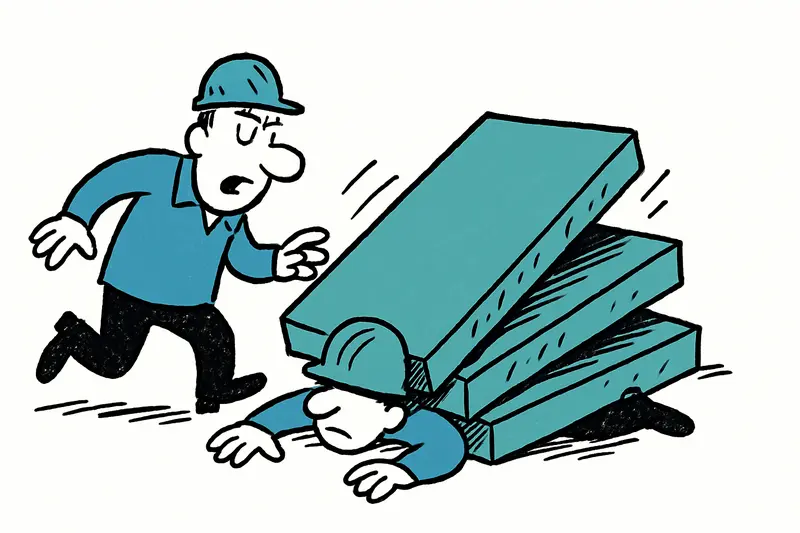
Concrete stacks in Santa Margalida: When the safety chain fails
A 57-year-old worker died after several heavy concrete slabs toppled in a factory street. The Guardia Civil is investigating — but the debate must go on: why does protection fail when routine becomes danger?
Concrete stacks in Santa Margalida: When the safety chain fails
On Tuesday afternoon the quiet factory street in Santa Margalida briefly turned into a scene of horror. At around 3:00 PM emergency services were called: several heavy concrete slabs had toppled and buried a 57-year-old worker. The man, an employee of the company, died at the scene, as reported in Fatal accident in Santa Margalida: concrete slabs bury worker – calls for improved workplace safety.
Colleagues immediately called the emergency services and tried to rescue the man. Fire engine sirens shrieked through the narrow alley, the voices of the rescuers mixed with the distant ringing of the village church and the occasional honk of a delivery van. Despite the rapid arrival of police, the Guardia Civil, several fire units and ambulances, help came too late. Later an on-duty judge and a forensic doctor arrived to assess the situation.
The key question: Why did the safety chain fail?
The Guardia Civil has taken over the investigation; more context on safety concerns at local sites is available in Fatal accident in Santa Margalida: Concrete slabs bury worker – How safe are our construction sites?. The focus is not only on the immediate cause — how could several concrete elements start to slide? — but on a broader question: why did the safety measures that are supposed to prevent exactly such scenarios break down? Are technical defects to blame, improper storage, human error or a combination of all these factors?
At first glance the scene sounds banal: pallets at the roadside, a quiet afternoon, the bakery on the corner closed. Yet it is often in such details that the seed of larger problems lies. Stacking without adequate securing, missing spacers or improvised storage areas in narrow streets can turn routine into life-threatening situations.
What is too often missing in the public debate
Many conversations about workplace accidents end with assigning blame. There are aspects that are rarely examined in depth: the informalization of work, language barriers on construction sites and in industrial facilities, the pressure to meet delivery times — especially in a region with seasonal fluctuations like Mallorca. Subcontractors, short-term temps and a mix of different clients mean that responsibilities become blurred.
In small communities people know each other, share a café con leche, and often offer improvised help. But this neighborly assistance must not replace formal safety processes. When storage areas on Carrer de Clavet partly occupy the roadway, pallets lie beside the factory gate and securing plans are not documented in writing, the risk is greater than it first appears.
Concrete steps and measures
The tragic incident offers — however cold that may sound — the opportunity to close specific safety gaps. Some possible steps:
Regular, independent inspections: In addition to routine checks, unannounced controls by the labor inspectorate should take place, especially in businesses that handle heavy materials.
Clear responsibilities: Contracts with subcontractors must include clear safety responsibilities. Who stacks, who secures, who documents — all in writing.
Better training and visible labeling: Training in multiple languages, clear pictograms at storage sites and mandatory checklists before shifts could prevent many incidents.
Technical safeguards: Non-slip bases, anchor points, slope supports and physical barriers between storage areas and traffic zones help stabilize loads.
Emergency and aftercare concepts: Psychosocial support for colleagues and relatives, fast communication channels and regular rescue drills on site.
The mood in Santa Margalida
The community is in shock. Colleagues stand at the factory gate, speak softly, some still tremble from the adrenaline of the rescue attempts. In a place where you greet the baker and know your neighbors' names, such an accident leaves a wide wave of grief. The victim's family should be given time and space — for now his name will not be published.
Authorities promise swift, thorough investigations. But those affected are waiting for more than explanations: for responsibility, prevention and concrete changes so that another coffee at the factory gate does not become a mark of horror. The question remains: do we want to keep living with provisional solutions until the next accident happens — or do we use this tragedy as a wake-up call to sustainably strengthen the safety culture in small companies? In Santa Margalida the answer will hopefully resonate for a long time.
Frequently asked questions
What happened in Santa Margalida with the concrete slabs?
How common are workplace accidents in Mallorca’s small industrial areas?
What safety failures can cause concrete stacks to collapse?
What should companies in Mallorca do to prevent accidents with heavy materials?
Why are construction and industrial accidents a concern in Mallorca’s seasonal economy?
What is the Guardia Civil investigating in the Santa Margalida accident?
What support is usually needed after a fatal workplace accident in Mallorca?
Why can narrow streets in places like Santa Margalida make storage more dangerous?
Similar News
Son Mayol in Establiments: Massive estate with winery for €34 million — what does it mean for the island?
Son Mayol, 97 hectares near Palma with a wine cellar, chapel and 25 hectares of vineyards is for sale for €34 million. A...
Shock on the A8: Ballermann singer in serious rear-end crash — what remains besides the wreckage?
Near Pforzheim, a Mercedes with Milla Pink (40) collided with a Daihatsu. No injuries — but the incident raises question...
Dwarf palms, hands, ideas: Llata in Cala Rajada lives on
A workshop in Cala Rajada keeps the Llata weaving tradition alive: braided baskets, modern bags and courses bring plants...
Fire at the Son Hugo Parking Lot: Was it Arson — and Who Protects the Caravan Community?
A fire at the Son Hugo sports complex parking lot destroyed several caravans and traumatized residents. The National Pol...
When Help Takes Too Long: Fainting at the Airport and Gaps in the Emergency Network
A 19-year-old airport employee lost consciousness. An ambulance did not arrive until about 40 minutes later. Why does he...
More to explore
Discover more interesting content

Can Cap de Bou

Townhouse Lleo 72
