
“You will live on in memory” – Curious drug find at Playa de Muro and what it reveals about Mallorca
“You will live on in memory” – Curious drug find at Playa de Muro and what it reveals about Mallorca
A tourist found a roughly one-kilogram package of cocaine at beach section 1 of Playa de Muro, wrapped in a cover depicting Jesus and bearing a dedication. The find shows that washed-up drugs are no longer an isolated incident. Time for clear beach rules and better prevention.
“You will live on in memory” – Curious drug find at Playa de Muro and what it reveals about Mallorca
Found while swimming, handed over to lifeguards, investigations by the Guardia Civil
Late on Wednesday afternoon, at around 5:05 p.m., a tourist discovered a parcel in the water while swimming at beach section 1 of Playa de Muro. He brought it ashore and handed it to the lifeguards, who alerted the local police. On site it turned out that the package contained about one kilogram of cocaine. The Guardia Civil has taken over the investigation.
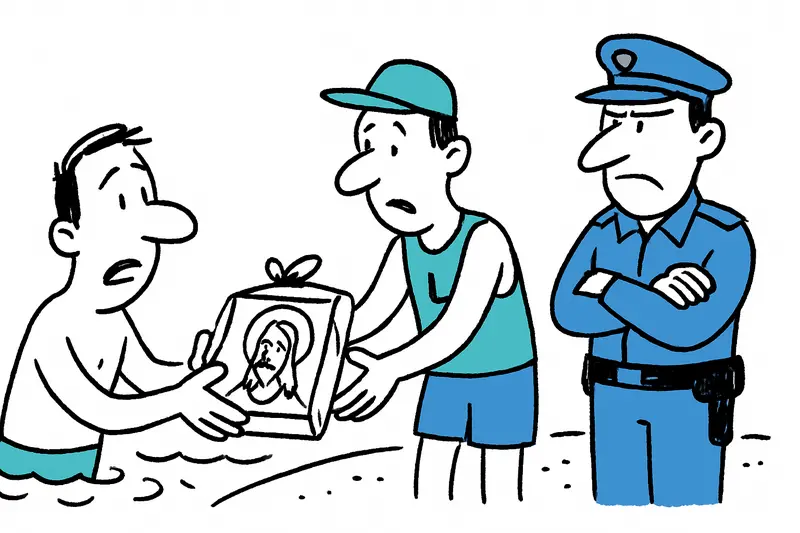
What made the scene seem even more curious to many was the packaging: the parcel was wrapped in a sleeve with an image of Jesus Christ. On it was a dedication in German: "You will live on forever in the memory of all your friends, pal." A macabre detail in a case that has attracted attention not only because of the motif.
Such finds are not new in the Balearics. In recent weeks there have been several similar incidents: about a month ago a drug package also washed up at Playa de Muro, and roughly two weeks ago anglers in Portocolom pulled a kilogram of highly pure cocaine out of the sea while fishing. The Guardia Civil estimates the potential street value of the most recently found material at around €60,000.
Key question: How does cocaine end up on our beaches — and who protects us from it?
The central question is not only who sends the parcels, but why they keep appearing on popular bathing beaches. Are consignments deliberately thrown overboard to conceal smuggling? Or do packages drift for days or weeks with currents until they wash ashore somewhere? Both are possible, and both have consequences for the safety of bathers, for the environment and for the work of emergency services.
Critical analysis
Investigations will later clarify the origin; but on site it is first of all lifeguards, beachgoers and the local police who must provide immediate hazard control. At present, protection for bathers depends heavily on individual vigilance. Lifeguards respond quickly, but their primary responsibility is saving lives, not preserving criminal evidence.
The recurring finds suggest that maritime smuggling follows certain routines. Currents and wind can carry loads for days; packaging methods vary — sometimes with deceptive elements, such as religious images or wrappings that suggest harmless contents. For emergency services this creates a double problem: forensic procedures and evidence preservation are governed by rules that are not always easy to implement on a beach.
What is missing from the public debate
There is little public discussion about the exact procedures to follow when beachgoers report dangerous finds. Who exactly should people call? How is the level of danger assessed? What protective measures apply to lifeguards when they recover suspicious packages? And more broadly: is there a systematic recording of which beach sections are affected more frequently? Without this transparency the debate stays at the level of anecdotes.
A scene from everyday life
Imagine Playa de Muro on a hot July evening: in the shimmering light, parasols sway like colorful boats, children shout while building sandcastles, a radio classic plays softly in the beach bar, and lifeguards sit on their red chairs watching blue and white. In that cheerful setting a small, tightly tied packet can suddenly break the routine. The finder emerges from the water startled, the lifeguard's whistle blows, and shortly afterwards the police arrive — serious-faced, while the rest of the beach returns to bathing activities.
Concrete solutions
1) Make reporting routes clearly visible: Every larger beach should have a clearly visible information board – short, precise, in several languages – explaining what to do when a find is reported (do not touch, inform the lifeguards, call emergency number 112).
2) Standardized training for lifeguards: In addition to first aid, short modules on the dangers of found items, safe handling and evidence preservation should be mandatory. Technical aids such as GPS marking of the find location or photos taken from a safe distance could help.
3) Better data collection: Authorities and municipalities should systematically record findings and map hotspots. That makes prevention plannable and reveals patterns of currents and accumulation.
4) More maritime surveillance in critical corridors: Drones, coordinated sea patrols and cooperation with fishermen could detect consignments earlier. This costs money but is cheaper than repeated legal follow-up after every find.
5) Public outreach: Short, local information campaigns at ports, in beach bars and at tourist information centers can raise awareness without causing alarm.
Punchy conclusion
Mallorca remains a popular holiday destination with dream beaches – but the island is also part of larger maritime routes on which crime sometimes washes ashore. Calmness and holiday smiles are justified, but naivety is misplaced. Reporting suspicious finds helps not only the police; it protects other beachgoers. Authorities, municipalities and beach operators should close the gap between immediate response and forensic evidence preservation. A clear plan for dealing with washed-up packages would benefit everyone – from the lifeguards on their high chairs to the families who want to take one last dip in the warm sea in the evening.
Frequently asked questions
What should I do if I find a suspicious item on a Mallorca beach?
Are Mallorca beaches safe from drug finds and how are incidents handled?
What happened at Playa de Muro with the cocaine find?
How can currents cause drugs to wash up on Mallorca's beaches?
What concrete steps are proposed to improve safety on Mallorca’s beaches when finds occur?
Do drug finds show patterns around Mallorca and where are hotspots?
What should tourists know about reporting dangerous finds near Mallorca's beaches?
How does Mallorca balance being a dream destination with maritime crime risks?
Similar News
Can Malle hits really work in Hamburg? A reality check for the premiere of "ALLE LIEBEN MALLE"
Premiere at the Großmarkt: thousands of attendees, stars from the Megapark and long beer queues. Why the concept works —...

Adrien Brody strolls through Mercat de l'Olivar – celebrity visit leading to Sa Pobla
Actor Adrien Brody was casually spotted at the Mercat de l’Olivar: tapas, fish stalls and later a stop in Sa Pobla spark...
Who can pick up whom? The complicated life of Mallorca's taxis
Three years after the inter-municipal service, empty runs are rarer — but there is a lack of equal treatment, transparen...

When the Tap Only Runs Sometimes: Why Municipalities in the Balearic Islands Are Now Rationing Water
Deià, Valldemossa, Esporles, Sóller and several places on Menorca are scaling back water supply. Who is responsible, why...
Battle for the Ramp: Why Cala Gamba Needs More Than Enforcement
The Guardia Civil intervened in Cala Gamba — residents breathed a sigh of relief, but unease remains. Key question: Are ...
More to explore
Discover more interesting content

Boat Tour with BBQ along Es Trenc Beach

Private transfer from Mallorca Airport (PMI) to Pollensa
