
103 km/h in the pedestrian area: Highly tuned e-scooter seized in Palma
103 km/h in the pedestrian area: Highly tuned e-scooter seized in Palma
On September 23, police in the Sant Miquel pedestrian zone in Palma confiscated a modified e-scooter that reached 103.2 km/h. The owner admitted to altering the battery and removing the speed limiter.
103 km/h in the pedestrian area: Highly tuned e-scooter seized in Palma
Key question: How could a scooter be upgraded so extremely on Mallorca's streets — and who is responsible?
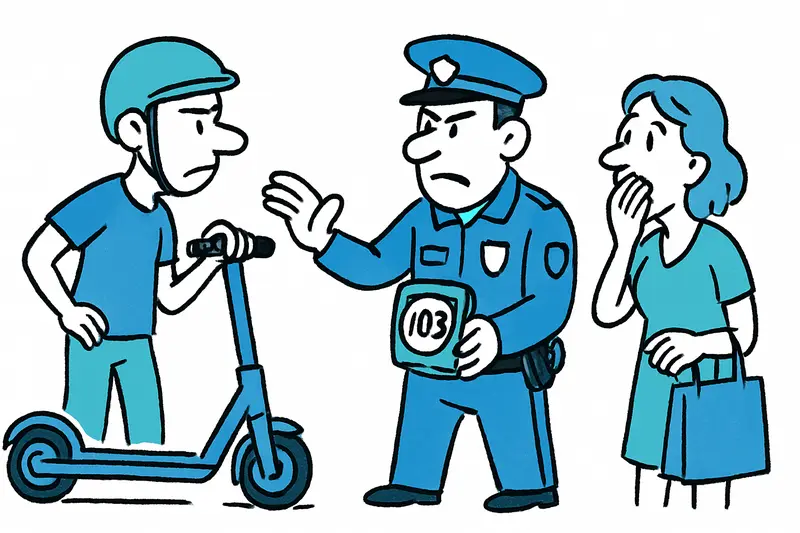
On September 23 the local police in Palma stopped an unusual find in the Sant Miquel pedestrian zone: an electrically powered scooter that later measured a top speed of 103.2 km/h with a speed-measuring device. The scene unfolded around 10 a.m.; delivery vans still rattled over the cobbles, coffee smelled from a café, and passersby paused with shopping bags in hand. The man pushed the scooter, wore a protective helmet — and at first kept a defiant attitude that only changed after a second patrol arrived.
The facts are sparse but clear: the vehicle did not conform to the construction type of a traffic mobility vehicle (VMP). The owner admitted to having modified the device himself. The base model had a factory-rated power of 800 watts; according to him he installed two additional batteries of 1000 watts each, so the technical system power was effectively 2000 watts. Parameters were also set so that the factory speed limiter could be disabled at any time. The result: a vehicle more than four times faster than the permitted 25 km/h.
Critical analysis: A grey zone has long existed on Mallorca (Serious E-Scooter Accident in Palma: More Than Just an Accident?). Electric scooters intended as a "last-mile" solution are being retrofitted afterwards. Spare parts, stronger batteries and online instructions are easy to obtain. The police can detect technical irregularities on site and confiscate scooters. What is missing, however, is a systematic approach against the trade in performance-enhancing components, routine checks of sellers and workshops, and clear information for buyers about the risks — not only legally, but also in terms of fire safety and general safety.
What is largely missing from the public debate is the battery side of the problem. High-performance batteries generate heat, pose a fire risk and, if installed incorrectly, increase the danger of explosion or fire incidents. It also often remains unclear who would be liable in the event of accidents: the owner, the modifier, or the parts supplier? And how are such modifications tracked at all if there is no central registration for private modifications?
An everyday scene from Palma: morning in Sant Miquel, children on their way to school, tourists heading to the cathedral, couriers with scooters, and in the middle of it a road-ready device that at 100 km/h would have turned the square into a danger zone. Such a thing affects not only other road users but also the patience and sense of safety of residents. Anyone who wants to drink their espresso in peace does not expect high-speed drivers between flower boxes and street cafés.
Concrete solutions: First: more checks at critical points — pedestrian areas, promenades, squares. Not just random checks, but with measuring devices that test power and possible top speed. Second: information campaigns about the danger of retrofitted batteries and the legal situation regarding changes to VMPs. Third: stricter rules for the trade in high-performance batteries; vendors should be registered and inspected. Fourth: mandatory testing protocols for workshops that perform modifications — including liability rules. Fifth: the establishment of a city or transport authority contact point for reports of illegal modifications and a clear process for the return of confiscated devices.
In practice this would mean: police officers on site with portable measuring devices, regular checks on weekends, multilingual information posters in shopping streets and at rental companies, and a list of authorized workshops. Extreme speed cases on Mallorca's roads have also drawn attention, including incidents such as 124 km/h on Camí de Can Pastilla — A Wake-up Call for Palma's Holiday Roads and 175 km/h on the Ma-13: Speeding as a Criminal Offense — What the Case Really Shows, underscoring the need for coordinated enforcement.
Conclusion: The case in Sant Miquel is not an isolated incident but a warning signal. A scooter that reaches 103.2 km/h is no longer a toy but a potential projectile. It is not enough to confiscate occasionally; a mix of enforcement, regulation and education is needed. For Palma this means: better citywide controls, clear rules for retrofits and visible prevention efforts. Otherwise the next dangerous encounter is only a matter of time.
Frequently asked questions
What are the general rules for electric scooters in Mallorca?
What are the risks of retrofitting e-scooters with high-performance batteries in Mallorca?
What should I do if I spot an illegally modified e-scooter in Palma?
Are some areas in Palma more risky for high-speed e-scooters, like Sant Miquel?
What steps could Mallorca take to prevent dangerous e-scooter modifications?
Who bears responsibility if a damaged or deadly accident involves a modified e-scooter in Mallorca?
What is the official speed limit for e-scooters, and how is it checked in Mallorca?
How can Mallorca improve public awareness and safety regarding e-scooters?
Similar News

Bierkönig Murder of 1997: More than 50 Tips — Opportunity or Distraction?
After a TV broadcast, numerous tipsters came forward in the case of the triple murder in S'Aranjassa. Senior public pros...

Underwater in Puig de Ros: How Sabrina Kleinas Turns Models into Sea Creatures
She works where the morning is clearest: Sabrina Kleinas photographs models just beneath the water's surface – in Port A...

37 Years of Power and a Tunnel: How 'El Pablo' Shaped La Soledat — and What's Missing Now
The renewed arrest of alleged drug boss Pablo C. M. raises questions: How could a clan deceive streets, homes and author...

Palma blocks parking spaces for tourists – what's behind it and who pays the price?
The city of Palma has declared 1,027 ORA parking spaces in the center as residents-only spaces by official notice. A cal...
Fatal accident near Son Llàtzer: When a medical episode at the wheel turns the road into a danger
In a collision near the roundabout at Son Llàtzer hospital, an approximately 80-year-old car driver died. The suspicion ...
More to explore
Discover more interesting content

Can Cap de Bou

Townhouse Lleo 72
