
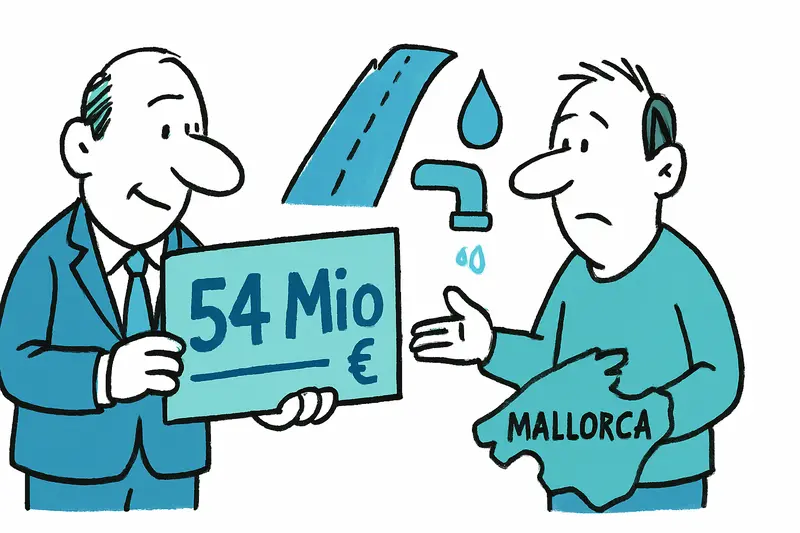
54 million euros for Mallorca's municipalities: Opportunity or bureaucratic boomerang?
The Island Council has approved 54 million euros for municipal projects. Good news — but will small villages benefit, or will the money get bogged down in tenders and administrative backlog?
More money, more questions: Who pulls the strings locally?
It sounds like sunshine for the island: 54 million euros for Mallorca's municipalities have been released for Mallorca's municipalities. On rainy days, when the Passeig Marítim drums with rain and the cafés close their windows, such a package feels like a promise. But the core question remains: who really decides which road gets patched, which pipe is replaced, and which school roof is fitted with solar panels?
The allocation in brief
The sum is divided into three main pots: around 40 million for general infrastructure — roads, squares, bridges — about 10 million specifically for water projects, and just over 4 million for energy efficiency and small photovoltaic solutions on municipal buildings. On paper it makes sense: consolidate, simplify, speed up, as outlined in 54 millones para los municipios de Mallorca: plan para infraestructura, agua y energía.
The heavier questions that rarely make the minutes
At Sineu's town hall I was told last week: the ideas exist, but the capacities are lacking. Smaller municipalities often do not have their own grant or technical offices. Tenders, expert reports, technical plausibility checks — all of this costs time and nerves. If it is not clearly regulated who provides help, the funds tend to be absorbed by larger places with their own administrative machinery.
Another blind spot: maintenance. Investments are nice, but who will pay in five years for repairs when pumps, meters or solar modules need replacing? Without a plan for follow-up and operating costs, shiny projects risk becoming abandoned facilities.
Opportunities beyond the asphalt
If used correctly, the 10 million for water could mean more than just pipes. Leak detection technology, pressure control systems or smart meters reduce long-term losses and operating costs. And the 4 million for energy — small, but strategic — could finance LED street lighting, battery storage in community centers or retrofitting school roofs. That creates energy savings, reduces operating costs and brings local skilled work.
Concrete steps to ensure the money arrives
A single fund is not enough if practice fails at bureaucratic hurdles. From the perspective of small municipalities I propose the following measures, which are both pragmatic and politically acceptable:
1. Public priority list: Each municipality submits projects; the Island Council publishes a transparent ranking with assessment criteria and a timetable. This way citizens can see why the plaza in their town is being prioritized.
2. Capacity fund (approx. 10%): A share of the funds is reserved to finance technical planning, consulting and tendering for small municipalities — essentially temporary external administrative staff.
3. Clear deadlines: A maximum of six months for priorities, twelve months until tendering, 24 months until construction starts for the majority of projects. Those who delay longer lose parts of the grant.
4. Transparency dashboard: A public online tool shows applicants, approval status, budget, schedule and contracted companies — no more secret dealings behind closed doors.
5. Ring-fencing for operation and maintenance: Every grant must include a follow-up cost plan. This prevents new installations from standing idle after a few years because no one pays for servicing.
Why acting now matters — and what's at stake
If the package gets stuck in piles of files and lengthy tenders, it remains a nice number in the budget. Properly managed, it can deliver tangible improvements: less water loss in Llucmajor, a safer MA-15 for commuters, or brighter, energy-efficient squares in Inca and Alcúdia. The assessment of this program will not happen in council chambers, but in the plaza under the lamppost that finally lights up at night, or at the school with the leaky roof.
I will be watching closely in the coming months: Who applies? Who wins the contracts? And above all — when will the diggers really roll in? In the end, what counts is not the resolution, but the pump that runs again, the roof that no longer leaks, and the road you can drive on without holding your breath.
Frequently asked questions
What will Mallorca's 54 million euro municipal fund be used for?
Why do small municipalities in Mallorca often struggle to use public funds?
Is Mallorca's new municipal funding enough to solve water problems?
What kinds of energy projects could Mallorca municipalities finance with this budget?
How can Mallorca make sure municipal money is distributed fairly?
What happens if Mallorca municipalities do not plan for maintenance?
What could Mallorca residents notice if the funding is used well?
Why do people in Sineu care about Mallorca's municipal funding plan?
Similar News

Release after bloody attack in Palma: Why the court's decision raises questions
An 18-year-old who allegedly inflicted a serious neck injury on a man at Plaza Gomila using a wristwatch wrapped around ...
Kidnappings in Inca: Three young men forced into car trunks and abused in the forest – a reality check
In Inca, three 18-year-old men were forced into car trunks by masked assailants at the Plaça des Bestiar, taken to a for...
Spreading Massification: The Brake That Still Has Much Work to Do
Marga Prohens announces limits on volume tourism. The measures sound harsh — but are they enough to save everyday life, ...

Through the Keyhole onto the Party Yacht: How Daniela Katzenberger Is Planning Her 40th on Mallorca
Daniela Katzenberger turns 40 and wants to celebrate it on the island — likely with a boat, cake and her mother. A relax...
By Boat Instead of the Road: Palma's Water Bus — a Reality Check
The 'Bus Nàutic' launches in two stages — but questions remain over interim operations, fares and environmental requirem...
More to explore
Discover more interesting content

Can Cap de Bou

Townhouse Lleo 72
