
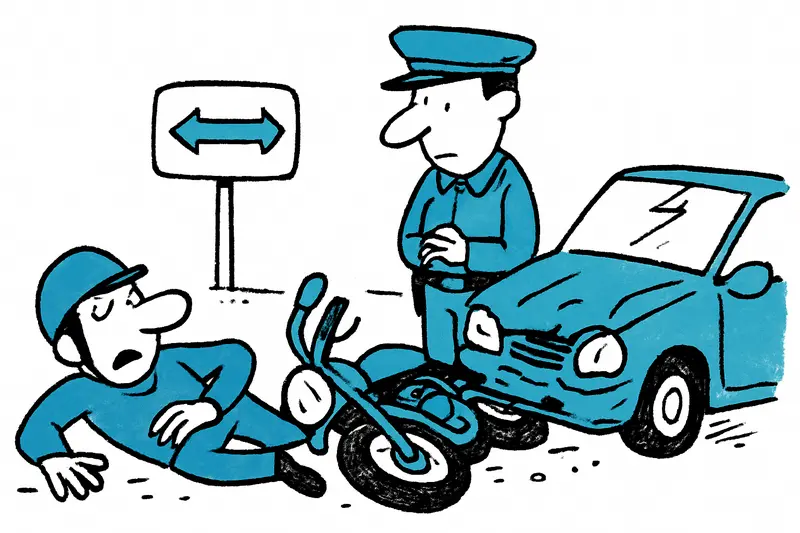
Serious motorcycle crash in Santa Eugènia: What needs to change at dangerous intersections?
A 54-year-old German man was seriously injured in a collision at the MA-3020/MA-3040 junction. The case raises questions about infrastructure, helmet choice and the rescue chain — and exposes gaps that Santa Eugènia must address.
Motorcycle ripped apart, rider in critical condition – the intersection that becomes a question
On Tuesday at around 1:40 p.m., the usually quiet junction of the MA-3020 and MA-3040 in Santa Eugènia briefly turned into a scene of horror. A 54-year-old German motorcyclist collided with a delivery van, as reported in Grave accidente de moto en Santa Eugenia: motorista alemán gravemente herido; the motorcycle was practically torn apart on impact. Parts lay scattered across the carriageway, one piece several metres away. The smell of petrol hung in the air and the hoarse wail of the Guardia Civil sirens mixed with the shouts of the first onlookers.
Main question: Could this trauma have been prevented?
Rescue teams flew the man with severe head injuries to Son Espases University Hospital. On site, emergency crews reported that he had been wearing an open-face helmet; emergency doctors had to intubate him at the scene. The Guardia Civil assumes a stop sign was overlooked. But the central question remains: was this a one-off human error — or does this accident reveal structural weaknesses that are often overlooked here on Mallorca?
The junction lies on a stretch used equally by commuters, delivery vans and two-wheeler riders. On a typical Tuesday afternoon, when buses make their rounds and shift changes occur at businesses, it becomes clear how many different types of traffic converge in a small area. Sightlines can be impaired by parked vehicles, urban vegetation or unfavourable lighting conditions. All of these are factors that rarely receive attention until something terrible happens.
Under-discussed aspects: helmet types, infrastructure and user behaviour
Often discussed less is the question of helmet choice. Open-face helmets are popular — they offer more airflow, less claustrophobia in the heat and a different riding comfort. In a frontal collision, however, they do not protect the chin and face. The accident in Santa Eugènia, in which the rider nearly lost all his teeth, makes this debate painfully clear. Changing individual behaviour is not a magic bullet, but it is a simple, effective measure: advertising and education for full-face helmets, combined with test rides and local events, could reduce the risk. See NHTSA motorcycle safety guidance for information on helmet protection and best practice.
At the same time, infrastructure is an issue. Stop signs at small junctions look simple on paper — in reality, their effectiveness depends on placement, maintenance, visibility and road users' expectations. Better markings, reflective signs, rumble strips before the stop or even a small roundabout would slow speeds and make the danger zone clearer. Such measures cost money, but they are feasible locally and could save lives.
The rescue chain: fast, but with gaps?
The fact that a helicopter was deployed and the polytrauma protocol was activated at Son Espases shows that the rescue chain works. Yet the accident also reminds us of the time windows that decide life and death: how well are first responders trained on site? Are AED stations or trained volunteers available at critical points in communities like Santa Eugènia? The rapid intubation at the scene may have saved a life, but the municipality should consider how to improve immediate assistance — for example through regular first aid courses at the local club or cooperation with nearby workshops, whose staff are often first on the scene.
Concrete opportunities and proposals
Several pragmatic steps can be derived from the accident:
1. Visibility and infrastructure: Review the MA-3020/MA-3040 junctions: better signage, reflective markings, clear sight corridors, and where appropriate traffic calming measures such as a roundabout or 30 km/h zones.
2. Prevention and education: Local campaigns on helmet choice and protective gear, information evenings in bars and clubs, collaboration with motorcycle clubs, and helmet and protector demo days.
3. Strengthen the rescue network: Expand first aid training, assess additional AED locations and set up volunteer groups able to give quick first aid.
4. Controls and data collection: Temporary speed and visibility checks and careful documentation of accidents to identify hotspots and implement evidence-based measures.
A call to the community
Santa Eugènia is a small place whose everyday life briefly paused that Tuesday afternoon: coffee cups, the distant chiming of church bells, the rumble of a bus. Such scenes remind us how fragile normality is. The Guardia Civil's investigations are ongoing, reported in Grave accidente de moto en Santa Eugènia: alemán de 54 años en estado crítico; the delivery van driver was uninjured and is cooperating. But the real work starts now: analyse, consult, act. It is not about assigning blame but about prevention so that fewer people have to take this grave journey to hospital.
We wish the injured man strength and keep his family and friends in our thoughts. The municipality and authorities should use this incident to find answers to the central question: how do we prevent an intersection from tearing lives apart next time?
Frequently asked questions
Why are some intersections in Mallorca more dangerous for motorcyclists?
What helmet is safest for motorcycle riding in Mallorca?
What should I pack for motorcycle riding in Mallorca in hot weather?
Is it safe to ride a motorcycle in Mallorca on busy weekday afternoons?
How are serious motorcycle crashes handled by emergency services in Mallorca?
What traffic changes could make Santa Eugènia roads safer?
Where is the dangerous junction in Santa Eugènia located?
What can Mallorca communities do to prevent serious motorcycle accidents?
Similar News
Release after bloody attack in Palma: Why the court's decision raises questions
An 18-year-old who allegedly inflicted a serious neck injury on a man at Plaza Gomila using a wristwatch wrapped around ...
Kidnappings in Inca: Three young men forced into car trunks and abused in the forest – a reality check
In Inca, three 18-year-old men were forced into car trunks by masked assailants at the Plaça des Bestiar, taken to a for...
Spreading Massification: The Brake That Still Has Much Work to Do
Marga Prohens announces limits on volume tourism. The measures sound harsh — but are they enough to save everyday life, ...

Through the Keyhole onto the Party Yacht: How Daniela Katzenberger Is Planning Her 40th on Mallorca
Daniela Katzenberger turns 40 and wants to celebrate it on the island — likely with a boat, cake and her mother. A relax...
By Boat Instead of the Road: Palma's Water Bus — a Reality Check
The 'Bus Nàutic' launches in two stages — but questions remain over interim operations, fares and environmental requirem...
More to explore
Discover more interesting content

Can Cap de Bou

Townhouse Lleo 72
