
Recklessness or Bad Luck: Sailing Yacht Stranded off Alcúdia Again
Recklessness or Bad Luck: Sailing Yacht Stranded off Alcúdia Again
A twelve-metre sailing yacht was driven onto the rocks off Alcúdia after a storm. The circumstances point to unsafe moorings and shortcomings in salvage procedures.
Recklessness or Bad Luck: Sailing Yacht Stranded off Alcúdia Again
Key question: Who bears responsibility — owners, authorities or the system?
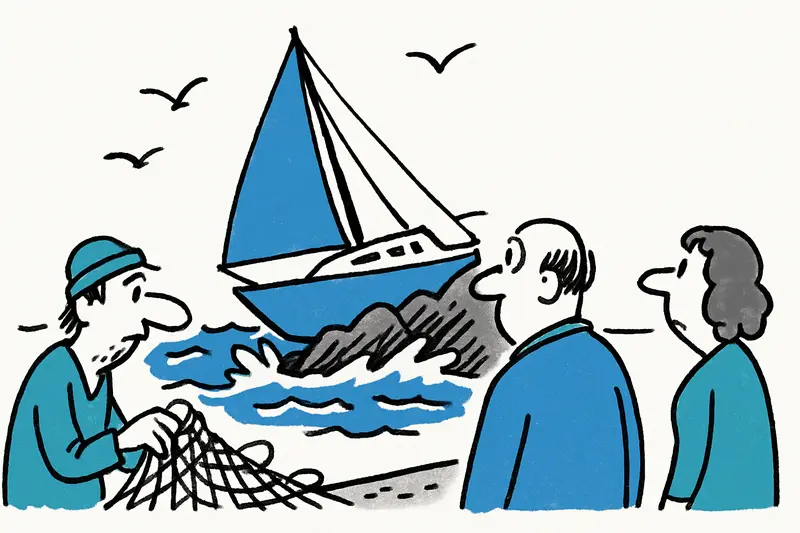
Early on Thursday afternoon a sailing yacht of about twelve metres lay immovable on the rocks near Alcúdia. Eyewitnesses report how the boat was driven across the Bay of Pollença during the storm until the waves left it grounded on the shore. The scene looked dramatic from a distance: breaking surf, seagulls, fishermen sorting their nets, and a few walkers on Alcúdia's Passeig Marítim who stopped to look at the wreck.
The environmental organisation Arrels Marines points out that the yacht apparently had been moored outside the port of Pollença on an unauthorised buoy, an issue also discussed in Drunk Boats, Battered Bays: When Private Boat Rentals Put Mallorca's Coasts at Risk. When a storm is forecast this is not a trivial matter: a boat of that size belongs in a safe harbour or on land. Whoever thinks a buoy is enough risks a lot — not only their vessel but also the seabed, bathing areas and the budgets of small towns.
Critical analysis
First a look at responsibilities: owners are legally responsible for salvage. That's clear. In practice, however, municipalities and coastal authorities end up with the mess when no one else can be reached. Pollença spent almost €50,000 on recoveries in 2025, and Alcúdia is currently examining whether the town may have to pay up to around €30,000 if the coastal authority does not act. These costs end up on the public bill — paid by everyone, even though the perpetrators are often not identified; similar controversies over responsibility and public cost have followed other maritime incidents, for example Boat tragedy off Mallorca: Between grief, legal battles and the question of a Plan B.
Technically, several sources of error are visible: unsafe moorings, inadequate securing at buoys, missing or insufficient warning and transfer measures before the storm begins. Added to this is the apparent availability of berths under peak-season logic: boats are supposed to stay outside until the weather turns — exactly at that point there is neither time nor capacity to react correctly.
What is missing from the public debate
There is a lot of reporting on spectacular strandings, but rarely on structural gaps. Three points are hardly discussed: first, preventive checks at popular anchor spots outside protected harbours. Second, a binding reporting and sanction system that makes owners reachable more quickly. Third, a coordinated emergency fund for salvage operations that helps municipalities at short notice without burdening budgets. Without these perspectives the debate remains piecemeal.
Everyday scene on the coast
Anyone walking the Passeig in Alcúdia early in the evening hears the surf hitting the breakwater; the small beach bars are still closed, an old boat mechanic smokes his pipe and says you keep seeing the same mistakes: 'Anchoring where you shouldn't.' Such observations are not gossip: they show how routine and neglect combine when storms arrive.
Concrete solutions
First: binding storm protocols for yachts above a certain length — reporting obligation, relocation or harbour entry at warning level. Second: better marking and control of unauthorised anchoring spots; regular checks by harbour police or the coastguard. Third: a digital owner register with an emergency contact, linked to buoy management so owners can be reached before a boat becomes a danger. Fourth: a tiered financial model for recoveries — an immediate fund to relieve municipalities short term, coupled with later cost recovery from proven responsible owners. Fifth: increased awareness in yacht harbours and marinas, especially before the storm season, combined with targeted checks during storm periods.
Who pays if no one can be found?
If owners cannot be identified, the municipality is left to cover the costs — this is legally possible and happens regularly. That is unfair to citizens who have nothing to do with the boat. That is why we need a clearer financial chain: a swift municipal intervention should not automatically mean that the town remains out of pocket, without recourse to a responsible party or insurance coverage; local reporting such as Alcúdia: Who Was Really at the Wheel? A Reality Check on Alcohol, Responsibility and Investigations shows how tracing responsibility can be complex.
Concise conclusion
A stranded boat is never just a maritime accident; it is the result of many small failures: wrong moorings, lack of controls, gaps in cost regulation. Anyone standing on the beach listening to the roar of the surf can interpret it as a force of nature — or as a preventable nuisance. Our island needs pragmatic rules that take effect quickly, and a clear plan for who acts when and who pays. Otherwise these images will repeat every few months — until the next bill lands on the town's desk.
Frequently asked questions
What should yacht owners in Mallorca do when a storm is forecast?
Who pays when a boat is stranded off Mallorca?
Why are unauthorised buoys around Mallorca a problem for yachts?
What happens when a yacht runs aground near Alcúdia?
Can Mallorca towns recover salvage costs from yacht owners?
Is anchoring outside Port de Pollença safe in bad weather?
What should Mallorca authorities check after repeated boat strandings?
Why do stranded boats in Alcúdia become a public cost issue?
Similar News
Released with Conditions: The Plus Ultra Suspicion and a Mallorcan Finca as Residence
A Dutch entrepreneur, sought in connection with the Plus Ultra case, was extradited to Spain after his arrest in Germany...

Haute Nuit in Puerto Portals: Fashion, Art and Indulgence by the Water
On October 2 the Lobster Club in Puerto Portals will be transformed into a stage for curated fashion, art and culinary e...
Magaluf: Watchtower Alarm – Lifeguards Pull Unconscious Beachgoer from the Water
After a drama in the late afternoon, two lifeguards at Magaluf beach rescued an unconscious 44-year-old man. He was stab...
Turquoise in the City: How dangerous is the color play of the Sa Riera?
The Sa Riera in Palma suddenly turned turquoise — a pretty motif, but behind the effect lies a discharge of saline waste...

Jeckliner at Sunnesching: Cologne spirit sets sail from Palma
In September 2027 the Mein Schiff 2 briefly becomes a floating carnival stage: four days with Cologne bands, comedy and ...
More to explore
Discover more interesting content

Can Cap de Bou

Townhouse Lleo 72
