
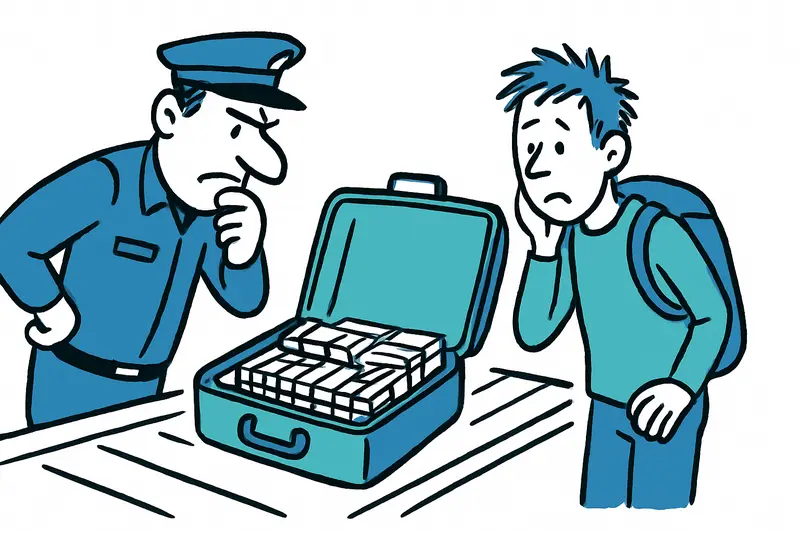
Almost 2,000 Cigarettes in a Suitcase: A Case That Raises Questions at Son Sant Joan
Almost 2,000 Cigarettes in a Suitcase: A Case That Raises Questions at Son Sant Joan
A 27-year-old passenger from Armenia arrived in Palma on a flight from Rome — and had almost 1,940 packs of cigarettes in his luggage. Why such quantities repeatedly get through checks and what it means for Mallorca.
Almost 2,000 Cigarettes in a Suitcase: A Case That Raises Questions at Son Sant Joan
How nervous behavior at the baggage claim exposed a large shipment
At the arrivals belt of Son Sant Joan: the monotonous clatter of rolling suitcases, the faint beeping of announcements and the heat, which on days like this reaches around 34 °C. There, during a routine check, a young man from Armenia stood out: nervous while waiting for his luggage, hesitant when leaving. It was enough for officers of the Guardia Civil and the customs surveillance unit of the state tax authority to take a closer look.
The facts, briefly: a passenger, 27 years old, had landed on a flight from Rome. In his two checked suitcases the inspectors found a total of 1,940 packs of cigarettes. The goods bore no Spanish tax stamps. The estimated value was around €10,458. Authorities seized the tobacco and initiated criminal proceedings for alleged smuggling.
Key question: Why do large quantities of untaxed tobacco end up in ordinary travel suitcases, and how effective are controls at a busy airport like Palma really?
A first, rather pragmatic answer is: checks often rely on routine and suspicion. Not every suitcase is completely unloaded. X-ray machines are used, but they operate amid a flood of luggage; human behaviour, such as nervousness, remains an important indicator. In this case it was enough to deepen the inspection. What public debate rarely touches on is the other side: the logistics behind it. Where does this quantity come from, who organises the transport — and how much is intended for sellers at street level?
The legal dimension is clear enough, though not automatically final: large quantities without tax stamps argue against personal use. In theory fines can far exceed the value of the goods; as a rule of thumb authorities sometimes calculate several times the value of the merchandise. Whether a fine of that magnitude will ultimately be imposed is something a court will have to decide.
What is missing from public discourse is a look at preventive levers. More checks alone are no panacea; they are costly, time-consuming and cause passenger queues. Instead, targeted measures are more effective: better analysis of flight movement data, enhanced cooperation between departure and arrival states, information posters at baggage belts and targeted training for staff who deal daily with thousands of travellers.
An everyday scene in Palma helps to illustrate this: on Passeig Mallorca older islanders sit early in the morning with their café con leche, while at the airport a flight to Rome departs and ten minutes later another arrives from northern Italy. Local control capacity fluctuates with surges of passengers. If staff are tired or procedures become too automated, things slip through. A vigilant officer who pays attention then makes the difference.
Concrete proposals that could be implemented immediately: targeted checks on flights from certain regions known for smuggling routes; a digital declaration form for passengers carrying high quantities of dutiable goods; automated risk filters that flag pieces of luggage with unusual weight-to-volume ratios; and targeted multilingual public information campaigns about permitted duty-free allowances.
For the hotel industry and the neighbourhoods near the airport access roads this means fewer sensational headlines but more lasting impact. If fewer untaxed goods enter circulation, the illegal small trade suffers — and the conversation at the kiosk in Plaça del Mercat calms down again.
Conclusion: This case is not an isolated “once-in-a-while” incident, but neither is it an alarming sign of systemic failure. It rather shows where the balance lies between practical day-to-day checks and structural prevention. Son Sant Joan will not reinvent its controls, but cases like this indicate which adjustments can be made: better information work, targeted data analysis and pinpointed controls — that combination is most likely to prevent nearly 2,000 packs of cigarettes from ending up in ordinary suitcases again.
Frequently asked questions
What happened at Son Sant Joan airport with almost 2,000 untaxed cigarettes found in a suitcase?
How do baggage checks at Palma de Mallorca’s airport detect untaxed goods?
Why are large quantities of tobacco seized at airports often not for personal use?
What preventive measures could improve airport controls at Son Sant Joan without slowing passengers?
How should travelers handle high-quantity tobacco when flying to Mallorca?
Why does staff vigilance matter at Mallorca's busy Palma airport?
What could tighter controls at Son Sant Joan mean for Mallorca's hotels and nearby neighborhoods?
What broader lessons can be drawn from the Son Sant Joan cigarette case?
Similar News
Why Mallorca Has Become So Terribly Expensive — A Reality Check
Rents are exploding, staple food prices are rising, wages are lagging behind. A look at the causes, what is missing from...
When Paradise Becomes Unaffordable
Hotel rooms, paella and the weekly grocery shop: Mallorca is becoming more expensive for many. Who pays the bill — guest...
End at Ballermann: What Is Lost with the Dino Mini Golf at Playa de Palma
On October 25 the dinosaur mini-golf course at Playa de Palma will close after more than 30 years. Why the city is recla...

Expensive Address Calvià: What Does First Place Mean for Mallorca?
The National Institute of Statistics (INE) ranks Calvià as Spain’s most expensive municipality for property purchases. W...
Emergency over Spain: Ryanair Dublin–Tenerife flight diverted to Santiago after medical emergency
A Ryanair flight from Dublin to Tenerife was diverted to Santiago de Compostela due to a passenger's acute health proble...
More to explore
Discover more interesting content

Can Cap de Bou

Townhouse Lleo 72
