
Ammunition bunker in Son Sant Joan temporarily halted – what now?
Ammunition bunker in Son Sant Joan temporarily halted – what now?
The Ministry of Defence has halted plans for a new ammunition bunker at the Son Sant Joan airbase. Why this decision must not be the end of the debate and which questions remain open.
Ammunition bunker in Son Sant Joan temporarily halted – what now?
Key question: Is a construction stop enough to guarantee safety and transparency in Mallorca?
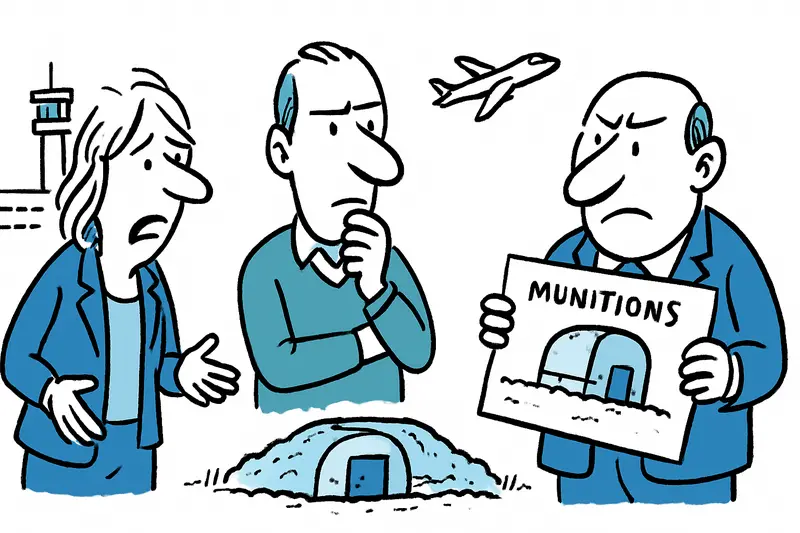
At Palma airport the concrete plans are on hold for now. A semi-underground ammunition storage facility had been planned at the Son Sant Joan base, designed for up to 75 tonnes of munitions – including rockets and bombs. After public pressure, the Ministry of Defence has halted the works and reports that the air force is now examining alternative locations, possibly even off the island, as reported in Munitions Bunker Near Son Sant Joan: Why Mallorca's Citizens Should Have a Say. Those are the known facts. And yet many questions remain open.
Analysis: A decision that buys time is not a decision. A construction stop does not automatically remove the project's risks: the plans still exist, technical documents are in circulation, and the debate has been postponed, not ended. On Mallorca, where the airport, tourism and residential areas lie close together, the question of pure feasibility is not enough. It is about hazard prevention, environmental consequences, air traffic and the trust of local people.
What has been missing so far in the public discussion? First: independent expert reports. Military risk assessments alone remain too opaque for many, as local reporting on the proposed Weapons Depot at the Airport: How Safe Is Mallorca Really? shows. Second: a clear statement on alternative locations—who examines mainland sites, which criteria apply (accessibility, distance to population centres, geology, environmental compatibility)? This demand for clarification has been voiced in Ammunition Depot at Son Sant Joan: Prohens Demands Clarification. Third: emergency planning for residents around Son Sant Joan – from Can Pastilla to El Arenal – has hardly been communicated openly.
An everyday scene shows why the issue concerns people: on a windy morning on the access road to the base you can hear the steady rumble of buses, taxi drivers wave at travellers, and on the street corner an older baker in Can Pastilla sells filled rolls. "We have small children who go to school here," a neighbour tells me, while seagulls cut through the noise above the terminal. Local unrest and demands for answers, for example from Sa Casa Blanca, make such images even more urgent Sa Casa Blanca demands answers.
Concrete approaches so that nothing vanishes in the fog of military language:
1) Independent risk and environmental assessment: Commissioned by the Balearic government or an academic institution with publicly available results. Not only explosion scenarios, but also groundwater and soil studies must be disclosed.
2) Participation format for residents: A local committee with citizen representatives, politicians and technical experts that receives regular, comprehensible information and is allowed to ask questions.
3) Transparent criteria for alternative sites: Clear minimum distances to residential areas, flight paths and sensitive ecosystems; priority for sites already used for military purposes and well secured on the mainland.
4) Make emergency plans visible: Evacuation routes, a siren concept, maps for schools and hospitals in the area – to be presented and rehearsed.
5) Interim low-risk solution: In the short term, stocks could be decentralised and stored in smaller, multiply secured depots until a permanent, tested solution is in place.
Politically only one thing helps: openness instead of backroom politics. The island lives from its reputation as a safe place for holidays and for living. Those who make decisions here must explain how they intend to minimise risks – and not just where they might be relocated.
Conclusion: The construction stop is a victory for citizen pressure and precautionary concerns. But it is only the beginning. Mallorca now needs clear, verifiable steps: independent assessments, participation for residents and a comprehensible alternative that takes safety, the environment and everyday life seriously. Otherwise the project will return sooner or later in altered form, and then with the same worries at the breakfast table in Can Pastilla and El Arenal.
Frequently asked questions
Is the ammunition bunker project at Son Sant Joan in Mallorca cancelled?
Why are people in Mallorca worried about the planned ammunition storage near Palma airport?
What happens next after the Son Sant Joan construction halt in Mallorca?
What kind of safety checks are being asked for in Mallorca over the Son Sant Joan depot plan?
Could the ammunition storage for Son Sant Joan be moved outside Mallorca?
What would the Son Sant Joan bunker mean for residents near Can Pastilla and El Arenal?
How should Mallorca authorities make the Son Sant Joan decision more transparent?
Does the Son Sant Joan bunker pause guarantee safety for Mallorca now?
Similar News

Magaluf: Watchtower Alarm – Lifeguards Pull Unconscious Beachgoer from the Water
After a drama in the late afternoon, two lifeguards at Magaluf beach rescued an unconscious 44-year-old man. He was stab...
Turquoise in the City: How dangerous is the color play of the Sa Riera?
The Sa Riera in Palma suddenly turned turquoise — a pretty motif, but behind the effect lies a discharge of saline waste...

Jeckliner at Sunnesching: Cologne spirit sets sail from Palma
In September 2027 the Mein Schiff 2 briefly becomes a floating carnival stage: four days with Cologne bands, comedy and ...
Finally Home: Mike and Leyla Heiter Buy Villa with Sea View in Mallorca
The reality TV couple Mike and Leyla Heiter have bought a house in Mallorca with a roof terrace and sea view. An Instagr...

Arrest after series in Palma: Who protects apartments from repeat offenders?
The National Police arrested a man in Palma who investigators say may have broken into several apartments. In one incide...
More to explore
Discover more interesting content

Can Cap de Bou

Townhouse Lleo 72
