
Autumn Holidays Begin: Why Suitcases Are Disappearing Again in Mallorca
Autumn Holidays Begin: Why Suitcases Are Disappearing Again in Mallorca
Just in time for the autumn holidays, lost suitcases are piling up at Palma airport. Who is to blame — the weather, tight connections, or thieves at the baggage carousel? A critical look and practical tips.
Autumn Holidays Begin: Why Suitcases Are Disappearing Again in Mallorca
Delays, tight connections — and sometimes plain bad luck
Key question: Why do so many suitcases fail to reach their owners precisely during the holiday season? The answer is not a single cause but a combination of operational disruptions, human error and security gaps. At Son Sant Joan airport this becomes immediately apparent: announcements echo between rolling suitcases on the carousel, travelers push trolleys across the forecourt at Passeig Mallorca, taxis honk, and queues form at the check-in desks — all of which increases the chance of luggage missing a connection or even disappearing.
Analysis: Three factors regularly stand out. First: connecting flights. When passengers change planes at a stopover, there isn’t always enough time for the suitcase to make the transfer — a commonly cited figure suggests that around 37 percent of lost bags are linked to transfers. Second: time pressure and late drop-off. Passengers who check their luggage only shortly before boarding increase the risk that it won’t be loaded in time. Third: theft in the hall. In recent months there have been repeated incidents where suitcases vanished from the carousel or were pulled off by strangers, as in Disguised as a Tourist: How an Alleged Thief Stole Suitcases and Watches in Palma, and there have also been reports of larger organized gangs Organized watch robbers in the Balearics: Why Mallorca must also stay vigilant. It doesn’t happen constantly, but often enough to raise the alarm.
What is missing from public debate: The discussion focuses too much on isolated incidents and too little on chains of responsibility. Airlines, ground handlers and airport operators share tasks, but who explains to travelers, transparently, how luggage is prioritized? Who ensures that more staff are available at check-in desks during bad weather or staff shortages? And: How clear are the rules on compensation and delivery time for lost suitcases to passengers — in plain language, not buried in the fine print?
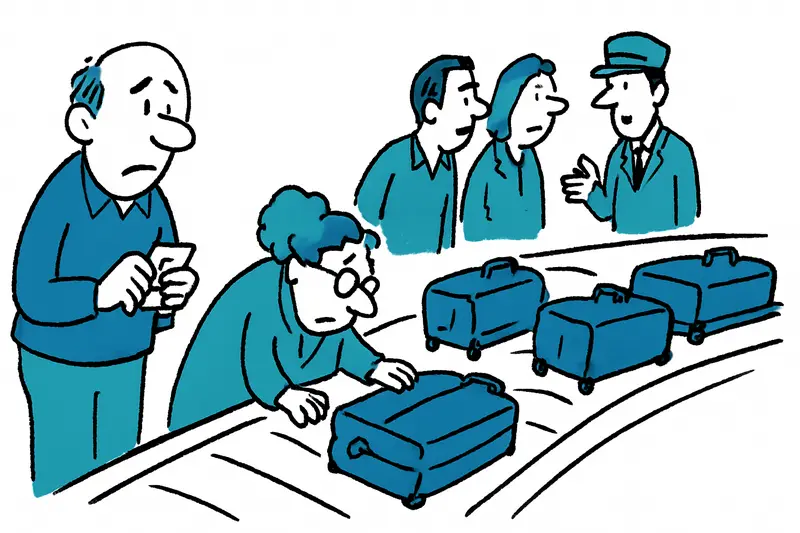
An everyday scene in Palma: On the way to baggage claim, families with strollers pass a man standing by the belt crumpling his boarding pass in his hand. An elderly woman tries to spot her case, but five almost identical dark blue trolleys spin side by side. Nearby a couple argues in Spanish with an attendant while an announcement booms through the hall that a delayed flight is still disembarking. Images like these repeat every hour during a holiday weekend — and in this chaos mix-ups or thefts happen most easily.
Practical measures — immediately feasible: 1) Pack for the worst-case scenario: change of clothes, medication and important documents in carry-on. 2) Use tracking: an AirTag or similar tracker in the suitcase increases the chances of finding it quickly. 3) Increase visibility: bright ribbons, stickers or a distinctive tag reduce the risk of confusion. 4) Check in early: at large airports it’s advisable to drop luggage around 90 minutes before departure — for low-cost or full flights, even earlier. 5) Act immediately if lost: stay calm, go to baggage services at the exit, have your boarding pass and baggage tag ready and ask for the reference number.
Structural and system proposals — for authorities and the industry: Airports should clearly communicate minimum connection times and deploy extra staff when weather problems or capacity bottlenecks are expected, and recent forecasts such as Short late summer — then a weather turnaround: What Mallorca needs to know now underline this risk. Airlines and ground handlers could use standardized digital baggage identifiers that customers can track via an app. CCTV and staff presence at carousels need to be increased to deter theft; visible measures are often effective. Finally: unified, easily accessible information on compensation and interim provisions would avoid frustration.
What travelers can do additionally: take photos of the suitcase before check-in, note the baggage tag number and make a short inventory of important items. Travel insurance that covers baggage loss and interim necessities is particularly worthwhile during peak times. And: for extra security, split essentials across two smaller bags instead of one large suitcase to reduce the risk of being left entirely without clothes.
Bottom line: Lost luggage is rarely just bad luck. It is the result of a system that quickly reaches its limits under stress — tight transfer windows, overload during bad weather and occasional thieves add to the problem. For holidaymakers this means: plan, mark, track and document. For the industry it means: communicate more transparently, digitalize processes and add staff where it really matters. Otherwise the holiday won’t start with the sound of the sea, but with a search at the baggage carousel.
Frequently asked questions
What is the best time to visit Mallorca for sunny days and outdoor activities?
Can you swim in Mallorca outside the peak beach season?
What should I pack for a trip to Mallorca?
What’s the easiest way to get around Mallorca without renting a car?
Are there family-friendly activities to do on Mallorca?
How do I choose a good beach in Mallorca?
What are must-see places around Palma and the Serra de Tramuntana?
How does Mallorca’s weather change throughout the year?
Similar News

Why Spain's housing crisis is driving snap elections — and what Palma must learn
The evacuation of an 87-year-old, failed rent decrees and tent camps in Palma: the housing crisis has escalated national...

Season Opening at the Auditorium: Elgar, Strauss and an Evening for Listening
On October 8 the Orquestra Simfònica de les Illes Balears brings two musical extremes together in Palma: Elgar's intimat...

Ca’n Garrit in Calvià – A Tavern Breathing Since 1905
In the middle of Calvià’s Carrer Mayor 45 stands an establishment that combines tradition and fresh craftsmanship: Ca’n ...
Severe motorcycle crash at Portals Nous: Why an open-face helmet and the slope can be dangerous
In the night to Friday a 48-year-old rider crashed on the Ma-1 near Portals Nous (km 9). He was taken to Son Espases wit...
Boating in Mallorca: Which License Applies? A Reality Check
Since early October: rental boats only with proof of competence. What this means for residents and holidaymakers, which ...
More to explore
Discover more interesting content

Can Cap de Bou

Townhouse Lleo 72
