
Severe motorcycle crash at Portals Nous: Why an open-face helmet and the slope can be dangerous
Severe motorcycle crash at Portals Nous: Why an open-face helmet and the slope can be dangerous
In the night to Friday a 48-year-old rider crashed on the Ma-1 near Portals Nous (km 9). He was taken to Son Espases with severe injuries, including fractured vertebrae and a brain hemorrhage. Time for a critical look at helmets, road profile and prevention.
Severe motorcycle crash at Portals Nous: Why an open-face helmet and the slope can be dangerous
The accident on the Ma-1 (km 9) on the night to Friday raises questions about protective clothing, route layout and enforcement
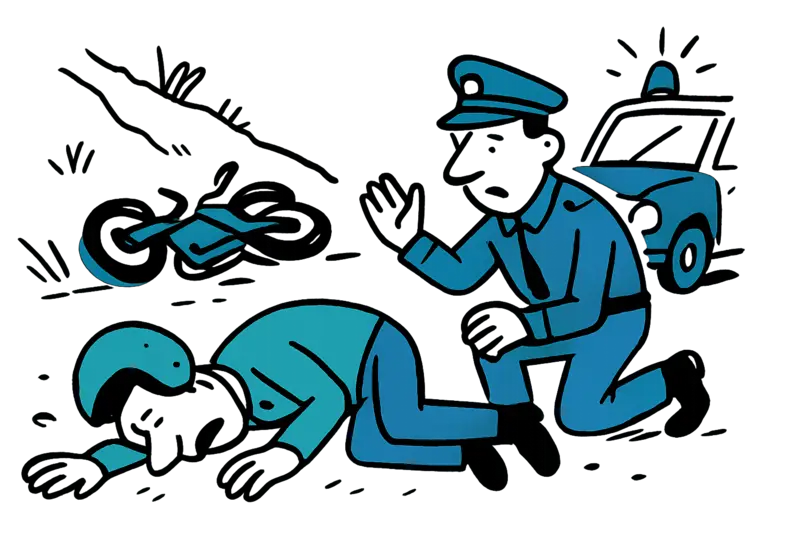
Around 10:15 pm last Friday, the silence along the Ma-1 was broken by sirens and flashing blue lights. A 48-year-old motorcyclist lay on the roadway after a fall near Portals Nous, only a few minutes from the harbor. Ambulances — one vehicle equipped with extensive life-support equipment and another providing basic care — as well as officers from the Guardia Civil arrived and treated the man on site. He was then taken in very critical condition to University Hospital Son Espases; the injuries: multiple fractured vertebrae and an intracranial hemorrhage.
Initial reports indicate the rider was wearing an open jet helmet. This helmet reportedly came off his head during the fall, causing his face to strike the asphalt directly. The accident site is on a section that transitions from Palma toward Andratx into a noticeable descent — a stretch many motorcyclists know and often ride with too much confidence.
Key question: Are legal helmet requirements and spot traffic enforcement enough — or do we need more fundamental improvements for mountain roads, steep gradients and the profile of our coastal routes?
Critical analysis: An open-face helmet offers little protection for the face; when the face impacts the road, the risk of serious facial and skull injuries increases significantly. On stretches with gradients and tight bends, speed becomes an additional risk factor. The Ma-1 near Portals Nous is popular with both local and tourist riders because of its smooth traffic flow. If an obstacle suddenly appears on a downhill section or a mistake is made, there is often little time to correct it — and the resulting injuries can be severe.
What is missing from the public debate: We talk a lot about radar controls and alcohol consumption, but seldom about the details that could prevent exactly these kinds of accidents: helmet types and their limitations, the importance of full protective clothing even on short rides, the condition of the roadway (grip, ruts), and whether sections with steep gradients are sufficiently signposted. Also largely absent: targeted information for foreign visitors, who may assess Mallorca's roads differently than locals.
An everyday scene: It is late evening, the neon signs at Portals Nous harbor are still flashing, café terraces are slowly filling up. A delivery van hums along the Ma-1, tourists look for parking spaces, and the deep bass from a bar vibrates a house wall. A motorcycle overtakes with too much momentum; a few hundred meters later the police stop — blue lights, a man on a stretcher. In no time a normal evening turns into an emergency for paramedics and relatives.
Concrete measures we should start now:
- Multilingual information campaigns at rental outlets and parking areas: emphasize the benefits of full-face helmets and complete protective gear.
- Technical measures on downhill stretches: additional signage, warnings for steep gradients, rumble strips or surface changes to reduce speed.
- Selective traffic enforcement: mobile controls in the evening hours on popular motorcycle routes; not only for speeding but also for risky maneuvers.
- Infrastructure checks: regular inspections of road surface, drainage and shoulders; small irregularities or ruts can throw a motorcyclist off line.
- Improved emergency communication: clearly marked rescue points on the Ma-1 for faster localization and shorter transport times.
For Mallorca this is not an abstract problem. Our island relies on roads that run through mountains and coastal landscapes. They are attractive for motorcycling but also treacherous. Authorities, the tourism sector and the riding community must work together: better information at rental shops, increased controls at critical points and a culture that sees protective gear not as "unnecessary baggage" but as part of the riding experience.
Pointed conclusion: This case at Portals Nous is bitter and teaches a clear lesson: laws alone are not enough. An open-face helmet offers less protection, a slope surprises more quickly, and the best rescue is prevention. If we don't focus not only on sanctions but also practically improve infrastructure, education and enforcement, we reduce the risk that such nights end up in the emergency room again.
Frequently asked questions
When is the best time to visit Mallorca for a beach holiday?
Is the sea in Mallorca suitable for swimming year-round?
What should I pack for a trip to Mallorca?
How can I get around Mallorca without a car?
What are the must-see places or natural spots in Mallorca?
Are Mallorca’s beaches suitable for families with young children?
What should I know about Mallorca's weather and packing for different months?
Are there easy day trips from Palma or other towns on the island?
Similar News
Boating in Mallorca: Which License Applies? A Reality Check
Since early October: rental boats only with proof of competence. What this means for residents and holidaymakers, which ...
Frontal collision in the Tramuntana: Who protects residents and spectators from risky driving maneuvers?
Near Fornalutx two motorcycles collided head-on. Shortly before the hill climb race, fans had gathered along the route. ...
FC Germania Mallorca aims for the top after just three matches
Newcomer FC Germania Mallorca hosts Deportivo Marratxi on Sunday at the Camp de Futbol La Nova Cabana. New reinforcement...

Etihad comes earlier: More flights between Abu Dhabi and Palma from May
The Gulf carrier shortens its summer break: from 16 May 2027 direct flights with the A321LR and premium cabins are expec...

Sudden braking at a pedestrian crossing in Palma: What this incident says about our streets
Three plainclothes police officers were nearly put at risk by a reckless driving maneuver at a pedestrian crossing in Pa...
More to explore
Discover more interesting content

Can Cap de Bou

Townhouse Lleo 72
