
Distraction at the Wheel: Why the Balearic Islands Suffer More — and What Steps Are Needed Now
36 percent of fatal accidents in the Balearic Islands are linked to distraction. Why are our islands hit so hard — and how can we stop the trend?
Distraction at the wheel: Why our islands see more suffering — and what that has to do with us
If you stand on the Ma-20 heading for Palma on a hot Tuesday morning, you hear more than engines: the steady hum of the motorway, a distant horn, now and then the beep of a phone from the queue. In the evening on the Paseo Marítimo, the sound of the sea mixes with the crunch of bicycle tyres and the brief clicking of displays. The balance is stark: on the Balearic Islands the share of fatal accidents in which distraction played a role is conspicuously high, as documented in Distracción al volante: más accidentes mortales en las Baleares — lo que debe hacerse ahora. The key question is therefore: why does it hit our islands harder — and what must happen now so that fewer people die?
More than a second of inattention: the local causes
Distraction looks like an individual failure. But on Mallorca and the neighbouring islands the conditions act as a catalyst. Narrow streets in Palma’s old town, many roundabouts, sudden access points to the Ma-20, plus a high proportion of tourists behind the wheel for the first time — all of this reduces the time window for proper reactions.
There is also a social factor: the island lives on constant availability. Landlords, hosts, employers and families send messages that are usually expected to be answered immediately. For many, "just a quick look" is normal, especially when navigation needs to be reprogrammed. And then there are rental cars: people with little local knowledge, often under time pressure, who must choose between the satnav, a roadbook and avoiding sunburn.
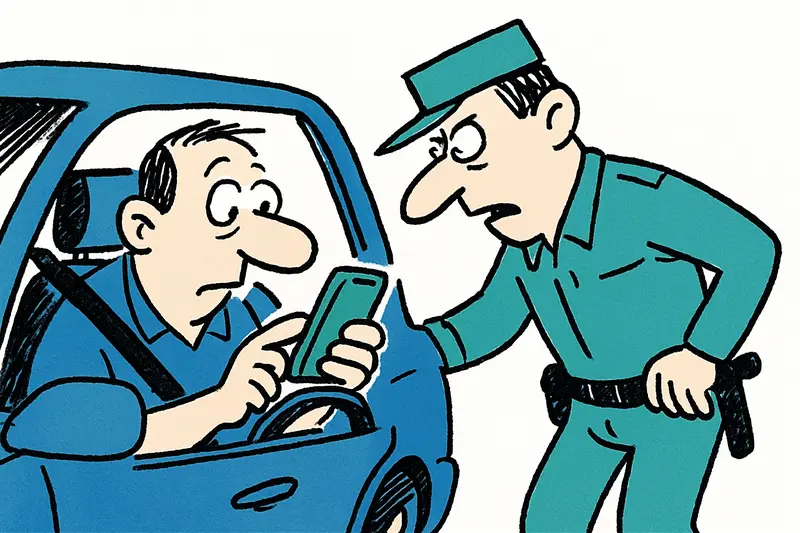
I once saw an older man at a checkpoint next to the Ma-20 who explained awkwardly: “I just checked the address quickly.” Sentences like that reveal the habit: what sounds harmless to him can be fatal for a pedestrian or cyclist.
What often gets left out of the public debate
The discussion quickly turns to fines and checks — important, no question. But the debate often overlooks structural approaches: why aren’t there mandatory warnings when rental cars are handed over? How could road layouts in holiday resorts be made safer? What responsibility do employers have who expect constant availability? And how do language barriers work: a foreign driver often interprets a traffic situation differently than locals.
Technology is usually seen as part of the problem, but it can also be part of the solution: driving modes, automatic replies or blocks for incoming messages already exist — yet they are rarely promoted systematically. Insurers, app providers or mobile operators could take action here.
Concrete measures — pragmatic and effective locally
Checks make sense, but they must be part of a larger package. Our islands need short-term implementable measures that have long-term impact:
1. Better data foundation: Totals alone are not enough. Where exactly do accidents happen? At what times? Which vehicle types, for example whether motorcyclists are disproportionately affected? Only with transparent evaluations can targeted measures be planned.
2. Mandatory notices with rental cars: A brief briefing at handover — multilingual, visible and mandatory — can reach many. A sign in the car with clear rules costs nothing but saves nerves and lives.
3. Road-engineering adjustments: Improve sightlines at junctions, expand pedestrian refuges, lower speed limits in tourist-dense areas and provide better signage on narrow side streets.
4. Technical cooperation: Collaboration with app developers, mobile operators and insurers to promote driving modes. Discounts or incentives for users of such safety features would be an incentive.
5. Cultural and corporate rules: Employers must communicate rules for work-related driving. Landlords and tourism associations should anchor the topic in their information materials. Schools and media can raise awareness in small, recurring campaigns — not just during the holidays.
What everyone can do right away
Short and pragmatic: set navigation before you start driving, put the phone out of reach or on speaker, mute notifications. If you have a passenger: delegate tasks. If you notice something dangerous: address it calmly but firmly or inform the local Guardia Civil or the Policía Local. A reminder on the spot often has more effect than a fine in the post.
Control weeks, extra patrols and speed checks send an important signal. Even more important is that this signal does not fade: if the outcry leads to lasting change — at rental desks, in companies, in apps and in behaviour on our roads — then on the next trip we will notice more eyes on the road than on the display. And that is worth it.
Have you observed a dangerous situation? Report it to the Guardia Civil or the Policía Local. Sometimes a reminder on the spot saves more than any statistic.
Frequently asked questions
Why is distracted driving such a problem in Mallorca?
What should I do with my phone before driving in Mallorca?
Are rental cars in Mallorca part of the distracted driving problem?
What traffic situations in Mallorca are most difficult for drivers who are distracted?
Can road design help reduce accidents in Mallorca?
Do tourists driving in Mallorca need extra safety guidance?
Who can I contact if I see a dangerous driving situation in Mallorca?
What is the simplest way to stay focused while driving in Mallorca?
Similar News
When Housing Becomes a Matter of Survival: Mallorca Between Rental Frenzy and Everyday Life
The case of 87-year-old Maricarmen showed that on Mallorca many people's lives are poised between affordable and uninhab...
Autumn in Mallorca: When Melancholy Gets a Window
Why autumn quietly tightens here — and how to make use of the mood: walks, culture, candles and the light from Palma to ...
Near-miss on Lanzarote: Landing Ryanair Jet and Iberia Takeoff — what really went wrong
On Lanzarote there was a dangerous incident: A Ryanair flight (FR5910) from Dublin landed on runway 03 while an Iberia E...
Eurowings introduces new Premium Business seats on Mallorca routes
From December 1, selected Eurowings flights to Palma and other destinations will feature eight particularly generous sea...
Car on MA-13 near Inca in flames – a safety check for the island
A vehicle caught fire on the MA-13 towards Alcúdia on Tuesday afternoon. The driver was uninjured, the car was destroyed...
More to explore
Discover more interesting content

Can Cap de Bou

Townhouse Lleo 72
