
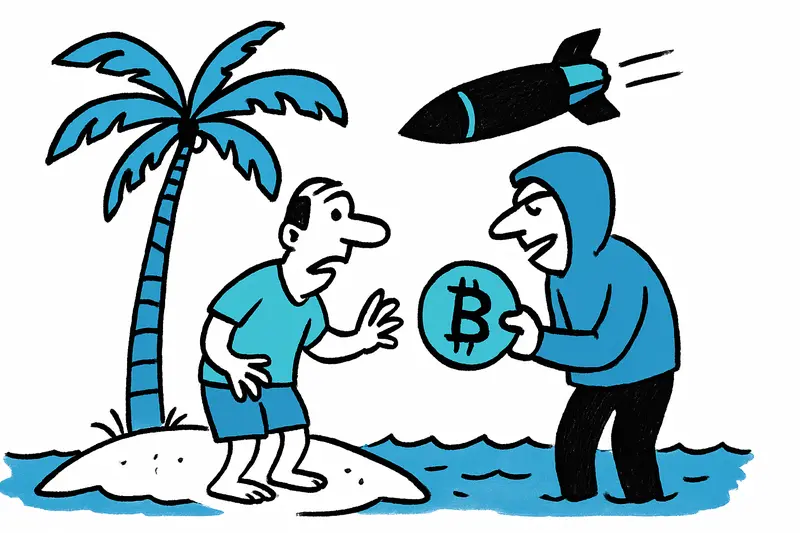
Balearic Islands Under Attack by Crypto Scammers: A Reality Check for the Island
Balearic Islands Under Attack by Crypto Scammers: A Reality Check for the Island
The National Police warn of rising crypto fraud cases in the Balearic Islands. How can residents and tourists protect themselves against convincingly produced fakes? A local reality check with concrete steps.
Balearic Islands Under Attack by Crypto Scammers: A Reality Check for the Island
Guiding question: How can people in Mallorca protect themselves from increasingly professional crypto scams?
The National Police issue a warning: attempts to defraud people using cryptocurrencies are rising noticeably in the Balearic Islands, as shown by local reporting such as Palma: How a crypto scheme nearly swallowed €68,000 — and why victims became helpers. Perpetrators lure victims with well-designed websites, fake social media profiles and manipulated profit notices. The consequences are real: people lose their savings, sometimes everything. The warning is clear. But is it enough?
If you walk through the Mercat de l’Olivar in the morning, you hear the same concerns you hear at Bar Cañota on Passeig des Born: "Did you see that investment? Sounds legit." Many people check their phones briefly, nod and move on. This is exactly where the fraudsters strike: speed, trust cultivated through presentation, and the loud promise of "quick profits." In an island economy where many families depend on tourism and invest online on the side, this creates fertile ground for such schemes, just as other crimes have shown the islands' vulnerability, for example Organized watch robbers in the Balearics: Why Mallorca must also stay vigilant.
Critical analysis: The schemes are not new, they are just more sophisticated. Professional design, technically flawless sites, testimonials in multiple languages and paid ads create an appearance of legitimacy where there is none. Victims report that the platforms appear to be regulated providers. Authorities warn against believing guaranteed returns. What public discussion rarely addresses, however, is the limited recoverability of cryptocurrencies, the language barriers when reporting fraud, and the gap between issuing a warning and providing concrete local help. Questions about resources surface in discussions such as Digital Shield for the Balearic Islands: Is the Budget Enough Against Invisible Attackers?.
What is missing from the debate? First: regional figures — how many cases lead to official reports, how many go unnoticed? Second: low-threshold advisory services in German, English and Catalan that explain locally how wallet transfers work and why lost coins are often irretrievable. Third: a coordinated response from banks, travel agencies and landlord associations that could inform their customers directly. In Mallorca, a police warning too often drowns in a sea of advertisements and tourist information.
An everyday scene: On a windy afternoon on Avinguda de Jaume III, an elderly woman sits on a park bench with a tablet. Her grandson has sent her a link via WhatsApp: "This is a safe platform that pays daily." She hesitates. She calls her neighbor. Neither of them knows the registration authorities, neither knows whether a payment can be reversed. Situations like this happen every day.
Concrete solutions that can be implemented immediately:
1. Check before you click: Before making a transfer, check the domain, the imprint and the registration number. Official registries in Spain — CNMV (Comisión Nacional del Mercado de Valores) and Banco de España — list authorized providers. If a provider does not appear there, keep your distance.
2. Start small: If you still want to test a service, start with small amounts. Large deposits to unregulated services are often irreversible.
3. Cultivate digital skepticism: Distrust of "guaranteed returns" is healthy. No reputable investment promises large, secure profits in a short time.
4. Technical checks: Use two‑factor authentication, avoid reusing passwords, and do not open emails and links uncritically. Tools like WHOIS can give hints about domain age — freshly registered sites are suspicious.
5. Report and network: Report suspicious sites and profiles to the Policía Nacional, but also inform local contact points at the town hall or consumer centers. The more reports authorities have, the better they can act against networks.
6. Local outreach: Town halls, community centers and banks should offer regular information booths — at markets, in front of supermarkets and at tourist hotspots. Short workshops in German, English and Spanish would engage many senses: listening, seeing and asking questions.
My conclusion: The police warning is important, but it is only the first step. In Mallorca we need more local prevention, simple advice and a network that provides quick help when coins are sent to the wrong wallets. Responsibility does not lie with the authorities alone: families, neighbors, businesses and banks must join in. If someone at the bar says, "I found a great investment," they should also be asked in future: "Have you checked it?" A bit of skepticism protects more than any lure of quick gains.
Frequently asked questions
How can people in Mallorca tell if a crypto investment is a scam?
What should I do before investing in crypto from Mallorca?
Can you get your money back after a crypto scam in Mallorca?
Why are crypto scams becoming more common in the Balearic Islands?
Where can people in Mallorca report a suspicious crypto website or profile?
How can older people in Mallorca avoid online investment fraud?
Is it safe to trust crypto ads on social media in Mallorca?
What local support is missing for crypto scam victims in Mallorca?
Similar News

Release after bloody attack in Palma: Why the court's decision raises questions
An 18-year-old who allegedly inflicted a serious neck injury on a man at Plaza Gomila using a wristwatch wrapped around ...
Kidnappings in Inca: Three young men forced into car trunks and abused in the forest – a reality check
In Inca, three 18-year-old men were forced into car trunks by masked assailants at the Plaça des Bestiar, taken to a for...
Spreading Massification: The Brake That Still Has Much Work to Do
Marga Prohens announces limits on volume tourism. The measures sound harsh — but are they enough to save everyday life, ...

Through the Keyhole onto the Party Yacht: How Daniela Katzenberger Is Planning Her 40th on Mallorca
Daniela Katzenberger turns 40 and wants to celebrate it on the island — likely with a boat, cake and her mother. A relax...
By Boat Instead of the Road: Palma's Water Bus — a Reality Check
The 'Bus Nàutic' launches in two stages — but questions remain over interim operations, fares and environmental requirem...
More to explore
Discover more interesting content

Can Cap de Bou

Townhouse Lleo 72
