
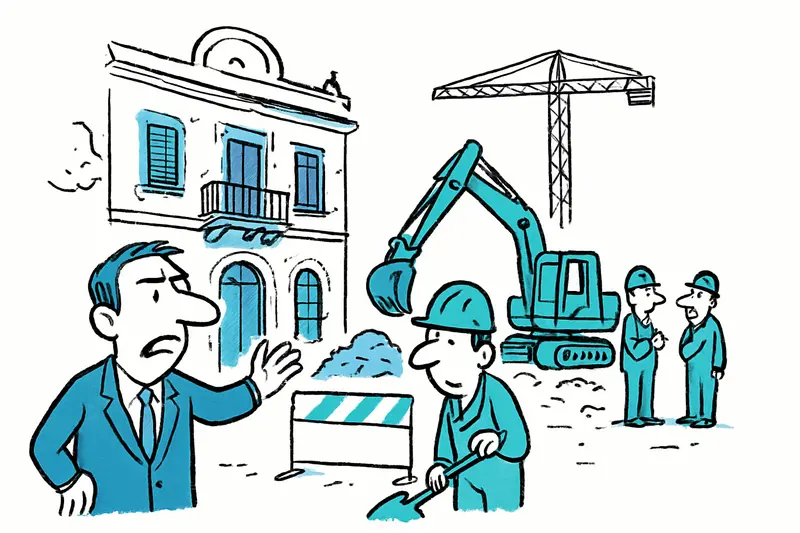
Bennazar House in Palma: Facade preserved — construction still contested
Bennazar House in Palma: Facade preserved — construction still contested
After months of standstill, construction continues on Calle 31 de Diciembre. The historic facade of the Bennazar building is to be preserved — but many questions about usage, transparency and the public realm remain unanswered.
Bennazar House in Palma: Facade preserved — construction still contested
Key question: Is saving a facade enough to truly protect cultural heritage?
On Calle 31 de Diciembre the morning bustle continues: delivery vans hop over the old cobbles, a bakery on the corner smells of freshly baked ensaimada, and the traffic light for the construction site beeps at short intervals. Amid this everyday noise the building by architect Gaspar Bennazar is a construction site again. Years of planning, a planned demolition, months of standstill — and now the order to preserve the historic facade; the demolition was halted in Palma. Sounds like a compromise. But is it really?
The facts in short: The investor originally planned the complete demolition of the house; afterwards 15 upscale apartments with parking spaces, storage rooms and commercial units were to be built. After objections from heritage authorities, preservation of the facade was demanded. Construction work continues. Those are the hard facts; the rest is a dispute about interpretation and consequences.
Critical analysis shows: facade protection can be symbolic without preserving the substance. Keeping a historic outer shell while completely modernizing the interior structure, volumes, materials and uses is a common practice — and it often satisfies neither preservationists nor the neighborhood. What is missing is a real plan for how the building remains part of the urban fabric: Who will use the commercial spaces? Will there be room for neighborhood needs or only exclusive units? And above all: who is responsible for long-term upkeep?
Three things are particularly lacking in the public debate: transparency about the investor's plans, concrete conditions from the city administration regarding use and preservation, and binding inspection mechanisms. Saying "the facade stays" and then only enforcing private interests is not enough. The city has instruments — such as contractual preservation obligations and re-use criteria — which apparently were not applied consistently. Where these instruments are missing, projects can exploit historic shells for modern profit objects without creating cultural added value.
A look at everyday life: On a Tuesday noon I observe retirees on a bench in front of the building, a market seller packing her fruit into boxes and a toddler pointing at the cranes as if they were new towers in the city. These people do not need a gimmick with historic facades — they want the public space to remain lively, shops affordable and housing not reserved only for the luxury segment. The smell of dust and fresh concrete mixes with the scent from the bakery; this is Palma, raw and direct. Here it is decided whether a building changes a neighborhood — for whom, that is the question.
Concrete solutions: First: any permit that requires facade preservation should be tied to a written maintenance and care obligation registered in the land register and binding for future owners. Second: usage obligations for ground-floor zones — for example a quota for local businesses or flexible, short-term rentable spaces — would prevent pure luxury commercialization. Third: an independent assessment of the building fabric and historical significance, financed in part by the investor and the city, would provide factual grounds instead of arguments. Fourth: public information boards at construction sites and a digital construction tracker would create transparency; neighbors could view schedules, noisy work windows and responsible parties. Finally: a municipal fund for the preservation of smaller cultural monuments, financed by a small share of municipal concession fees, could secure long-term maintenance.
Legal instruments exist; their application is often the weak point. Contracts with conditions on use and maintenance, follow-up inspections by municipal inspectors and clear sanctions for violations would not be regulatory fantasy but practical tools. One additional idea: for large-scale conversions a minimum share of affordable housing should be mandatory — not for populist reasons, but so that urban development does not serve only a few owners.
The Bennazar project is exemplary: it shows how local protest can have an effect — the facade stays — and at the same time how half-hearted solutions leave the door open for exclusive transformations that change the city's character. Those who love the city should ask critically: is preserving a facade as heritage protection sufficient when behind it a completely new, closed-off housing model is created?
Conclusion: The decision to preserve the Bennazar facade is not an endpoint but a question mark. Binding conditions, more transparency and municipal instruments that go far beyond the exterior shell are needed. Otherwise the protection of the cityscape becomes a sham — attractive to look at from the outside, but empty inside. For Palma that would be a loss you will smell in the dust and see in empty shop windows in a few years.
Frequently asked questions
What weather can you expect in Mallorca in early May?
Is May a good month for swimming in Mallorca?
What should you pack for a trip to Mallorca in May?
Is May a good time to visit Mallorca for outdoor activities?
What is Sa Pobla known for in Mallorca?
Why do people visit Pollença in Mallorca?
What makes Alcúdia a popular place in Mallorca?
What is the weather usually like in Mallorca in spring?
Similar News

When the Wallet Becomes a Danger: Attack in Peguera and Lessons for Mallorca
In Peguera, two women are said to have stolen the wallet from a 75-year-old German couple. When the victim intervened, t...
Plata stays Plata: Young people take over, Llonguets remain
A small bar on Carrer de l'Argenteria will continue: Tolo Serra hands the place over to young Mallorcans at the end of t...

Unnoticed in the Luggage Compartment: How a Boy Traveled More Than 100 Kilometers in a Team Bus
A minor traveled in the undercarriage of a team bus for more than 100 kilometers until his cries for help were heard. A ...

Cap Vermell Grand: Second Michelin Key – a Gift for the East
The Cap Vermell Grand in Capdepera has been awarded its second Michelin key. For the region this elevates the luxury off...

Eurowings lets four aircraft carry names – a friendly idea that also reaches Mallorca
Eurowings is launching a campaign: four Airbus A320s are to carry the first names of people who help others in everyday ...
More to explore
Discover more interesting content

Can Cap de Bou

Townhouse Lleo 72
