
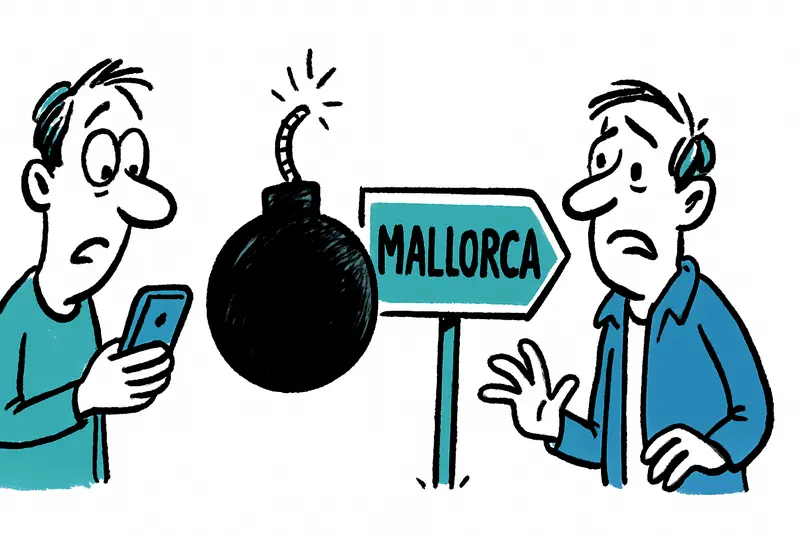
Bomb threats paralyze Europe — what does this mean for Mallorca?
Bomb threats paralyze Europe — what does this mean for Mallorca?
Several anonymous bomb emails recently caused diversions, evacuations and military escorts. A stocktaking from a Mallorcan perspective — and a look at what is missing.
Bomb threats paralyze Europe — what does this mean for Mallorca?
Key question: How well is Mallorca prepared for repeated bomb threats sent by email — and what do authorities, airports and airlines need to do differently now?
In recent days, anonymous emails claiming bomb threats have disrupted multiple flights and airports across Europe. Aircraft were diverted, passengers evacuated, explosive experts deployed, and in one case a flight was escorted by fighter jets. For travelers, crews and airport staff this is no longer an abstract risk but a logistical nightmare.
It is noticeable that routes served by low-cost carriers seem to be affected more often. Many routes that connect Mallorca with the continent are operated by low-cost airlines. When a threat email hits a plane en route to Sofia, Rome, Vienna or Copenhagen, there are immediate consequences for connections, baggage logistics and for people waiting at Palma (Son Sant Joan) for incoming flights.
Critical analysis
The response by security forces is routine: diversion decisions, evacuations and disposal protocols have already prevented worse outcomes. But routine does not fix the structural weaknesses that such waves of alarms reveal. First, each search ties up limited specialist teams and delays normal airport operations; second, passengers and staff suffer from information deficits; and third, the high frequency of false threats places constant pressure on security infrastructure.
The escort by military jets highlights another dimension: when civilian response options reach their limits, the state switches to a military emergency mode. That may be appropriate in individual cases, but it is expensive, logistically demanding and generates additional distrust among residents and travelers.
What is missing from the public debate
There is much reporting on the spectacular moments — jet escorts, evacuations, emergency landings. Hardly discussed, however, are the following: Who bears the costs of massive diversions and long ground times? How is ground staff given psychological support after repeatedly handling delicate operations? Which technical gaps in mail and cyber monitoring allow such series of emails in the first place? When Servers Strike: How a Cyberattack Disrupted Flights to Mallorca And finally: is there a coordinated, Europe-wide information duty toward passengers?
These questions are not details; they concern the system. Without answers, airports remain vulnerable — not only in Madrid, Rome or Sofia, but also here in Palma. A recent local example was a bomb alert in Palma that proved a false alarm.
Everyday scene from Mallorca
Early in the morning, when the tram to Passeig Mallorca is still half empty and the espresso machine hums quietly in the corner café, many Mallorcans receive news of diversions and evacuations on their phones. At Son Sant Joan airport you see travelers with suitcases asking: Will I make my connection? On bus 1 toward the city center people discuss delays, and an older couple worries about their return flight in the evening. These small, everyday reactions show how quickly distant incidents reverberate back into island life.
Concrete solutions
- Harmonized reporting chains: A clear, Europe-wide protocol for warning emails that quickly assesses and prioritizes email sources would buy time and exclude false alarms faster.
- Better communication with passengers: Automated, verified SMS or app notifications from airport and airline about status, connection rules and support services reduce uncertainty at baggage belts and in cafés around Son Sant Joan.
- Strengthening regional detection units: Investment in mobile explosive detectors and regular training for ground staff at regional airports would prevent every report from immediately tying up national resources.
- Cyber forensics and prevention: Origins of mass emails are often concealed. Closer cooperation between telecom providers and security authorities can close attack paths more quickly. When Servers Strike: How a Cyberattack Disrupted Flights to Mallorca
- Social support for staff: Regular psychological support services and financial arrangements for unforeseen duty hours relieve airport employees (for related lessons, see When Mental Health Crises Disrupt Air Travel: Lessons for Mallorca After the Nuremberg Incident).
Pragmatic conclusion
The island does not need panic, but it does need a plan. Mallorca is part of a European air traffic network — when disruptions occur there, we feel the impact in Palma within hours. Security today means not only more checks, but faster information, targeted technical investments and fair rules for affected travelers and employees. This should include a public debate about local infrastructure, including proposals such as a munitions bunker near Son Sant Joan. Otherwise we will continue to hear the roar of jets on every diverted flight day and watch queues at the terminal without knowing whether the next alarm is just a prank or a real emergency.
One final practical tip for travelers: check your airline messages shortly before departure and save the local airport hotline in your phone. It is a small effort that can prevent a lot of uncertainty.
Frequently asked questions
How prepared is Mallorca for repeated bomb-threat emails across Europe, and what should airports adjust?
Palma de Mallorca: how can the airport improve passenger communication during disruptions?
Why are Mallorca's routes with the continent more affected by mass-threat emails?
What are the broader costs of diversions and emergency responses for Mallorca's airports and residents?
How could Europe-wide information sharing help travelers connected to Mallorca during security alerts?
What security upgrades are suggested to strengthen Mallorca's regional response to mass email threats?
What should travelers departing from Palma (Son Sant Joan) check before departure to avoid uncertainty?
How do bomb-threat disruptions shape everyday life in Mallorca?
Similar News
TV tip: A Wollny daughter on the Bierkönig stage – why Mallorca briefly takes notice
Estefania, a daughter from a well-known large family, stops in Palma and sings at the Bierkönig season opening. A light ...
Almost four in ten purchases by foreigners – Who still owns Mallorca?
The share of foreign property buyers in the Balearic Islands climbed to 37.19 percent in the third quarter. At the same ...
Night ride against the flow: Cyclist on the Vía de Cintura hit by car
An approximately 60-year-old cyclist was struck by a car on the Vía de Cintura at around 23:15 near the roundabout of Ma...
After the eviction in Lloseta: Knife attack raises questions about safety and housing policy
Upon returning to the recently cleared house in Lloseta, two men were stabbed by a 28-year-old. The incident exposes gap...
Villa Cortina in Formentor: From Demolition Order to Luxury Listing — How Much Landscape Protection Is Left?
The controversial Villa Cortina in Formentor is back on the market — nine years after a disputed legalization. What does...
More to explore
Discover more interesting content

Can Cap de Bou

Townhouse Lleo 72
