
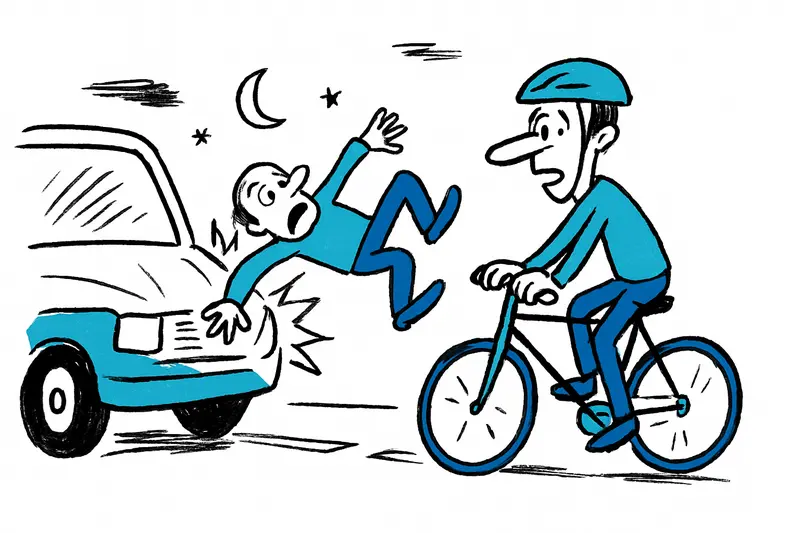
Night ride against the flow: Cyclist on the Vía de Cintura hit by car
Night ride against the flow: Cyclist on the Vía de Cintura hit by car
An approximately 60-year-old cyclist was struck by a car on the Vía de Cintura at around 23:15 near the roundabout of Manacor street. Key question: How safe are our roads after sunset?
Night ride against the flow: Cyclist on the Vía de Cintura hit by car
Key question: Why does a person end up at night on a road for motor vehicles — and who makes sure this does not happen?
An estimated 60-year-old man was riding on the Vía de Cintura in the opposite direction last Wednesday at about 23:15. At the height of the Manacor roundabout a car had just left the tunnel beneath, encountered the cyclist and collided with him, a scenario reminiscent of Skid Hazard on the Vía de Cintura: Burst Pipe Triggers Serious Motorcycle Accident. Emergency services took the injured man to Son Espases hospital. The man had no identification on him.
I visited the scene later: the asphalt still gleamed from recent rain, the air smelled faintly of exhaust and pine. In the dim light two Guardia Civil patrol cars were parked, spotlights scanned the embankment, and a crane lifted the damaged car onto a flatbed. The Vía de Cintura, a road intended for fast motor vehicles, suddenly felt like the scene of something that should not have happened.
Critical analysis: Riding a bicycle on high-speed roads is dangerous by nature. In Spain, motorways and many dual carriageways are not suitable for cyclists; signage and traffic rules usually exclude bicycles. Yet people still end up there out of desperation, disorientation, alcohol influence, or because they are seeking the most direct route. The accident illustrates a collision of infrastructure, enforcement and social reality, an issue also highlighted after Third traffic death in a few days: Do Palma's night streets need to be safer?.
What is often missing from public debate: the discussion typically ends with assigning blame — cyclists versus motorists — and legal questions. Less attention is paid to why someone gets onto that road at night: Was there missing lighting, unclear signage, or blocked alternative routes? Was the person disoriented or medically impaired? Did they suffer an e-bike breakdown or were they someone without stable housing? Such details often remain in the shadows during investigations.
A daily scene from Palma that explains the problem: after shops close around midnight I get off the bus at Plaça d'Espanya. Garbage bags lie by the curb, the small bar closes after its last guest. You hear the rumble of lorries on the Vía de Cintura, red taillights, occasionally a bicycle bell from the Passeig Marítim, as in Seriously injured on Palma's Paseo Marítimo: An accident, many questions — but whoever heads across to the fast road in the middle of the night does not do so without reason. Disorientation and time pressure are real factors.
Concrete approaches we should seriously examine immediately:
1) Increased visibility and blocking: Assess whether night-time access points to the Vía de Cintura can be better secured; clear barriers at entrances that allow motorized traffic but prevent bicycles.
2) Lighting and signage: Better, highly visible signs before entry points and junctions, retroreflective markings and targeted night lighting at critical spots such as the tunnel under the Manacor roundabout.
3) Open alternatives: Expand and sign safe bike routes parallel to the ring; signage that points to accessible cross-connections at night.
4) Prevention and social support: Night patrols or mobile teams that show presence and assist people in need; cooperation with social services for people without papers or housing.
5) Visibility for cyclists: Awareness campaigns for cyclists on the importance of reflectors, lights and high-visibility clothing, combined with low-cost distribution in problem areas.
6) Data and enforcement: Systematic recording of such incidents by traffic authorities so recurring danger points can be identified and prioritized for remediation.
All of this costs money, time and organization. Still: if a crane spends half the night recovering a car, that is expensive and symbolic of a system leaking in several places. The Guardia Civil managed traffic and island council specialists cleared the carriageway. Good work, no question. But if every night shift becomes an emergency operation instead of targeted prevention, the response remains reactive.
Pointed conclusion: It is not enough to recover accident victims; we must create conditions that prevent people from getting onto the Vía de Cintura in the first place. A bit of road engineering, some signs and more night services help — but above all there must be awareness that road safety is also a social responsibility.
The man in hospital is now in the hands of the doctors. For the rest of us the question remains: who do we call the next time we see a silhouette in the headlights at night?
Frequently asked questions
Why do cyclists ride at night on Mallorca's fast roads, and is this common or legal?
What practical steps can reduce nighttime cyclist dangers on Mallorca's Vía de Cintura?
What gear helps you stay visible when cycling in Mallorca at night?
What happened on the Vía de Cintura near the Manacor roundabout in Mallorca?
What measures are proposed to prevent night-time cyclists from entering Mallorca's Vía de Cintura?
How are night-time road incidents recorded and investigated by authorities in Mallorca?
Where can I find safer cycling routes around Palma and how are they signposted?
What social and policing support exists in Palma and Mallorca to prevent dangerous night-time road situations?
Similar News
After the eviction in Lloseta: Knife attack raises questions about safety and housing policy
Upon returning to the recently cleared house in Lloseta, two men were stabbed by a 28-year-old. The incident exposes gap...
Villa Cortina in Formentor: From Demolition Order to Luxury Listing — How Much Landscape Protection Is Left?
The controversial Villa Cortina in Formentor is back on the market — nine years after a disputed legalization. What does...

Meliá Takes Over Beach Hotel in Cala Millor – a Boost for the East Coast
The long-established hotel company Meliá took over a 171-room property in Cala Millor on November 1. Direct beach access...
The Sweet Comeback: Carob, a Museum and a Chance for Mallorca's Countryside
In Llucmajor an old cultivated plant has found new fans: at Finca Ca s’Hereu the Museu de la Garrova shows how the brown...

Escarrer inheritance dispute: Who controls the votes in the family empire?
Four grandchildren demand shares — and encounter family rules, contractual obligations and a power core within the hotel...
More to explore
Discover more interesting content

Can Cap de Bou

Townhouse Lleo 72
