
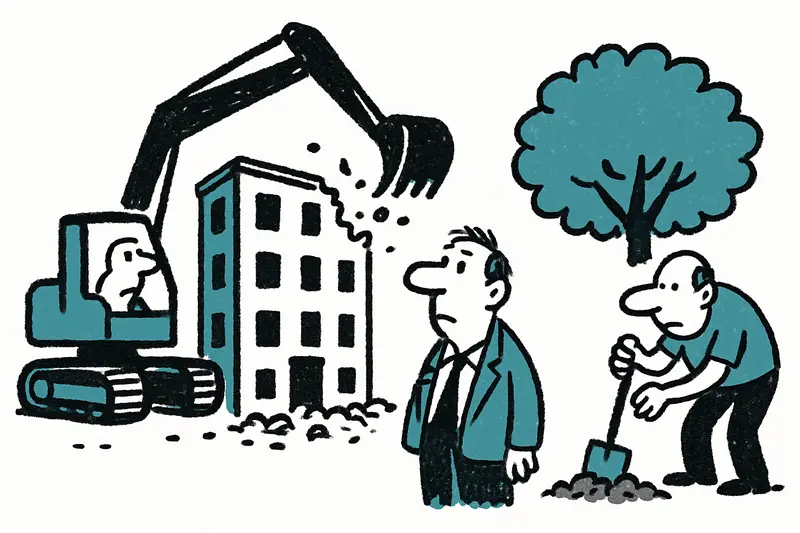
Vacancy turns green? Calvià plans demolition of two hotels – opportunities and risks for Paguera and Magaluf
Calvià has announced the demolition of the vacant Hostal Colón in Paguera and the Hotel Teix in Magaluf. New green spaces are planned — but questions remain about jobs, participation and environmental safeguards.
Vacancy turns green? Calvià announces two demolitions
If you pick up your morning espresso from the café on the promenade in Paguera, the abandoned building on Calle Marivent stands out: the former Hostal Colón. Cold concrete in the backlight, a few scraps of paper in the wind and the seagulls cooing over the roofs. 36 beds, almost 600 square meters – and now a date: demolition is scheduled for November, as noted in the Mallorca-Magic report on demolition and green spaces in Paguera and Magaluf. Shortly afterwards the Hotel Teix in Magaluf is on the list; similar moves have included the town hall's plan to demolish long-closed shops in the area, according to the Mallorca-Magic report on Calvià's plan to demolish eleven vacant shops in Magaluf. The municipality talks about new green spaces on both plots. Pleasant to look at, but the question remains: who wins, who loses?
What exactly is planned – and who pays
The town hall says the costs for the deconstruction amount to around €1.5 million and would be financed from the European 'Next Generation' fund information. Directly afterwards the area is intended for new public open spaces: benches, shade-giving trees, maybe a small play area. There are no concrete designs yet; the planning phase is to start in the coming months. Until then many details remain open – and with them room for fantasies and fears.
Neighborhood between relief and concern
"In summer it was often loud and crowded. A small square with trees would be a relief," says María from Calle Marivent as she pushes her bicycle. Such voices paint a picture of residents longing for places to stay: shade against the midday heat, a patch of green against the concrete. On the other hand is Toni, who has worked in a bar on the coast for a decade: "Fewer rooms means fewer seasonal jobs."
Critical questions that are not being asked enough
The planned demolition raises several barely audible but relevant questions. First: What are the consequences of the land-use change for employees? Seasonal jobs are often precarious, but they are part of family and household plans. Second: How will the municipality deal with potential pollutants in old buildings – WHO asbestos factsheet, old insulation materials, contaminated paints? Third: Who decides on the design of the new spaces, and how will neighborhood interests be included?
Environmental requirements are necessary – and often expensive
The town hall emphasizes dust protection, proper disposal following the EU guidance on construction and demolition waste and inspections. Such measures are important so that residents do not end up paying the bill for careless demolitions: fine dust on hot days settles in doorways, apartments and lungs. In practice, strict environmental requirements can make deconstruction more expensive and extend the schedule. That means: more money, more paperwork – and possibly longer uncertainty for local people.
Concrete opportunities and practical solutions
A demolition is not only a loss, it is also an opportunity. To ensure the opportunity does not remain wishful thinking, here are concrete proposals Calvià should actively consider now:
1. Secure employment: Contracts with demolition companies should include conditions to employ local seasonal workers, training offers for deconstruction work and placement programs into municipal green maintenance or construction projects.
2. Reuse materials: Many old buildings contain reusable material – paving stones, doors, tiles. A local reuse depot could create jobs and improve the climate balance.
3. Make citizen participation binding: Public design workshops, voting rounds and mobile information booths in Paguera and Magaluf – transparency must not remain a slogan, following UN-Habitat guidance on public participation.
4. Flexible interim use step: Instead of planting immediately, interim uses (pop-up park, market spaces, art installations) could be tested. That creates user experience and prevents hasty designs.
5. Environmental monitoring: Independent experts and regular air and soil measurements during the demolition. Residents should have easy access to the results.
Between symbol and strategy
It is tempting to read the removal of a dilapidated building as a symbolic new beginning: an ugly facade gives way to a palm tree, a pine, a small playground. But on Mallorca success is not decided only by the image. It is shown in concrete, well-managed transitions for employees, in sustainable use of resources and in genuine participation of the neighborhood.
What happens next
The municipality still has time: until November questions can be asked, concerns expressed and ideas submitted. Anyone who wants to know more about what will emerge after the diggers should follow the public meetings at the town hall – or look out for neighbors discussing it over an espresso at the harbour. If Calvià uses the planning phase well, a demolition could become more than a construction site: a pilot project for a greener, more social approach to vacancy. If not, it will remain pretty plans and a few trees on a hot summer day.
What matters is balance: not just green for the photos, but green with a face – jobs, transparency and real involvement of the people who live here.
Frequently asked questions
Why is Calvià demolishing the former Hostal Colón in Paguera?
What will replace the Hotel Teix site in Magaluf?
When will the demolitions in Paguera and Magaluf take place?
Who is paying for the demolition work in Calvià?
Will the new green spaces in Paguera and Magaluf be open to everyone?
Could the demolition of old hotels in Mallorca affect local jobs?
Are old buildings in Mallorca checked for asbestos before demolition?
How can residents in Paguera and Magaluf give input on the new public spaces?
Similar News

After Being Admitted to Hospital Again: Heinz Hoenig and the Questions We Should Ask in Mallorca
Long-time Mallorca resident Heinz Hoenig was admitted to hospital again. A clear “what next?” is missing from the covera...
Yellow Alert: Is Mallorca Prepared for the Next Rain Band?
Aemet has issued a yellow alert for the south, southwest and the island's interior. Thunderstorms and heavy rain are for...
Kegel brothers trial postponed: Why Mallorca must wait for a verdict
The trial of 13 German holidaymakers will not begin until May 2028. The long wait raises questions — for victims, defend...

Chaos on Palma's Runway: Why the Summer at the Airport Was So Disrupted
This summer laid bare where Palma airport is faltering: only just over half of departures were on time and seven percent...

Cocaine Offer on Ham Street: Why the Open Trade Should Ring Alarm Bells
In the middle of Pare Bartomeu Salvà a tourist was offered a packet of cocaine as part of a sunglasses deal. A short int...
More to explore
Discover more interesting content

Can Cap de Bou

Townhouse Lleo 72
