
When Rescuers Stand Down: Why the Lifeguards' Strike in Calvià Is More Than Just a Loud Bang
When Rescuers Stand Down: Why the Lifeguards' Strike in Calvià Is More Than Just a Loud Bang
Lifeguards in Calvià have called a strike for August 23. What's behind the conflict, what risks are looming — and what is missing from the public debate?
When Rescuers Stand Down: Why the Lifeguards' Strike in Calvià Is More Than Just a Loud Bang
Key question: Is a safety vacuum threatening the beaches next Sunday — and who is responsible?
On August 23 the lifeguards of Calvià plan to stop work. This is not a protest that happens behind closed doors: affected are bathing areas like Portals Nous, Illetes, La Romana and El Toro — places where in high summer every minute counts. The union Unió de Socorristes de Calviá cites dilapidated lookout posts, excessively long shifts and a lack of appreciation as reasons. The municipality rejects the allegations and calls the action irresponsible; it stresses that it is working on improvements. The situation remains contradictory.
Brief overview: In Calvià about 11 of roughly 30 bathing areas are currently actively supervised. The official watch period formally runs from May 1 to October 31, even though the beaches are used commercially from mid-March to the end of November. Last year there were seven drowning cases, of which, according to the rescuers, five occurred at unsupervised sections or outside monitored hours. In addition there are reports of defective or poorly equipped towers (La Romana, El Toro), no proper station at Balneario Illetes, communication problems and only four beaches with reliable offers for people with reduced mobility.
Critical analysis: The pattern is clearer than the few statements on paper. First: the time gap between commercial use and actual supervision creates a risk window — especially on weekends with heavy visitor numbers. Second: infrastructure deficiencies are not merely cosmetic; missing wash facilities, unclear emergency routes or run-down towers weaken response procedures and increase stress for teams. Third: communication failures are not just an annoyance, they can break lifelines. That a private mobile phone was needed for a resuscitation attempt in Portals Nous is a warning sign.
What is missing from the debate: The discussion often narrows to mutual accusations between the union and the municipal administration. Important questions remain unasked: How is personnel planning carried out in detail? Are there objective inspections and maintenance protocols for the towers? Who is responsible for access routes and sanitary infrastructure at individual coves? What do robust emergency chains look like if radio connections fail? And: How are people with disabilities concretely included — not only in press releases but in practical access routes and assistance offers?
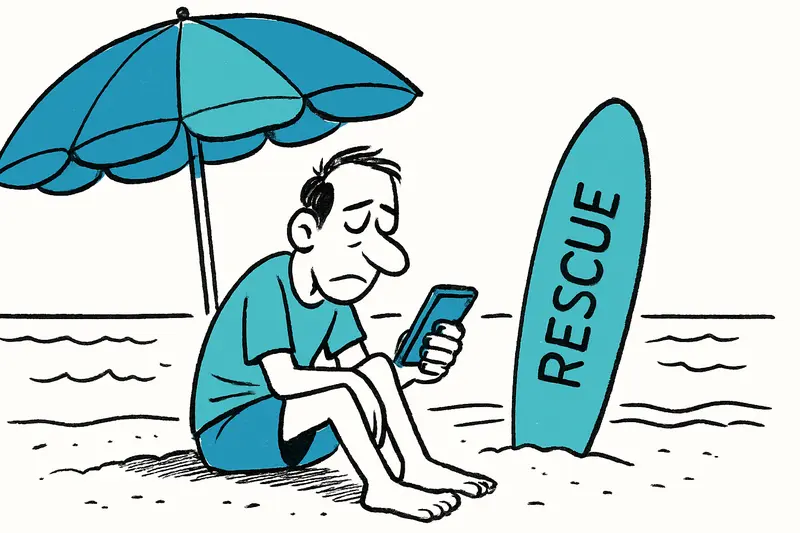
An everyday scene from Illetes: Morning, the smell of sunscreen in the air, voices in Spanish, German and English mixing with the cry of the seagulls. On the sand there is no proper watch post, only a folding beach umbrella and a rescue board in the shade. The rescuers who are present sit on the ground, phone in hand — and wait. Such observations are not isolated; they repeat at several locations along the southwest coast.
Concrete solutions (not a wish list, but a priorities list): 1) Immediate emergency arrangement for the strike day: a clear, public contingency plan with alternative alarm chains, additional temporary personnel from neighboring municipalities and prioritized presence at tourist hotspots. 2) Short-term infrastructure measures: provisional wash and hygiene stations at La Romana and El Toro, portable radios with redundant connections (e.g. mobile network + VHF) and clear maintenance checks for towers. 3) Consider extending the season: cover weekend service in March/November at heavily used beaches. 4) Expand accessible access: short-term ramps and mobile toilets at additional beaches, medium-term binding standards for all monitored sections. 5) Personnel policy: fixed minimum staffing levels, regulated breaks, rotation to reduce stress and a mandatory mental health support offer. 6) Transparency: external audits of equipment and operational plans by independent bodies and a publicly viewable defect list with a timetable for remedies. 7) Legal clarification: if a union does not have legal mandate for all employees, this must be taken into account in negotiations — but that must not be the only response.
What must happen now: Politics and administration should take the risk situation seriously instead of exchanging accusations and denials. For the coming Sunday moral appeals alone are not enough. Quick action is needed on the beaches and clear information for tourists and locals: Which sections are supervised, which are not, and which emergency numbers are available?
Pointed conclusion: The strike is both a symptom and a warning light. When towers decay, radio links falter and protection times lag behind tourist use, a safety gap opens at the waterline. Calvià cannot manage this halfheartedly. It is a matter of human lives — and of respect for a job that is often noticed only when it is absent.
Frequently asked questions
Why are lifeguards in Calvià planning to strike and what safety concerns does that raise?
Which beaches in Calvià could be affected by the strike and what does that mean for swimming?
How do the official watch periods relate to actual beach use in Mallorca?
What concrete steps are proposed to address safety gaps if the strike continues?
What questions should authorities answer to improve beach safety beyond the current debate?
Why is the strike seen as both a symptom and a warning for Mallorca’s coastal safety?
What should visitors do to stay safe if Sunday beaches are not supervised in Calvià?
How might accessibility for people with reduced mobility be affected by the strike, and what’s proposed?
Similar News
Pickpocketing at Ballermann: What the intervention of two off-duty police officers shows
Two off-duty officers stopped two suspected pickpockets near Playa de Palma and secured the victim's phone and wallet. T...
Short Jump, Big Fright: Pregnant Holidaymaker Falls on Rocks at s'Arenal
A 29-year-old British woman, ten weeks pregnant, jumped into the water near the jetty at s'Arenal on Monday afternoon — ...
Who Pays the Price? Why Holidaymakers in Mallorca Are Now Skimping on Excursions and Taxis
Several bus companies report idle capacity, and taxi drivers notice more cautious guests. Our guiding question: How deep...
Off-duty police officers stop thieves at Ballermann – a reality check
Two off-duty police officers observed on Playa de Palma how two men stole a tourist's phone and wallet. What does the in...
Two Children on a Windowsill: A Nightmare Raising Questions About Supervision Duty in Mallorca
In Palma, two minors balanced on a narrow third-floor windowsill while the grandfather responsible for supervision slept...
More to explore
Discover more interesting content

Boat Tour with BBQ along Es Trenc Beach

Private transfer from Mallorca Airport (PMI) to Pollensa
