
Who Pays the Price? Why Holidaymakers in Mallorca Are Now Skimping on Excursions and Taxis
Who Pays the Price? Why Holidaymakers in Mallorca Are Now Skimping on Excursions and Taxis
Several bus companies report idle capacity, and taxi drivers notice more cautious guests. Our guiding question: How deep does the pressure to save go — and what does it mean for everyday life in Mallorca?
Key question: How deep does the holidaymakers' pressure to save go and who feels it first in Mallorca?
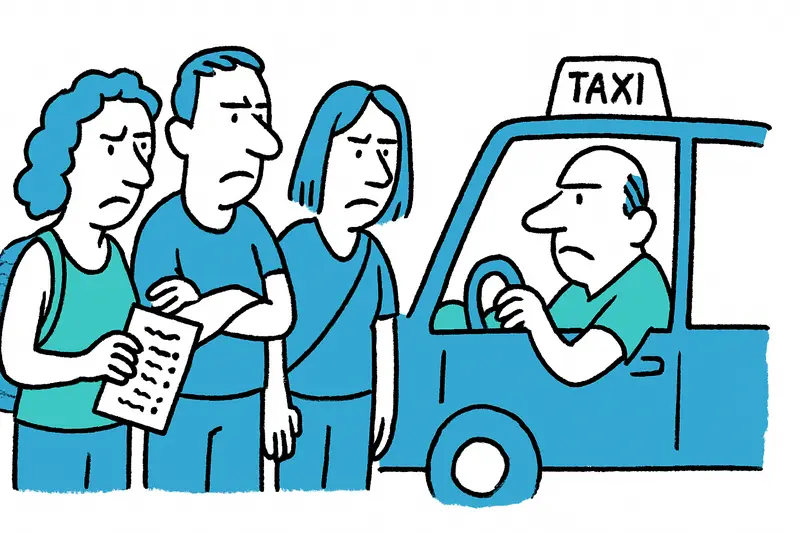
On the Passeig Marítim in Palma, in the middle of August, a hotel air conditioner hums, a few taxi drivers sit in the shade under a parasol and exchange barely audible glances. In the tourist centres you see more suitcases than bookings for organised tours. The figures reported by bus operators and the taxi association match this picture: demand for large, organised bus excursions has collapsed; on some days more than a hundred coaches stood idle — while taxi drivers report more restrained passengers.
The situation is visible not only in parked buses. Hotels and flights now take a larger share of many guests' budgets. Those who previously booked an excursion or a taxi without thinking now calculate twice. Booking decisions are increasingly spontaneous, individual and often cheaper: smaller transfers, Why Rental Cars in Mallorca Have Become Noticeably More Expensive — and What You Should Know or walks instead of full-day coach tours.
Critical analysis: Thin wallets, heavy consequences
For bus operators the problem is visible and structural: empty coaches mean fixed costs that cannot be covered by sporadic small bookings. Smaller, more individual providers pick up some customers but cannot replace the volume that large groups used to bring. The taxi industry is experiencing less dramatic declines, but a noticeable shift in spending behaviour: short rides instead of longer transfers, bargaining over prices, and fewer spontaneous Empty Tables, Tight Wallets: Mallorca's Gastronomy at a Crossroads.
On the demand side the reasons are obvious: Rising Cost of Living in Mallorca: Who Pays the Price? — higher flight prices, more expensive accommodations; simple arithmetic, every extra activity is scrutinised. On the supply side, however, the public debate lacks a clear picture: How flexible are bus companies with pricing? How quickly can they switch to smaller groups? And what role do intermediary platforms play that take commissions and push up ticket prices?
What's missing from the public discourse
The discussion focuses almost exclusively on the obvious consequences: lower occupancy, lost income and Emptier sunbeds, growing worries: How is Mallorca reacting to more frugal beachgoers?. Little attention is paid to how much seasonality and dependence on standardised packages make Mallorca's providers vulnerable. Also rarely discussed is the coordination between hotels, transport companies and local businesses: if everyone stubbornly sticks to old routines, the system remains fragile. The perspective of employees — drivers, tour guides, small intermediaries — also appears too rarely.
Everyday scene from Mallorca
A Wednesday noon in Port d'Alcúdia: a group of German guests strolls along the quay, loudly debating the next kiosk and cancelling a planned boat trip. "Too expensive," says a woman showing a list of expenses. A minibus pulls up but remains without passengers. The driver switches off the engine, leans back and watches the waves. Such small scenes are becoming more common now — not dramatic, not alarming, rather stubbornly persistent.
Concrete approaches
The island needs pragmatic adjustments, not theoretical debates. Proposals that could work:
Coordination instead of competition: Hotels could make framework agreements with bus companies for half-day, discounted tours aligned with spare capacity. This keeps revenue in the region and reduces empty runs for providers.
Flexible products: Instead of rigid full‑day excursions: short trips, modular offers that guests can assemble on site. This responds to the trend toward individualisation.
Shared platforms for small providers: A local booking network with lower commissions could reduce intermediary costs and encourage spontaneous purchases.
Shift and fleet management: Bus companies should deploy their fleets more dynamically — e-mini buses for small groups, pooled transfers at peak times, closer planning with organisers.
Transparency and combo offers: Bundles (taxi + museum, boat trip + lunch) with a visible price advantage help guests justify the expense.
Pragmatic conclusion
Guests' frugality is not a mood issue; it is a reaction to real costs. Mallorca is not a global casino but an island with many small incomes. If politicians and the industry continue to act as if everything is normal, empty seats and noticeably less tipping will remain. Those who want to react responsibly must bring local partners together, downsize products and make offers clearer. Otherwise the island will pay the price — not as a headline, but as a quiet everyday reality: fewer jobs, less diversity, more empty places at the harbour.
Frequently asked questions
How is Mallorca's tourism changing this season regarding excursions and taxis?
What practical options exist for travellers who want to still see Mallorca without breaking the bank?
Why are large bus excursions less common in Mallorca right now?
Are there coordinated, cost-effective ways for hotels and transport to work together in Mallorca?
What are some practical signs that Mallorca tourism is adapting at the guest level?
How could small providers survive in Mallorca when big groups decline?
What real-life scenes in Mallorca illustrate visitors cutting costs?
How can travellers spot affordable, transparent deals for Mallorca activities?
Similar News
Serious Fall at the Son Ferriol Roundabout: Who Protects Us from Gaps in Road Design?
A 77-year-old driver fell early Saturday morning with his car from the upper section of a roundabout in Son Ferriol. The...
Inca in Toilet Stress: Why Wet Wipes Are Crippling the Sewer System — and What Needs to Happen Now
The city of Inca warns: wet wipes are clogging almost all wastewater pipes. A guide to why this happens, what's missing ...
Control with a Mask in Santanyí: Protest, Culture or Administrative Offense?
In Santanyí the local police escorted a traditionally masked activist away. Was it an identity check, an administrative ...
Up to €9,000 Fine in Inca: Why Wet Wipes Can Blow Up the Sewers — and What We Should Really Do
The municipality of Inca warns of blockages caused by wet wipes — fines of €300 to €9,000 are possible. A reality check:...

World Cup Trophy in Palma: Two Days Up Close
The World Cup trophy is coming to Palma at the end of October: two days on display at City Hall, and on 31 October photo...
More to explore
Discover more interesting content

Can Cap de Bou

Townhouse Lleo 72
