
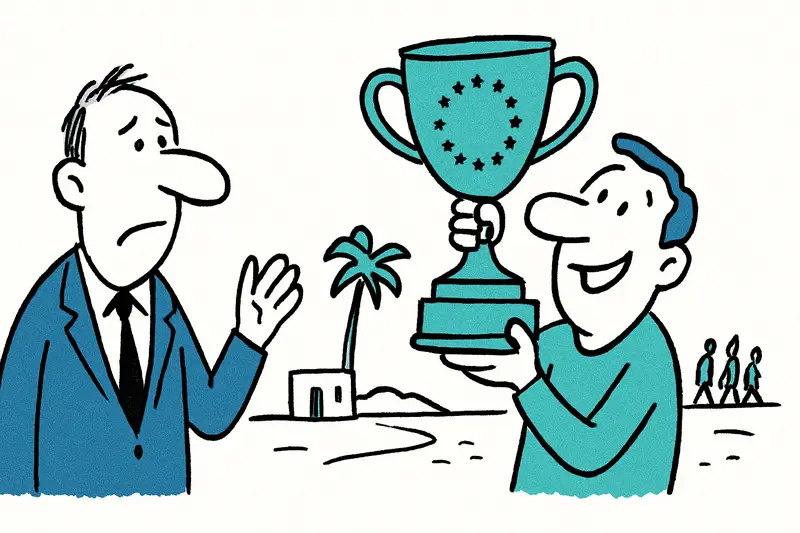
Calvià Wins Europe’s Tourism Award – But What Will Change Locally?
In 2027, Calvià will be named European Capital of Tourism in its population category. The title recognises plans and initiatives—but the real test is whether nature, daily life and visitor flows measurably improve.
An award is not yet proof of sustainable tourism
Can a municipality become a European Capital of Tourism while the crucial question remains unanswered: will local people feel less pressure and see more benefits as a result? Calvià has received the title for 2027 in the category for municipalities with 25,000 to 100,000 inhabitants. The decision was announced at an awards ceremony in Brussels. Other finalists included Ibiza and applicants from several European countries.
The award recognises approaches to sustainability, accessibility, digitalisation, cultural heritage and local talent. These are worthwhile areas. But an award assesses an application and the plans presented in it. On its own, it does not show whether less water is being used, whether sensitive natural areas are better protected or whether pressure on residential neighbourhoods is actually easing. For Calvià, the real test starts now.
A packed agenda—and plenty of unanswered questions
In Brussels, the municipality presented its development over the past three decades. It also wants to give culture and audiovisual productions a more prominent place in its profile. In Magaluf, the Vertifest, a festival for short-form vertical series, and the AI Movie Awards are planned; the next edition of the film event is scheduled for March 2027. This could create opportunities for creative professionals and showcase another side of the municipality. Whether it will lead to lasting local employment or mainly provide another marketing label remains to be seen.
Calvià also includes the Magaluf wetland among its tourist attractions. The municipality plans to highlight its ecological importance through a documentary; according to the information available, the municipality and public broadcaster IB3 are contributing funding from the tourism tax. A film can raise awareness. But it cannot replace the protection of a sensitive area or transparent information about how that protection is monitored in practice.
Another initiative focuses on data. Calvià is taking part in a tourism management pilot project with Benidorm, Lloret de Mar and Seville. Over two years, the participants will share information on visitor flows, spending, length of stay, local residents’ perceptions and environmental impacts. This is more useful than relying on gut instinct—if the data is made public and leads to changes in decisions. Who is collecting it? How are environmental impacts being measured? And what happens when a clear pressure point is identified?
What can get lost in the celebrations
Public discussion of awards often focuses on presentations, new formats and international visibility. Less attention is paid to the standards by which success will later be assessed. A municipality can list many projects; what matters more to residents is whether streets and public spaces remain usable in peak season, whether natural areas feature in more than just a film, and whether local businesses benefit from additional productions.
This is not a claim that Calvià will fail to meet these goals. It is the difference between a convincing application and demonstrable impact. The term “sustainable” also needs concrete local figures and clear, verifiable limits. Without baseline data from before the initiatives begin and regular updates on results, the award could quickly become an attractive headline that is difficult to assess.
The real test lies between the bus stop and the wetland
You don’t notice tourism only through large visitor numbers. You also notice it when several people with suitcases are waiting at a bus stop in Magaluf while residents try to get on the bus with their shopping. It is a brief scene, not proof of a wider trend. But precisely these everyday frictions determine whether tourism policy feels sensible to people or like something organised mainly for visitors and brochures.
For the title to mean more than a presentation in Brussels, Calvià should set out its goals for 2027 publicly and clearly. Which environmental indicators will be monitored? How will pressure in individual towns be measured? What does accessibility mean in practice? And how will residents’ feedback inform decisions? The results of the data project should be made available regularly, not just presented later as a success story. Sensitive areas such as the wetland need clear protection rules and an explanation of how compliance is checked.
For cultural and film projects, a simple measure would be to disclose how many local professionals and businesses are involved and whether this leads to recurring work. Such information does not make an event any less appealing. It simply shows whether the benefits stay in the community.
The title is a beginning, not an all-clear
Calvià is right to celebrate its European recognition. The mix of cultural heritage, nature, digital initiatives and new cultural formats sounds more ambitious than the usual beach promotion. But the distinction is not a seal of approval for every consequence of tourism. The better question is not how impressive Calvià looks in 2027, but what has concretely improved for nature and neighbourhoods by then. Only when the municipality can answer that with verifiable results will the crown become more than a pretty symbol.
Frequently asked questions
What does Calvià’s European tourism title mean for Mallorca?
Does Calvià’s tourism award prove that tourism there is sustainable?
Will Calvià’s tourism award improve life for local residents?
How can visitors tell whether tourism benefits local businesses in Mallorca?
What tourism data will Calvià collect with other cities?
What cultural events are planned in Magaluf for 2027?
What is Calvià planning for the Magaluf wetland?
How should Calvià show whether its tourism plans are working?
Similar News

After the Marratxí Accident: Who Inspects the Movable Football Goals?
A goal became dangerous while being moved. After the accident at FC Germania Mallorca, maintenance, clear responsibiliti...

Mallorca Holiday with Your Phone: How Much Protection Does Your Digital Life Need?
Boarding pass, hotel Wi-Fi, beach photos: your smartphone is now part of every trip. A few simple precautions can protec...
When Motorhomes Become Homes: Palma’s Difficult Parking Question
A public car park must remain accessible to everyone. But people living in campers do not simply disappear when an entra...
A Shipwreck from the Islamic Period off Mallorca: Protection Comes Before Curiosity About Its Location
A member of the public alerted the Island Council to a shipwreck from the Islamic period. Ceramic fragments and deer ant...
Luxury Hotels near Banyalbufar: What’s Still Missing on Paper
New upscale hotels are being discussed around Banyalbufar. What matters is not the glamour of the plans, but what they m...
More to explore
Discover more interesting content

Can Cap de Bou

Townhouse Lleo 72
